Evolution: Setting the Stage, Part 1

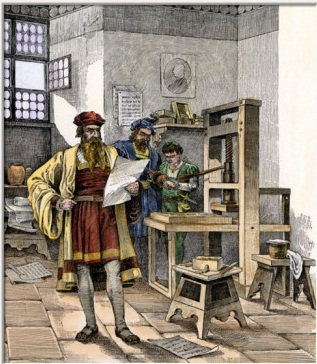
gutenberg-and-fust-with-the-first-printing-press-germany-1450s

The decline of the Holy Roman Empire in the 5th century was followed by a period of absolute power and control by monarchs and the Catholic Church known later as the Middle Ages or Dark Ages, so called by those in succeeding generations who wanted to believe theirs was a more “enlightened” age. Starting with the Italian Renaissance, in the 14th century and continuing through the Age of Reason and the Enlightenment of the 16th through the 19th centuries, the Western world was in a state of constant turmoil and social change.

The invention of the printing press by Johann Gutenberg in 1450 made mass printings and translations of the Bible and other books possible so that they became accessible outside of elite circles. This furthered the Protestant Reformation which had begun in the 14th century with John Wycliff in England and Czech priest Jan Hus who was burned at the stake in 1415. These departures from Catholic tradition were followed by other reformers including Martin Luther, a Catholic priest, who posted his Ninety-five Theses in Wittenberg in 1517 condemning church abuses.

The Medieval Catholic Church, with its domination by rich and powerful men, had become more of a political and military force than a representation of Christ’s love and compassion as reflected by the apostles and the early church. This is not to say that the Church did not do many good things as exemplified by church run universities, hospitals, orphanages, observatories, libraries and other repositories of ancient and new knowledge.

Forced conversions, persecution of “heretics,” i.e. any form of Christianity[1], science or philosophy not sanctioned by the Church, excommunications, torture and death by burning and other means were all practiced at times by the Church. The reader should note that excommunication to the devoted Catholic of the time meant he had no chance of salvation and was doomed to hellfire forever – as opposed to Protestant belief that only God could ever decide that. (What a freeing concept!) Imprisonment, torture and even death were preferable to excommunication. Similarly, monarchies had absolute power over the people and could, almost at will, have anyone stripped of his position, his property, his freedom or his life. Only the Church had any power over monarchies.

Assisted by the rise of Protestantism, the alienation of the people by abuses and domination of the Catholic Church and the Monarchy eventually led to limitations or overthrow of monarchies and the rise of various types of social philosophies and experimentation within and outside the various churches. In this vacuum, many experimental philosophies were espoused, some of which were irreligious or openly hostile to religion. Some went so far as to throw out Christianity altogether. The Directory, set up in France after the French Revolution, is probably the best, though later, example of such an extreme view. For a period of time under this regime in the 18th century, religion, particularly Christianity, was actually outlawed in France, which led to persecution of Christians and Jews.

The Italian Renaissance, beginning in the 14th century, marked a return to classical thinking of the Greek philosophers such as Plato and Aristotle. This influenced the formation of humanist and materialist philosophies, which became popular among intellectuals. Materialist philosophy states that there is nothing beyond the material world that we can see and touch. Humanists[2] believed that man was basically good and was only corrupted by society. Materialism[3] said “down with god,” and Humanism said “up with man.”

The goodness and eventual perfection of man and society was/is an important part of the basic philosophy of Progressivism and was/is practiced by communists, socialists and their ilk. It is, in my view, a misinterpretation of human nature and a false belief in our ability to change it. This is Magical Thinking because it is contrary to experience. The unchanging nature of man is the reason that both Shakespearian and Greek plays still have relevance today. The circumstances and society are different, but the human reactions are the same. The Christian viewpoint was/is that man himself is imperfect and cannot be perfected by human endeavor, no matter how noble. If society is faulty, it is because imperfect man is its author.

Note that the word “progressive” has been corrupted from its original meaning. The progressive philosophy originally meant that progress was possible through work, learning and inspiration, built on the works of others progressively. This is contrary to today’s interpretation of progressivism as an inevitable quality of the universe, moving naturally from simpler to more complex and from imperfection to perfection and utopia, which is again Magical Thinking.

In the 19th century, socialist thought was dominated by the “man good, society bad” humanist philosophy of Rousseau, and was guided by the “scarcity and struggle” philosophy of economist Thomas Malthus[4]. The dominant theme of the day was social progress of the “noble savage” toward ultimate social perfection, once he was freed from the tyranny of governments and religion. This utopian dream was a perfect philosophy for radicals who wanted to overthrow, rather than reform, what they perceived to be the corrupt and corrupting society of the time. Many social experiments were carried out in which utopian socialist communities were formed, lived and ultimately failed.

A very early forerunner of this was the Plymouth colony in the 17th century, led by William Bradford. From the beginning they tried a form of communal living wherein all production was shared equally by everyone. When it became obvious that people would not produce well unless they were rewarded in proportion to their labors, this philosophy was quickly rejected, and was replaced by private ownership and free enterprise that quickly produced more prosperity and created wealth. Nineteenth century examples of these utopian socialist experiments include New Harmony, Indiana, Brook Farm, Massachusetts and North American Phalanx, New Jersey.

[1] Example: Waldensians were a group professing poverty, preaching, and opposed to image worship, relics, pilgrimages, intercession of the saints, etc. that were persecuted by the Roman Catholic Church beginning in the 12th century.

[2] Originally from the Italian word umanista for a teacher of classical Greek and Latin beginning in the 14th century and promoted by Petrarch.

[3] Note that the word Materialism has been corrupted by the left to mean living for gain of material things, not a philosophy that denies any spiritual aspects. Reinterpretation of words is a common practice of the left that blurs real meanings.

[4] An Essay on the Principles of Population, 1798, predicted starvation because populations were increasing exponentially while food supplies were increasing arithmetically. This philosophy assumed no improvements above subsistence level farming, no development of more prolific and disease resistant crops or mechanical means to increase production, and no other factors that would limit population such as disease and war.
 

Origin of Life Scenarios

500px-Cyanobacterium-inline_svg

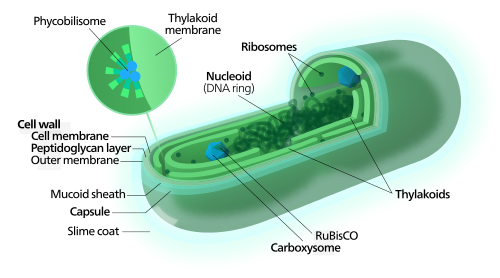
Complex structures of cyanobacteria[1]

 The earliest known Life fossils are 3.8 billion year old stromatolites, rocky structures composed of cyanobacteria and sand. 

 From the previous post, “What is Life?” it is readily apparent that living things possess multiple levels of complexity. For even the simplest organism to survive, all of the components, whether they be physical structures or biochemicals, must perform their functions well and in concert. Living things must balance on a thin edge of interconnected complexity to survive.

How is it possible to believe that all of this was built up piece-meal over millions of years, during which many of the components and functions were not fully in place, or to believe that small, stepwise changes in DNA over time result in new structures, when the incomplete sections of DNA must have existed long before there was a workable function? To believe that is not only improbable but insane! And it is not science. It is based on the progressive philosophy that the universe is naturally progressive and will naturally, without any directions, progress from simpler to more complex and from nonliving to living. When applied to the origin of life a new principle is proposed called the Life Principle[2]. This theory assumes that the universe will naturally self-organize to produce life in any “suitable” environment over time.

The scenarios for the first life are equally unbelievable except to the true philosophical believer. These scenarios cannot be called theories, but at best hypotheses and at worst wild speculations.  Among the speculations about where and how life emerged from nonliving matter, the most popular are as follows.

  1. Interstellar Pre-assembly: Life self-assembled from amino acids, peptides (short sections of protein), and proteins that came to earth from space where they were assembled from stardust.
  2. Warm Soup: In the absence of life to consume them, biochemicals that spontaneously formed accumulated in shallow seas until there were enough to form the first primitive life. This is the warm soup Darwin spoke of.
  3. Panspermia: Life forms came to earth from space where they had existed for eons, thus extending the time period for their formation beyond the 4.5 billion years of earth’s existence.
  4. Geothermal Energy: Life formed at geothermal vents that provided the energy needed to build complex biochemicals and structures that then came to life.
  5. Deep Hot Biosphere: Life formed deep underground from hydrocarbons cooked by mantle heating to form more and more complex molecules that then came to life.
  6. Clay Template: Life formed from biochemicals on the surface of clay, which acted as a template for assembling biochemicals and structures that eventually came to life.
  7. Inorganic Life: Life first formed from inorganic particles such as clay, later adding organic chemicals for more efficient functions and finally rejecting or eliminating the original inorganic chemicals.
  8. RNA World: RNA formed first and “learned” to make proteins and other structures through self-catalysis, later replaced by catalysis by protein enzymes.
  9. Protein First: Proteins formed first that then assembled RNA and/or DNA and membranes.
  10. Polycyclic Aromatic Hydrocarbons, (PAH), assumed to be abundant in space and early earth, through reactions such as hydroxylation, oxygenation and hydroxylation, led to formation of more complex molecules such as amino acids, proteins and RNA.

Whatever the means, it is hard to believe that all of the interlocking biochemical systems and cellular structures could have self-assembled over eons of time. The famous experiment that true believers point to as evidence of spontaneous creation of life is the Urey-Miller experiment[3]. In it, a mixture of methane, ammonia and hydrogen, which were thought to compose the earth’s early atmosphere, were subjected to an electrical spark, simulating lightening. Over time, a few of the smallest amino acids, the basic building blocks of proteins, were formed in very low concentrations within a mixture. The truth about the experiment is that it formed a tar of numerous organic chemicals often referred to a “beilstein,” meaning a gross mixture. Beilstein is short for the largest and oldest database of organic chemicals that was first published in 1881 as Beilstein’s Handbook of Organic Chemistry. Its current electronic database can be found on line at Reaxys and contains many thousands of chemicals, thus the definition.

The conditions of the experiment are now not thought to have existed on the early earth. HDTKT? They took an “educated” guess from proxy evidence. Additionally, oxygen would have prevented many of the reactions leading to amino acids and would have destroyed many other products. However, without oxygen in the atmosphere, there would have been no ozone layer to protect the products from the destructive effects of ultraviolet rays streaming from the sun. Reaction products that were formed by lightning in the atmosphere would not be favored or exist for long enough to accumulate under such conditions. Water will also prevent or retard these reactions, and it is destructive to many products. Interfering molecules and water would have to be eliminated to create even the simplest peptide, (a short section of a protein consisting of a few amino acids linked together by eliminating one molecule of water for each link).  Excess water would result in peptide links falling apart to leave amino acids.

The few amino acids in the experiment were formed as mixtures of right and left handed molecules, but only left handed amino acids are used by living things. Going from a mixture of amino acids in low concentrations in a tar containing many compounds to proteins or larger amino acids is not so evident, nor is it evident that it led to the creation of life. Forming a few amino acids in a tar in a highly controlled experiment does not point to an accidental, spontaneous creation of life or molecular evolution. If anything, it points to a designer, not the opposite. It is a leap of faith and thus not science. It is philosophy, opinion or religion, not science based on facts.

The encouraging thing about origin of life studies is that there are still multiple schools of thought, which is a healthy situation in theoretical science. A lot of work is being done to try to determine the best solution to the problem, but the search is far from over. Even if we can discover A route from dead chemicals to living systems, we will never know if it is THE way it occurred. It is a one-time event that cannot be fully understood by science because Science is only concerned with predictable, repeatable and measurable aspects of the universe with which we can or could conceivably interact.

[1] Image from Wikipedia “Cyanobacteria” used under the Creative Commons Attribution-Share Alike 3.0 Unported license, User:Kelvinsong/Great board of biology

[2] Robert Shapiro, Planetary Dreams, John Wiley and Sons, Inc., 1999

[3] Urey-Miller experiment or simply Miller experiment by Stanley L. Miller directed by Harold C. Urey in 1953.

Did Darwin steal his theory of Evolution?

After his trip around the world on The Beagle, Darwin waited 23 years to present his theory of Evolution.  The myth is that he sat on the theory out of fear of repercussions. However, when Charles Darwin published On the Origen of Species in 1859 evolutionary theories had been around for a long time.  There were at least a dozen evolutionary theories, including one by Erasmus Darwin, Charles’ grandfather, in the late eighteenth and early nineteenth century that were openly debated among scientists.

Alfred Russel Wallace 1862 - Project Gutenberg eText 15997
Alfred Russel Wallace 1862

It wasn’t until Alfred Russell Wallace, a naturalist and admirer, sent Darwin his observations and theory of Evolution while still away on a voyage to the Malay Archipelago and Borneo, that Darwin’s theory was (hurriedly?) presented, acknowledging Wallace as co-discoverer, and published, establishing primacy over Wallace.  Was Wallace the true originator of a theory that Darwin had overlooked in his own observations?  Did Wallace provide the link that brought all his speculations together?  Darwin’s claims were backed by his friends Charles Lyle and Joseph Hooker, so we may never know the truth.  It is sure that the scientific reputation of Wallace declined, while Darwin’s grew.  It is interesting to note that Wallace later rejected the theory as lacking both mechanism and sufficient evidence.

Darwin’s Problem with Ants

Darwin’s Claims

Worker ants of various castes and two large queens
Leaf Cutter Ants – Worker ants of various castes and two large queens

Darwin thought cells were simple bags of gel.  He knew nothing of DNA or any other cellular structures.  He believed that inheritance was through “Gemmules” that each cell shed and that traveled to the gametes (sperm and egg).  Since each cell “voted” it was called pangenesis. He believed that the life experiences of the parents were passed on to their offspring in this way. He believed evolutionary incremental changes occurred by passing these life experiences on to subsequent generations.

Darwin’s Dilemma

Colony insects were a problem for Darwin.  If life experiences were passed on, how does a queen ant, who has never experienced foraging for food, pass on the behavior of the worker ants who hunt for food and bring it back to the colony?

His theory of evolution taught that use and disuse along with adaptation to environmental changes experienced by parents were passed on and were responsible for the changes seen between species by gradual changes over time, coupled with natural selection aka survival of the fittest.  How is this any different from J-B Lamarck’s theory of acquired characteristics, which was discredited as having no foundation?  Did acceptance for Darwin’s theory and not Lamarck’s have more to do with politics and marketing than science?

Modern Evolutionary Biologists’ Dilemma

Obviously, modern evolutionary biologists found pangenesis and inheritance of acquired traits embarrassing, so, in the early 20th century they changed the theory to include genetics with an emphasis on natural selection and called it Neo-Darwinism or the Modern Synthesis. Later, they included DNA.  Although Darwin is still revered as if he had everything right, this form of Evolutionary theory is grossly different from the original Darwinian theory except for the assumption of natural selection and unlimited gradual changes producing new species over time.