Origin of Life Scenarios

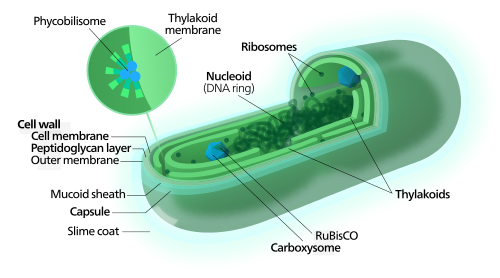
500px-Cyanobacterium-inline_svg

Complex structures of cyanobacteria[1]

 The earliest known Life fossils are 3.8 billion year old stromatolites, rocky structures composed of cyanobacteria and sand. 

 From the previous post, “What is Life?” it is readily apparent that living things possess multiple levels of complexity. For even the simplest organism to survive, all of the components, whether they be physical structures or biochemicals, must perform their functions well and in concert. Living things must balance on a thin edge of interconnected complexity to survive.

How is it possible to believe that all of this was built up piece-meal over millions of years, during which many of the components and functions were not fully in place, or to believe that small, stepwise changes in DNA over time result in new structures, when the incomplete sections of DNA must have existed long before there was a workable function? To believe that is not only improbable but insane! And it is not science. It is based on the progressive philosophy that the universe is naturally progressive and will naturally, without any directions, progress from simpler to more complex and from nonliving to living. When applied to the origin of life a new principle is proposed called the Life Principle[2]. This theory assumes that the universe will naturally self-organize to produce life in any “suitable” environment over time.

The scenarios for the first life are equally unbelievable except to the true philosophical believer. These scenarios cannot be called theories, but at best hypotheses and at worst wild speculations.  Among the speculations about where and how life emerged from nonliving matter, the most popular are as follows.

  1. Interstellar Pre-assembly: Life self-assembled from amino acids, peptides (short sections of protein), and proteins that came to earth from space where they were assembled from stardust.
  2. Warm Soup: In the absence of life to consume them, biochemicals that spontaneously formed accumulated in shallow seas until there were enough to form the first primitive life. This is the warm soup Darwin spoke of.
  3. Panspermia: Life forms came to earth from space where they had existed for eons, thus extending the time period for their formation beyond the 4.5 billion years of earth’s existence.
  4. Geothermal Energy: Life formed at geothermal vents that provided the energy needed to build complex biochemicals and structures that then came to life.
  5. Deep Hot Biosphere: Life formed deep underground from hydrocarbons cooked by mantle heating to form more and more complex molecules that then came to life.
  6. Clay Template: Life formed from biochemicals on the surface of clay, which acted as a template for assembling biochemicals and structures that eventually came to life.
  7. Inorganic Life: Life first formed from inorganic particles such as clay, later adding organic chemicals for more efficient functions and finally rejecting or eliminating the original inorganic chemicals.
  8. RNA World: RNA formed first and “learned” to make proteins and other structures through self-catalysis, later replaced by catalysis by protein enzymes.
  9. Protein First: Proteins formed first that then assembled RNA and/or DNA and membranes.
  10. Polycyclic Aromatic Hydrocarbons, (PAH), assumed to be abundant in space and early earth, through reactions such as hydroxylation, oxygenation and hydroxylation, led to formation of more complex molecules such as amino acids, proteins and RNA.

Whatever the means, it is hard to believe that all of the interlocking biochemical systems and cellular structures could have self-assembled over eons of time. The famous experiment that true believers point to as evidence of spontaneous creation of life is the Urey-Miller experiment[3]. In it, a mixture of methane, ammonia and hydrogen, which were thought to compose the earth’s early atmosphere, were subjected to an electrical spark, simulating lightening. Over time, a few of the smallest amino acids, the basic building blocks of proteins, were formed in very low concentrations within a mixture. The truth about the experiment is that it formed a tar of numerous organic chemicals often referred to a “beilstein,” meaning a gross mixture. Beilstein is short for the largest and oldest database of organic chemicals that was first published in 1881 as Beilstein’s Handbook of Organic Chemistry. Its current electronic database can be found on line at Reaxys and contains many thousands of chemicals, thus the definition.

The conditions of the experiment are now not thought to have existed on the early earth. HDTKT? They took an “educated” guess from proxy evidence. Additionally, oxygen would have prevented many of the reactions leading to amino acids and would have destroyed many other products. However, without oxygen in the atmosphere, there would have been no ozone layer to protect the products from the destructive effects of ultraviolet rays streaming from the sun. Reaction products that were formed by lightning in the atmosphere would not be favored or exist for long enough to accumulate under such conditions. Water will also prevent or retard these reactions, and it is destructive to many products. Interfering molecules and water would have to be eliminated to create even the simplest peptide, (a short section of a protein consisting of a few amino acids linked together by eliminating one molecule of water for each link).  Excess water would result in peptide links falling apart to leave amino acids.

The few amino acids in the experiment were formed as mixtures of right and left handed molecules, but only left handed amino acids are used by living things. Going from a mixture of amino acids in low concentrations in a tar containing many compounds to proteins or larger amino acids is not so evident, nor is it evident that it led to the creation of life. Forming a few amino acids in a tar in a highly controlled experiment does not point to an accidental, spontaneous creation of life or molecular evolution. If anything, it points to a designer, not the opposite. It is a leap of faith and thus not science. It is philosophy, opinion or religion, not science based on facts.

The encouraging thing about origin of life studies is that there are still multiple schools of thought, which is a healthy situation in theoretical science. A lot of work is being done to try to determine the best solution to the problem, but the search is far from over. Even if we can discover A route from dead chemicals to living systems, we will never know if it is THE way it occurred. It is a one-time event that cannot be fully understood by science because Science is only concerned with predictable, repeatable and measurable aspects of the universe with which we can or could conceivably interact.

[1] Image from Wikipedia “Cyanobacteria” used under the Creative Commons Attribution-Share Alike 3.0 Unported license, User:Kelvinsong/Great board of biology

[2] Robert Shapiro, Planetary Dreams, John Wiley and Sons, Inc., 1999

[3] Urey-Miller experiment or simply Miller experiment by Stanley L. Miller directed by Harold C. Urey in 1953.

Does the observer determine outcomes in quantum physics ?

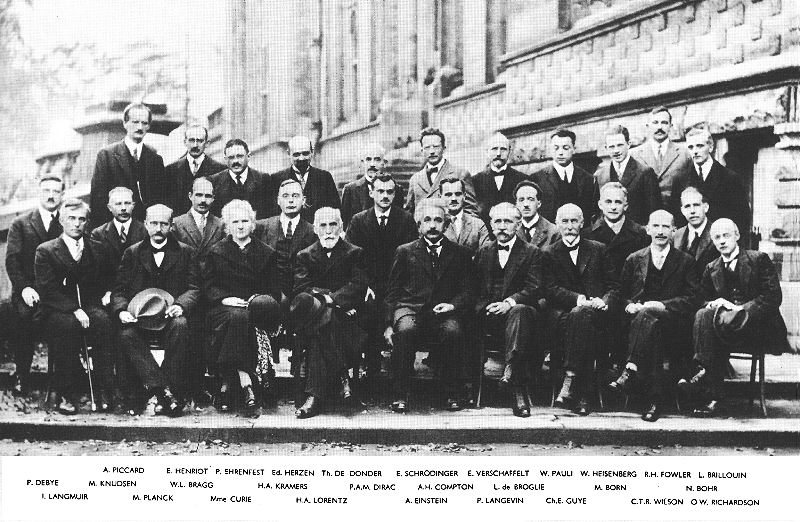
Solvay Conference on Quantum Mechanics 1927

Quantum Mechanics or Quantum Theory, which is based on complex mathematics, tries to describe and explain the odd behavior of particles and forces in the atomic and subatomic realm. In this theory, things don’t happen in a smooth (analog) manner but in a punctuated (digital) manner Electrons move around the nucleus at high speeds so that their exact location at any one moment is not known precisely without measurement. The likelihood of finding a given electron at a particular place in its orbital is described by a probability, thus defining the electron “cloud” or “shell.” An electron jumps from one allowed orbital to another by absorbing energy (a photon) at a specific energy (wavelength).

The absorbed photon at a specific energy level is called a quantum, thus quantum theory. The electron will also fall from this “excited” state back to its more stable “ground” state orbital by emitting a quantum of energy. Electrons exist or move between one allowed energy state (orbital) and another based on discrete quanta of energy that they absorb, emit or carry. Each element has unique orbital energies so that light interacting with an atom shows absorption and emission lines at specific wavelengths that can be used to identify the element.

Wave-Particle Duality:

In Quantum Theory, subatomic particles are described as both particles and waves simultaneously. This is referred to as wave-particle duality. All types of energy, including subatomic binding forces, are also defined as both particles and waves, so that matter and energy are treated as if they are the same thing. Both subatomic particles and photons sometimes act like waves and sometimes like particles, depending on how they are tested or detected. Two experiments are noted as evidence: the double slit interference patterns and the photoelectric effect in which electrons are emitted when light is shined on a metal surface. Einstein assumed this proved that energy waves were really made of particles that he called photons.

The double slit experiment is said to demonstrate the wave nature of particles and photons. The photoelectric effect is said to demonstrate the particle nature of particles and photons. Wave-particle duality rests on the assumption that single photons or particles are being measured. Since all detectors have threshold sensitivities below which nothing is detected, it could mean that multiple, not single, photons or particles are really being tested[1]. This would explain the interference patterns seen when either photons or electrons are tested in the double slit experiment. Photoelectric experiments may also be misinterpreted. It is possible that absorbed energy, not photon particles, causes emission of loosely held electrons on the metal surface. Granted, this is speculation at this time, but calls for more study.

Copenhagen Interpretation:

In the widely accepted Copenhagen interpretation of quantum mechanics, a particle is said to not have a fixed state but exist in a smeared out multiplicity of states at once until a measurement is taken when it “collapses” into one state. The observer (or detector) becomes a part of the quantum system. This is the principle of superposition. Because an electron can be found in any of the probability-allowed “shell” locations, this interpretation assumes that the electron really is at all the locations or states at once and only assumes a fixed state when measured. This assumption extends to all of the characteristics of the electron such as position, spin or momentum. This assumption also extends to all other subatomic particles and photons (energy particles).

The Copenhagen interpretation of Quantum Theory also says the electron exists in one or the other allowed orbital level but does not exist anywhere between.   When a quantum of energy is absorbed the electron is said to pop out of existence in the original shell and simultaneously pop into existence in the new shell. But, since the electron shell defines a probability, and most of the time the electron exists in one of these shells, the probability of finding it anywhere between is statistically infinitesimal.   It is said not to exist there, and it is thus called “forbidden.” Is it only an extremely small probability or are we talking about its actual existence? The Copenhagen interpretation of Quantum Theory says it is the latter. Other interpretations of Quantum Theory differ as to what actually happens. See list below.

Uncertainty Principle: Ontology or Epistomology?

 In trying to measure these discrete orbitals and their electron locations and momenta, it became apparent that measurement of any kind disturbed the system so that only one of two coupled parameters could be determined at any one time, e.g. position and momentum (or speed). This led to the Heisenberg Uncertainty Principle, which states that it is impossible to know both the position and the momentum of any one subatomic particle at the same time. The system is disturbed by measurement because measuring subatomic particle parameters is like administering eye drops with a fire hose. Because the subatomic particles are so small compared to any means of measuring their parameters, what is measured is in a disturbed condition.

The Heisenberg Uncertainty Principle was meant to be a statement of experimental limitations, not that location and momentum (or other coupled parameters) did not exist in a fixed state at the same time. However, Bohr and other Copenhagen interpretation proponents interpreted it that way, assuming that atoms or atomic particles were never in a fixed state until measured, and that uncertainty is a fundamental characteristic of subatomic particles, not just an experimental limitation. Thus they have substituted ontology (being) for epistemology (ability to know). Heisenberg never accepted the principle of superposition or non-locality claimed in the Copenhagen interpretation.

Superposition:

 Edwin Schrodinger provided the mathematical equations for the behavior of electromagnetic waves that are used in quantum mechanics[2]. These probabilistic differential wave equations are linear (first order), that is, they can be plotted as straight lines on a graph. Superposition is a concept in mathematics stating that in linear equations all of the contributing factors must add up to the net effect of each factor individually. Since Schrodinger’s equations for waves are linear, it is assumed that their application to subatomic particles is also linear. From there it is a leap of faith to assume that particles don’t just have the capability of being in different states, but that they are simultaneously in all possible states at once. Instead of just being a mathematical concept, superposition now was applied directly to subatomic particles in a real physical sense.

However, Schrodinger did not agree with this Copenhagen interpretation of quantum mechanics. He came up with an example within everyone’s sphere of experience that illustrated the absurdity of their assumed superposition. This was the famous Schrodinger’s Cat thought experiment. He set up the experiment so that a cat in a closed box could be either alive or dead, depending on whether a radioactive particle spontaneously decayed setting off a mechanism that released a deadly poison gas. In this thought experiment, using the Copenhagen interpretation of superposition, since we don’t know what state the cat is in until the box is opened, the cat is both dead and alive until it is opened at which time the cat becomes either dead or alive. The act of observing somehow must cause the cat to assume either a dead or alive state. In all other realms, this would be called Magical Thinking. Meant to point out the weakness or absurdity of superposition, it has been used to illustrate the opposite through convoluted “reasoning” to make it fit the Copenhagen or similar interpretations.

 Communication at a distance:

 The idea of instantaneous communication and action at a distance is a consequence of this assumed superposition where particles did not assume a fixed state until observed. By Pauli’s Exclusion Principle, no two electrons in the same orbital can be in the same quantum state. Each must differ in some way, for example they must have opposite spins. The two particles are said to be entangled since each must be in the opposite state to the other.   If one of the electrons is emitted and travels relatively far away, when one of the electrons is measured (observed), it collapses into a fixed state and simultaneously the other one collapses into the opposite state that can be confirmed when it is measured. This implies speed of communication faster than the speed of light, the assumed upper limit of speed[3].

Einstein thought that quantum action at a distance was an illusion based on the assumption of superposition, aka non-locality. If particles are assumed to have fixed states, although unknown to an observer, the action at a distance is no mystery. It only implies that entangled states, e.g. opposite spins, persist after separation. When one of the particles is measured, you automatically know the state of the other since they must be the opposite of each other, whether together of separated. Einstein spent the latter part of his career trying to prove this.

Other Interpretations:

There are more than a dozen other interpretations. The most popular, among a long list, (see table following), are the Copenhagen interpretation and its variants, the Many Worlds interpretation and the Ensemble interpretation. Variants of the Copenhagen interpretation involve either the observer or the cat (as observer and participant) as being parts of the quantum system. Another, the Many Worlds interpretation is even more speculative. In this scenario, each time a subatomic particle collapses and “chooses” a fixed state, reality splits in two and both possible realities still exist, but in different undetectable dimensions. Think of this as a time series of pictures or a strip of movie film. At the decision point, the one series becomes two, and at the next decision point, becomes four, etc. ad infinitum.

The Ensemble interpretation states that Quantum Mechanics can only be applied to statistically significant numbers of particles, not to individual particles. Since the wave equations describe probabilities, it would be meaningless to apply probabilities or statistics to single particles. This is the interpretation favored by Einstein but is discounted by leading QM physicists. Similar realistic interpretations such as those proposed by de Broglie-Bohm and science philosopher Karl Popper assume real particles with real positions and real wave functions that do not need to “collapse” upon measurement. I tend to prefer these theories because of their realism.

“The attempt to conceive the quantum-theoretical description as the complete      description of the individual systems leads to unnatural theoretical interpretations, which become immediately unnecessary if one accepts the interpretation that the description refers to ensembles of systems and not to individual systems.”

—A. Einstein in Albert Einstein: Philosopher-Scientist

Is the universe really indeterminant?

As a consequence of the probabilistic view of the subatomic world, Quantum Theory leads to a conclusion that events are not deterministic, but rather are indeterminate; that they just happen without actual connections between cause and effect. If deterministic, then events in the past must predict future events as causal antecedents. In the macro or “real” world, everything has a cause or causes, whether known or not. Determinism is the accepted view or apparent state of the real universe because, knowing the mass, position and the momentum of a (larger) body, plus all of the influences on it and the mathematical equations governing its movement, one can (in theory) calculate its position and speed at any other time in the future or the past. This is the basis of celestial mechanics by which planets, etc. are tracked.

The question is: since we don’t know for sure what the outcome according to QM will be, is it really indeterminate or are there certain things we don’t or can’t know about the system that only makes it look indeterminate? If it were possible to know all of the parameters and influences without disturbing the system could we, with certainty, predict outcomes? According to the Copenhagen interpretation of quantum theory, the universe is really indeterminant at the atomic level and only LOOKS determinant at the macroscopic level. This eliminates the infinite series of cause and effect, and therefore the question of a first cause.


[1] See also Andrew Ancel Gray at http://modelofreality.org/cgi-bin/iet.cgi

[2] Side note: These equations assume massless particles and waves. Since real particles have mass, particle physicists assume there is a particle that gives all other particles mass. The Higgs boson is the assumed particle that creates mass when a particle is in a Higgs field.

[3] It should be noted that many thought experiments and most actual experiments have been done using light, not subatomic particles. The results of these actual experiments depend on your interpretation of Quantum Theory. See other interpretations that follow.

Major QM Interpretations  (click to follow link)

Darwin’s Problem with Ants

Darwin’s Claims

Worker ants of various castes and two large queens
Leaf Cutter Ants – Worker ants of various castes and two large queens

Darwin thought cells were simple bags of gel.  He knew nothing of DNA or any other cellular structures.  He believed that inheritance was through “Gemmules” that each cell shed and that traveled to the gametes (sperm and egg).  Since each cell “voted” it was called pangenesis. He believed that the life experiences of the parents were passed on to their offspring in this way. He believed evolutionary incremental changes occurred by passing these life experiences on to subsequent generations.

Darwin’s Dilemma

Colony insects were a problem for Darwin.  If life experiences were passed on, how does a queen ant, who has never experienced foraging for food, pass on the behavior of the worker ants who hunt for food and bring it back to the colony?

His theory of evolution taught that use and disuse along with adaptation to environmental changes experienced by parents were passed on and were responsible for the changes seen between species by gradual changes over time, coupled with natural selection aka survival of the fittest.  How is this any different from J-B Lamarck’s theory of acquired characteristics, which was discredited as having no foundation?  Did acceptance for Darwin’s theory and not Lamarck’s have more to do with politics and marketing than science?

Modern Evolutionary Biologists’ Dilemma

Obviously, modern evolutionary biologists found pangenesis and inheritance of acquired traits embarrassing, so, in the early 20th century they changed the theory to include genetics with an emphasis on natural selection and called it Neo-Darwinism or the Modern Synthesis. Later, they included DNA.  Although Darwin is still revered as if he had everything right, this form of Evolutionary theory is grossly different from the original Darwinian theory except for the assumption of natural selection and unlimited gradual changes producing new species over time.


Why Science and Religion are Compatible


“Try and penetrate with our limited means the secrets of nature and you will find that, behind all the discernible concatenations, there remains something subtle, intangible and inexplicable.”                                                    

                                                                                          — Albert Einstein


“In view of such harmony in the cosmos which I, with my limited human mind, am able to recognize, there are yet people who say there is no God. But what makes me really angry is that they quote me for support of such views.”

                                                                                          — Albert Einstein


But is it Science?


“Geese are but Geese tho’ we may think ’em Swans; and Truth will be Truth tho’ it sometimes prove mortifying and distasteful.” — Benjamin Franklin 


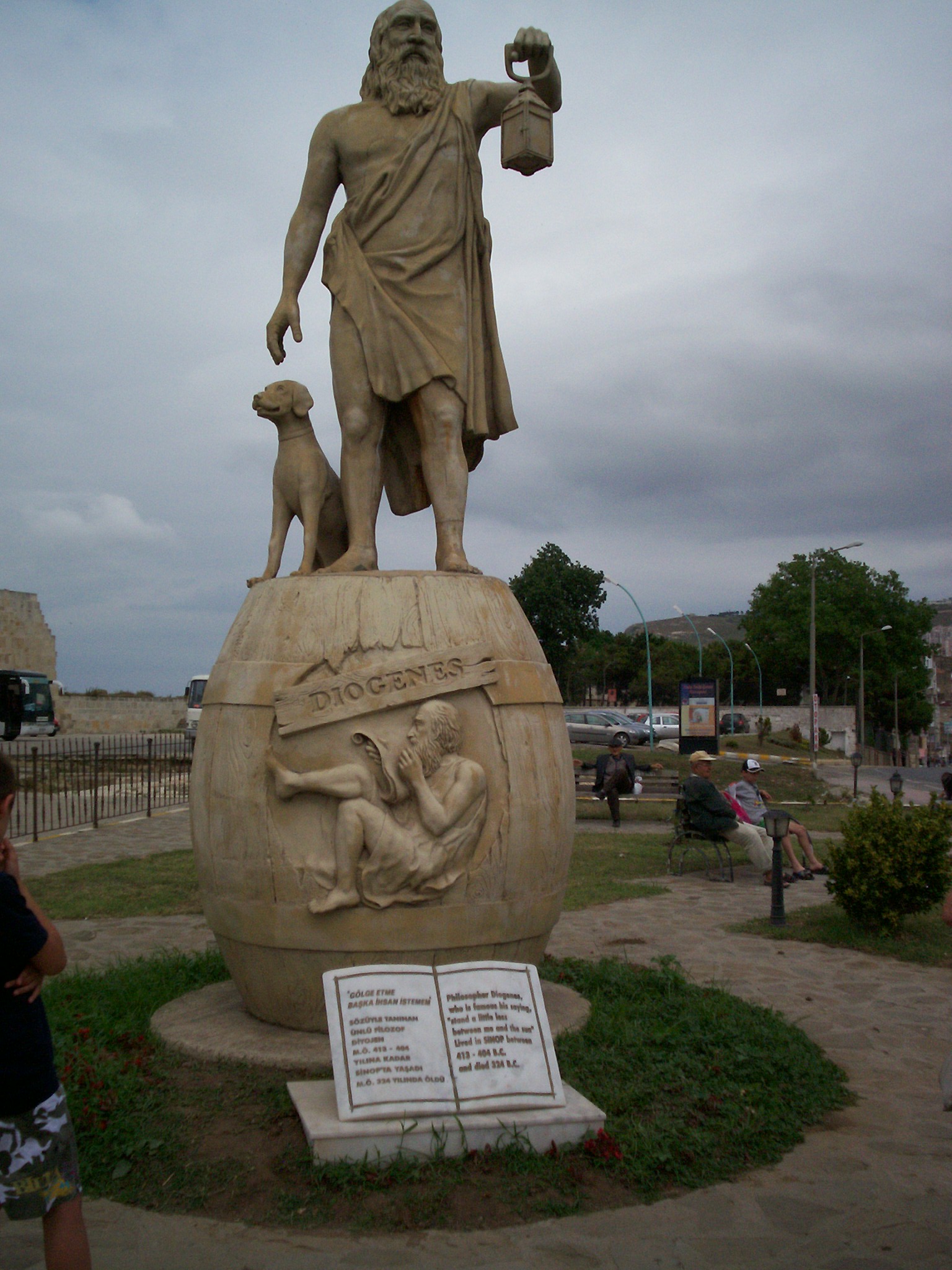
Diogenes of Sinope statue
Diogenes looking for an honest man

Science is the pursuit of truth about the predictable, repeatable and measurable aspects of the universe with which we can or could conceivably interact.  It must also be verifiable, falsifiable and testable.

Much of what we think we know about the universe and life is really belief, based on faith.  Much of what we think we know about science is actually not science at all but philosophy.  While technology is certainly real, and observation and experimental data are real, inferences, conclusions, projections, deduction from pure reason of what (we believe) must be, models and other “facts,” especially about events in the past, are really beliefs disguised as facts.  Many of the “facts” that fall into this category are either irrelevant or detrimental to true science, and are only relevant to supporting certain social and cultural paradigms.

Through all of this philosophy disguised as science is a common thread of progressivism and atheism.  The universe, the earth, life, everything are assumed (on faith) to be naturally progressing from simpler through more organized and complex toward perfection.  Progressivism is teleological because progress is assumed to have a purpose – to move toward perfection.  As such, it requires faith.  It takes as much faith to believe in a universe and life that invented themselves, as it takes to believe in a creator, whether it is one that set up the initial conditions and walked away, or one that continues to orchestrate its functions or cares about mankind on a personal basis.


“It ain’t so much the things we don’t know that get us into trouble. It’s the things we know that ain’t so.”  

                                       — Artemus Ward aka Charles Farrar Browne


Most of the people who “preach” this dogma don’t even know that it is not science because they have been taught it all their lives and assume the theories have been proven absolutely in the past.  They have never gone back to historical or original sources to learn the truth.

So how do we combat this progressive philosophy disguised as science? It is not sufficient to use religion (another philosophy) against it; facts are needed to defeat this magical thinking.  The facts are there but have been suppressed by true believers and media that support the standard line, and have been hidden by rewriting history. Keep watching this site and the facts will be presented. Then it is up to all of us to use facts to hold accountable those spreading this false paradigm of how the universe works.


“The discovery of truth is prevented more effectively, not by the false appearance things present and which mislead into error, not directly by weakness of the reasoning powers, but by preconceived opinion, by prejudice.”

                                                                        — Arthur Schopenhauer