Carbon Dioxide is plant food and increases growth rates

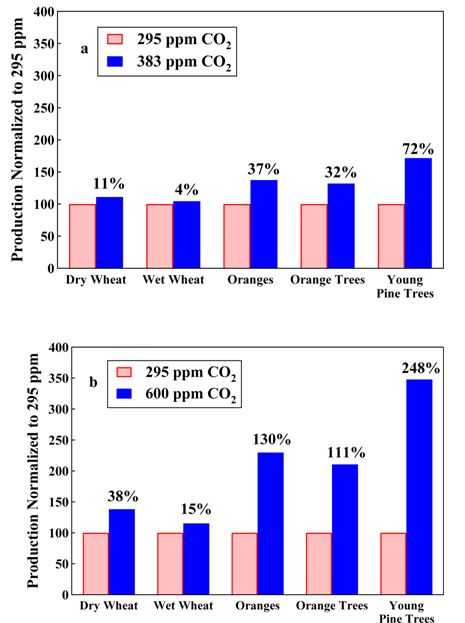
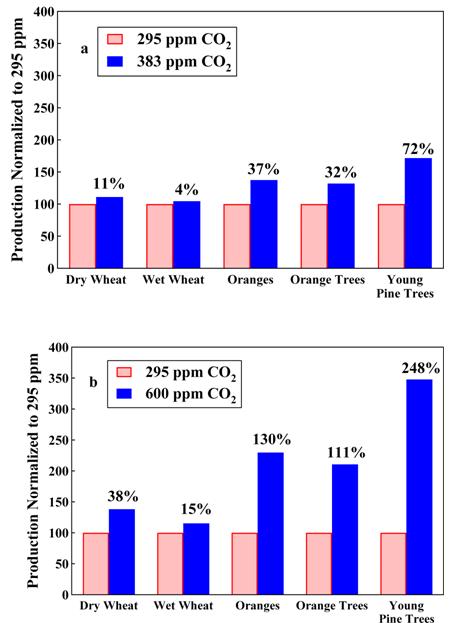
Animals exhale Carbon Dioxide (CO2) and breathe Oxygen (O2), while plants use CO2 and exhale O2. Professional greenhouses often add extra CO2 to increase growth rates. Increased plant growth removes much of the CO2 released into the atmosphere. Between pre-industrial and present times, studies show an average of 15% increase in plant growth rates, with some species increased many times that, e.g. young pine trees. Increased plant growth rates and wider distribution of arable (farmable) land due to warming as well as improved farming practices can solve the so-called overpopulation problem. If much of the data used in the climate models are based on proxy data from tree rings, and growth has been increased by CO2, does that mean that the data is artificially skewed toward “warmer” results? Hmmm.
Plant Growth Chart 1.png


Figure 1. Comparison of Plant Growth at Pre-industrial CO2 levels (295 ppm in pink), at 383 ppm and 600 ppm (in blue) in Dry Wheat, Wet Wheat, Oranges, Orange Trees and Young Pine Trees. Note Percent increases.
Source: Review Article: “Environmental effects of increased atmospheric carbon dioxide,” Willie Soon (1), Sallie L. Baliunas(1), Arthur B. Robinson (2), Zachary W.Robinson (2) Climate Research. 13, 149-164, (1999)  Affiliations: (1) Harvard-Smithsonian Center for Astrophysics, 60 Garden Street, Cambridge, Massachusetts 02138; (2) Oregon Institute of Science and Medicine, 2251 Dick George Road, Cave Junction, Oregon 97523

A. Critics created the “progressive nitrogen limitation hypothesis,” which assumes that increased growth rates of trees would deplete poor soils of nitrogen, thus mediating the positive effects of increased CO2. This is a scenario based on theory, not reality, which stubbornly refuses to support the hypothesis. Many studies[1] show that, contrary to the hypothesis, although roots grow deeper and produce more fine hairs, soil and forest floor are enriched in nitrogen from biological sources, i.e. increased root mass and leaf litter supporting beneficial microbes in the soil.

B. One benefit of increased CO2 is that the stomata (openings) of leaves, which take in CO2 and emit water vapor and oxygen, are reduced, leading to less water loss, enhanced water use and improved tolerance to dryer conditions. At elevated CO2 levels, stomata do not need to be open as far to allow sufficient CO2 in for photosynthesis and, as a result, less water is lost through transpiration[2]. In controlled studies, an additional benefit of reduced stomata openings is a reduction of ozone damage.

C. The increased rate of growth of plants, from forests to sea algae, results in more of certain cooling aerosols being produced. These include Carbonyl Sulfide (COS) from soil and seas that become highly reflective sulfate in the stratosphere to reflect more solar radiation back into space, Iodo-compounds from sea algae that nucleate clouds to reflect more solar radiation back into space, dimethyl sulfide (DMS), from seas that nucleates clouds and other aerosols such as isoprene from trees with similar effects.

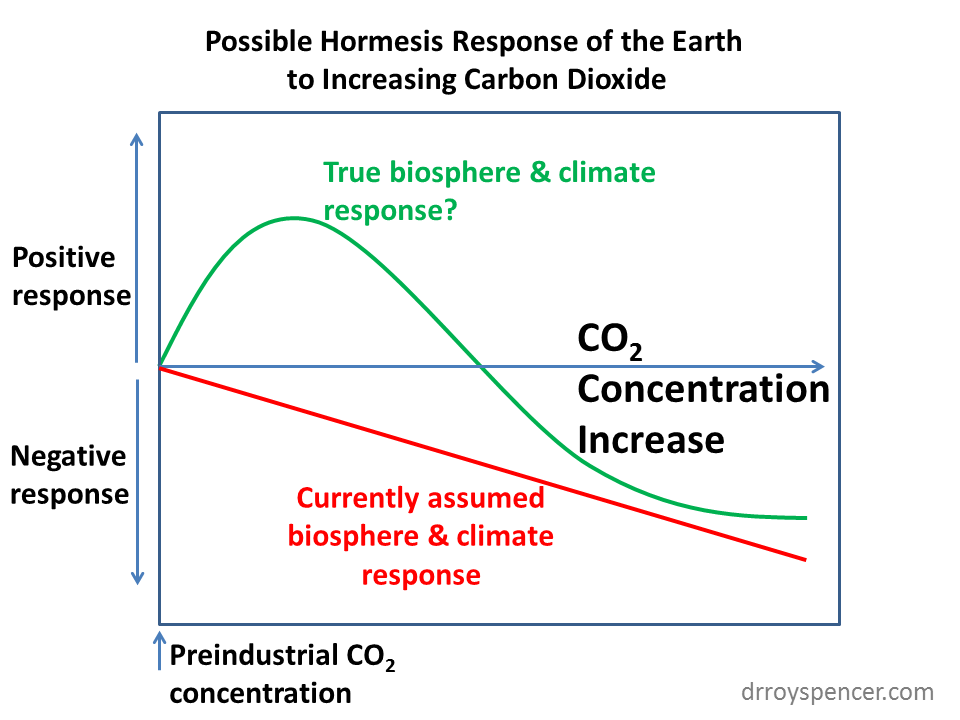
D.  Hormesis is a phenomenon, commonly seen in medicine and nutrition, where a low concentration or dose results in a positive effect, but a larger dose results in damage. For instance, some salt and water are necessary to good health, but beyond a certain point, ingesting more can be harmful or fatal. The effect of CO2 on plant life appears to be one such system. Increased CO2 obviously benefits plant life, but it is uncertain at what level CO2 might have a detrimental effect on growth. In professional greenhouses and experiments, even ten times the current level is still beneficial.
Hormesis Chart 1

Figure 2.  Illustration of how Carbon Dioxide is beneficial to plants through Hormesis. Horizontal Axis is Increasing CO2 level.

Source: http://www.drroyspencer.com/Earth’s Response to Increasing CO2: An Example of Hormesis? August 11th, 2014

As a matter of fact, CO2 below 400 ppm restricts growth, and below 150 ppm plants die en masse.  For a good summary of this, see post at http://notrickszone.com/2013/05/17/atmospheric-co2-concentrations-at-400-ppm-are-still-dangerously-low-for-life-on-earth/ by posted on 17. May 2013 :   Atmospheric CO2 Concentrations At 400 PPM Are Still Dangerously Low For Life On Earth 

[1] Example: Phillips, R.P., Finzi, A.C. and Bernhardt, E.S. 2011. “Enhanced root exudation induces microbial feedbacks to N cycling in a pine forest under long-term CO2 fumigation”. Ecology Letters 14: 187-194.

[2] See review article of research papers: “Responses of agricultural crops to free-air CO2 enrichment” Kimball, B.A., Kobayashi, K. and Bindi, M., Advances in Agronomy 77: 293-368 2002.

This article was first published in August, 2015. Some revisions/links have been added. Information is from my book Perverted Truth Exposed: How Progressive Philosophy has Corrupted Science, published June 2016, available online from Amazon.com

Dirty Rotten Scoundrels: American Wind Industry Caught Faking Community ‘Support’ for Wind Power

All politics, all the time – and thousands of dead birds and bats – and ruined rural serenity and sleep.

stopthesethings's avatarSTOP THESE THINGS

The wind industry was founded on myth, is built on lies and runs on a mix of subsidies and propaganda.

And, it should never be forgotten that, the greatest economic and environmental fraud of all time, was only made possible by our political betters.

Armed with the belief (not unjustified) that you can fool most of the people, most of the time, politicians run the same nonsensical lines as the rent-seekers, who critically depend upon them for endless subsidies, mandated targets, tax credits, soft loans and corrupt planning rules and regulations. It’s a match made in heaven.

Then there’s the need to pretend that wind power has broad and lasting community support.

In its efforts to ‘win hearts and minds’ in increasingly switched-on and cynical rural communities, the wind industry is utterly shameless.

Sham surveys, phoney consultations and barefaced lying are all par for the course.

Struggling to conjure up…

View original post 1,294 more words

Receding Swiss Glaciers Reveal 4000 Year Old Forests – Warmists Try To Suppress Findings

Paul Homewood's avatarNOT A LOT OF PEOPLE KNOW THAT

By Paul Homewood

I ran this story in 2014, but it is worth re-posting:

As many sources, including HH Lamb, have pointed out, back in the Bronze Age around 2000BC, the climate in the Alps was much warmer than now.

It is therefore no surprise to find direct evidence of this from geologist Dr. Christian Schlüchter, Professor emeritus at the University of Bern in Switzerland.

Larry Bell at Newsmax has the story:

Dr. Christian Schlüchter’s discovery of 4,000-year-old chunks of wood at the leading edge of a Swiss glacier was clearly not cheered by many members of the global warming doom-and-gloom science orthodoxy.

This finding indicated that the Alps were pretty nearly glacier-free at that time, disproving accepted theories that they only began retreating after the end of the little ice age in the mid-19th century. As he concluded, the region had once been much warmer than today, with…

View original post 804 more words

German Animal Lovers Boycott Wind Power: Vegans Incensed by Bloody Bird & Bat Slaughter

stopthesethings's avatarSTOP THESE THINGS

German vegans have mounted a boycott against wind power, incensed by the pointless and bloody slaughter of millions of birds and bats.

Irony comes in many sizes and shapes, but the idea of one group of moralising zealots taking on another group of moralising zealots, is simply delicious (so to speak).

The concept of carnivorous wind and sun worshippers going toe to toe with tofu and mung bean munching Germans throws up the opportunity for a new form of blood-sport, a bit like bear-baiting, in the Deutschland of old.

At least one electricity retailer has decided to deliver up the kind of electricity that might just satisfy the ethically fussy palates of German vegans. The cleverly named ‘Vegawatt’ promises to deliver electricity to satisfy all animal lovers, including hard-core vegos.

Although, STT is not quite sure how Vegawatt proposes separating its morally sound megawatts from the unethical stuff, enabling it…

View original post 605 more words

EU climate law could cause ‘catastrophic’ deforestation — NOT A LOT OF PEOPLE KNOW THAT

By Paul Homewood From the I told you so dept. The Guardian reports: Senior climate scientists say that the world’s carbon sinks could be facing a grave threat from a wholly unexpected source: the EU’s renewable energy directive. The climate law could suck in as much imported wood as Europe harvests each year […]

via EU climate law could cause ‘catastrophic’ deforestation — NOT A LOT OF PEOPLE KNOW THAT

Time to Die: New PM Must Bury Turnbull’s $10bn Snowy 2.0 Pumped Hydro Boondoggle

stopthesethings's avatarSTOP THESE THINGS

Wind and large-scale solar are doomed, but the saviour is said to be pumped hydro; paid for, of course, with other people’s money.

Touted by ex-PM Malcom Turnbull and his hapless sidekick, Josh Frydenberg as the Nation’s mega-battery, the heavily-hyped Snowy 2.0 pumped hydro scheme (shelved in the 1970s because it was uneconomic then) has been heralded as the saviour for the Australian wind industry.

The line goes something like this: if we use 3 MWh of wind power to pump water through 27 km of tunnels, over an elevation of 900m, later, when power consumers actually need it, Snowy Hydro could return 2 MWh to the grid.

Never mind squandering 1/4 to 1/3 of the electricity originally generated; never mind that with the inclusion of the $85 per MWh REC the cost of the wind power involved exceeds $110 per MWh; never mind that the owners of Snowy 2.0…

View original post 2,309 more words

Victorian Vengeance: Neighbours Launch $Multi-Million Noise Nuisance Law Suit Against Wind Farm Operator & Local Council

stopthesethings's avatarSTOP THESE THINGS

Don Jelbart: launches million dollar claim against his tormentors.

Tormented by wind turbine noise for years, a group of Victorian farmers have launched Supreme Court action seeking $millions in damages.

The community surrounding the Bald Hills wind farm, built by a Japanese developer, Mitsui and Co, have been tortured by incessant turbine generated low-frequency noise and infrasound since May 2015, when its 52, 2 MW Senvion MM92 turbines spun into action.

Neighbours started complaining to the developer about noise, straightaway.

But, as is their wont, the developer and its goons simply rejected the mounting complaints and carried on regardless. As we explain below, that callousness will soon come back to bite them.

Locals, however, were not perturbed.

Instead, they lawyered up. Engaging the feisty and tenacious Dominica Tannock.

Starting in April 2016, Dominica went after the South Gippsland Shire Council which, under the Victorian Public Health and Wellbeing Act 2008…

View original post 3,850 more words

Global Warming Skepticism for Busy People — Watts Up With That?

By Dr. Roy Spencer I sometimes get asked for a concise and accessible summary of my skeptical views on global warming. After a year or more of thinking and writing, my new Kindle book Global Warming Skepticism for Busy People is meant to fill that need. As a bonus, I guarantee it will be easier to understand…

via Global Warming Skepticism for Busy People — Watts Up With That?

Climate Change: What’s Real and What’s Artificial? Reposted

Urban Heat 3Although we apparently are in a pause, I decided to repost the part of this article about Urban Heat Island effects FYI.

o

 o

One “cause” of rising average global temperatures is the urban heat island effect. Cities are hotter than rural areas. Many of the reporting stations that were once in undeveloped rural areas have experienced either suburban or urban development, or the stations have been moved to more urban settings. It is well documented that some have been, seemingly intentionally, relocated near or at heat sources such as paved parking lots and air conditioners.

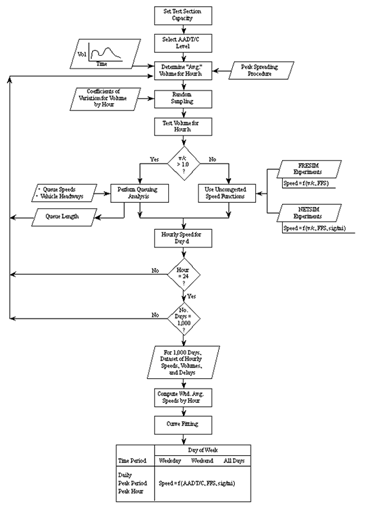
One reason for relocation near buildings or other structures could be that new automatic-reporting equipment needs to be connected by cable. Rather than dig up parking lots or roads to install units in a grassy or protected area, many have opted to locate them where they can be directly connected without involving costly excavation, although such sites do not meet the stated requirements. Instead of excluding data from stations that are poorly situated, a convoluted mathematical algorithm (scheme) is used to “correct” it to presumed pre-industrial levels. See illustrations below.

One additional problem with the newer sensors is their fast response.  Since they record the high and low temperature point each day, not the average, they can report a transient heat source like a passing bus, an idling auto or jet engine exhaust at the airport instead of the actual ambient temperature.

Urban Heat 6
Actual Conditions are run through a algorithm (below)
Urban Heat 8
Example flow chart of algorithms used to correct actual data
Corrected data approximated by algorithm

Urban area plus mathematical correction algorithm equals pristine nature

Source: “The Influence of anthropic surface processes and inhomogeneities on gridded global climate data” Slide 21, Powerpoint presentation to the American Chemical Society, Denver CO via Webinar, August 28 2011 by Ross McKitrick, Department of Economics, University of Guelph, Guelph ON Canada  http://www.rossmckitrick.com/general-overviews.html

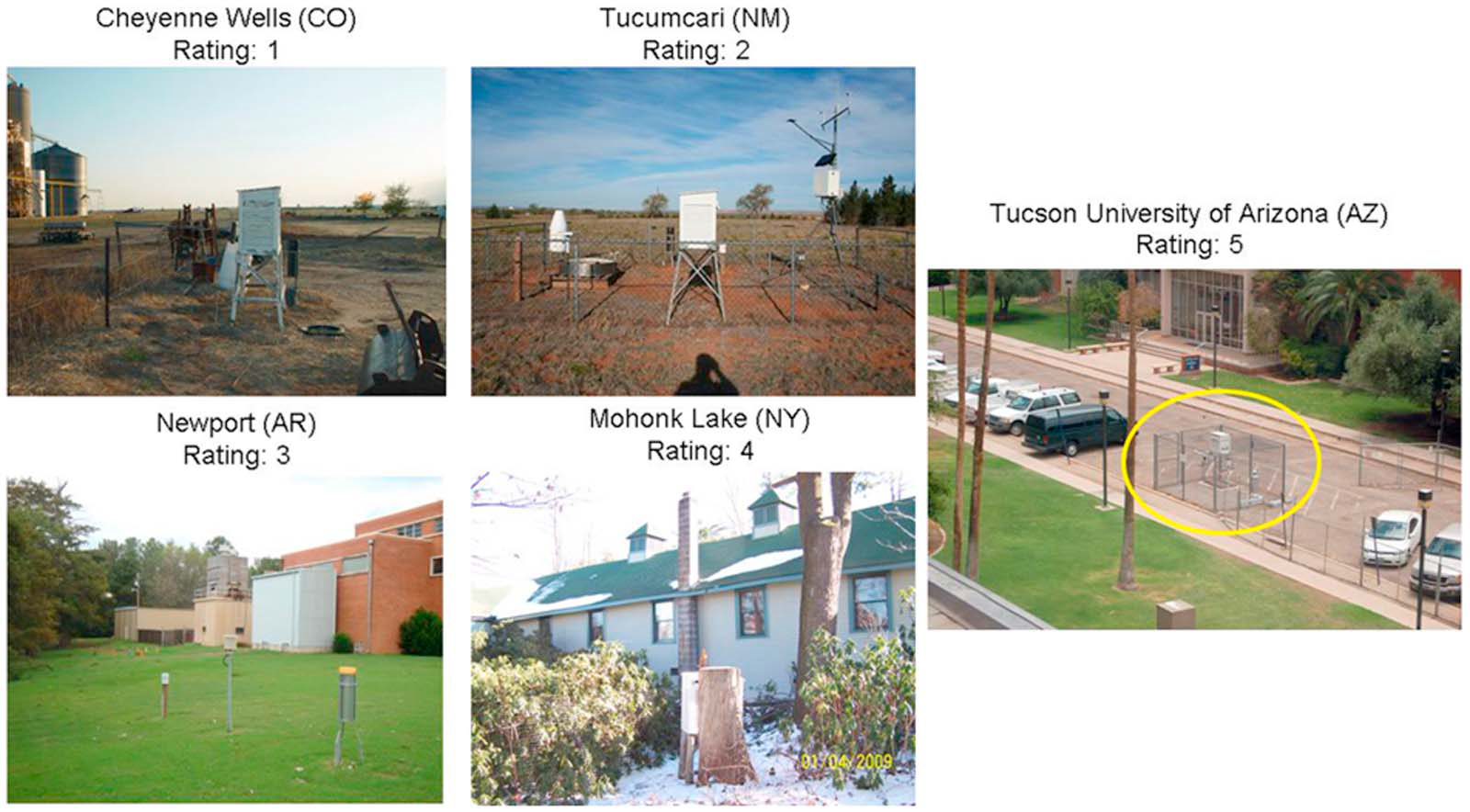
Proposed rating of reporting stations with regard to surroundings:

Urban Heat 5

Figure 3. U.S. Historical Climate Network (USHCN) station exposure at sites representative of each CRN class: CRN 1, a clear flat surface with sensors located at least 100 m from artificial heating and vegetation ground cover <10 cm high; CRN 2, same as CRN 1 with surrounding vegetation <25 cm and artificial heating sources within 30 m; CRN 3, same as CRN 2, except no artificial heating sources within 10 m; CRN 4, artificial heating sources <10 m; and CRN 5, sensor located next to/above an artificial heating source.

Source:  “Analysis of the impacts of station exposure on the U.S. Historical Climatology Network temperatures and temperature trends,” Souleymane Fall, Anthony Watts, John NielsenGammon, Evan Jones, Dev Niyogi, John R. Christy,5and Roger A. Pielke Sr., Journal of Geophysical Research, Vol. 116, D116, D14120  doi:10.1029/2010JD015146, 2011

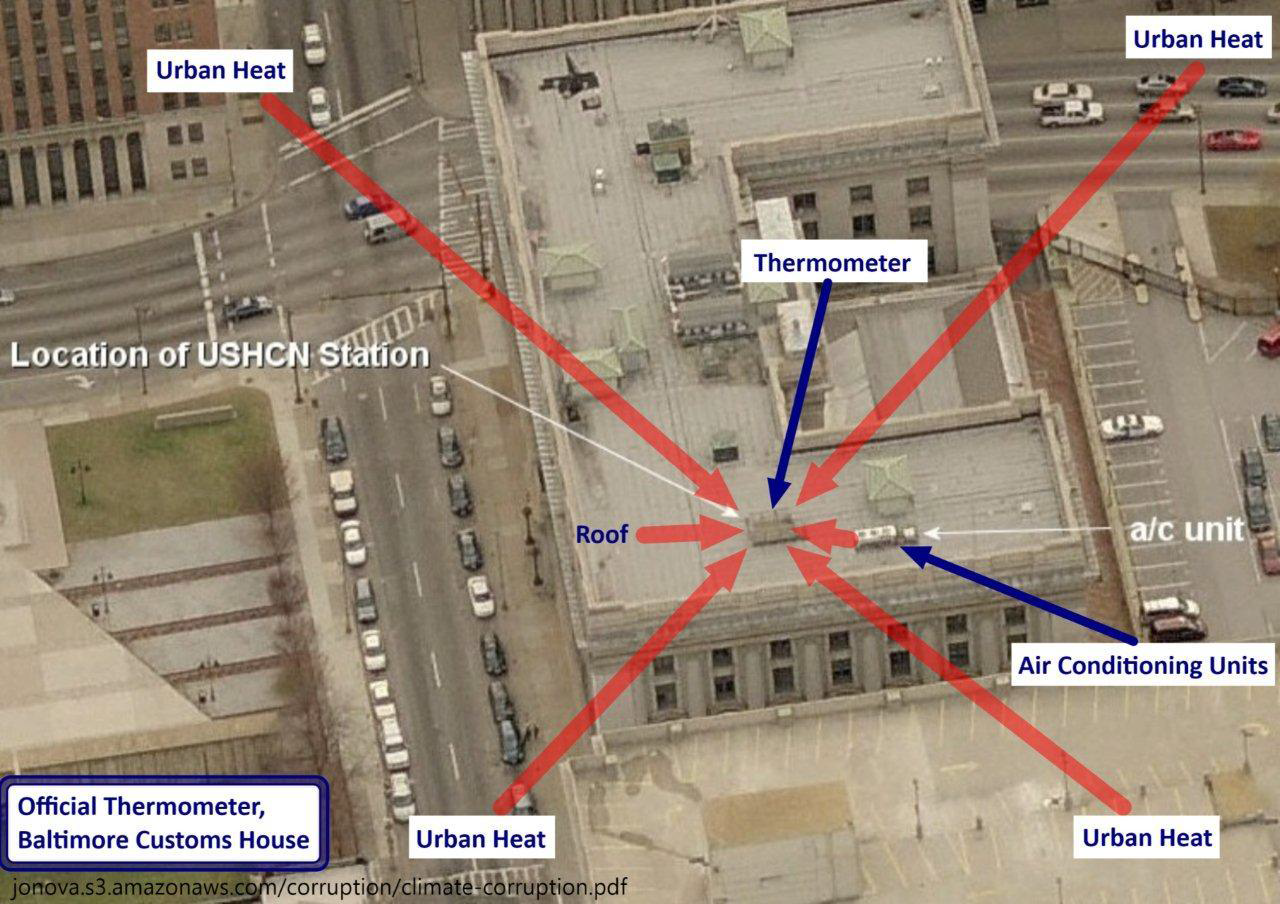
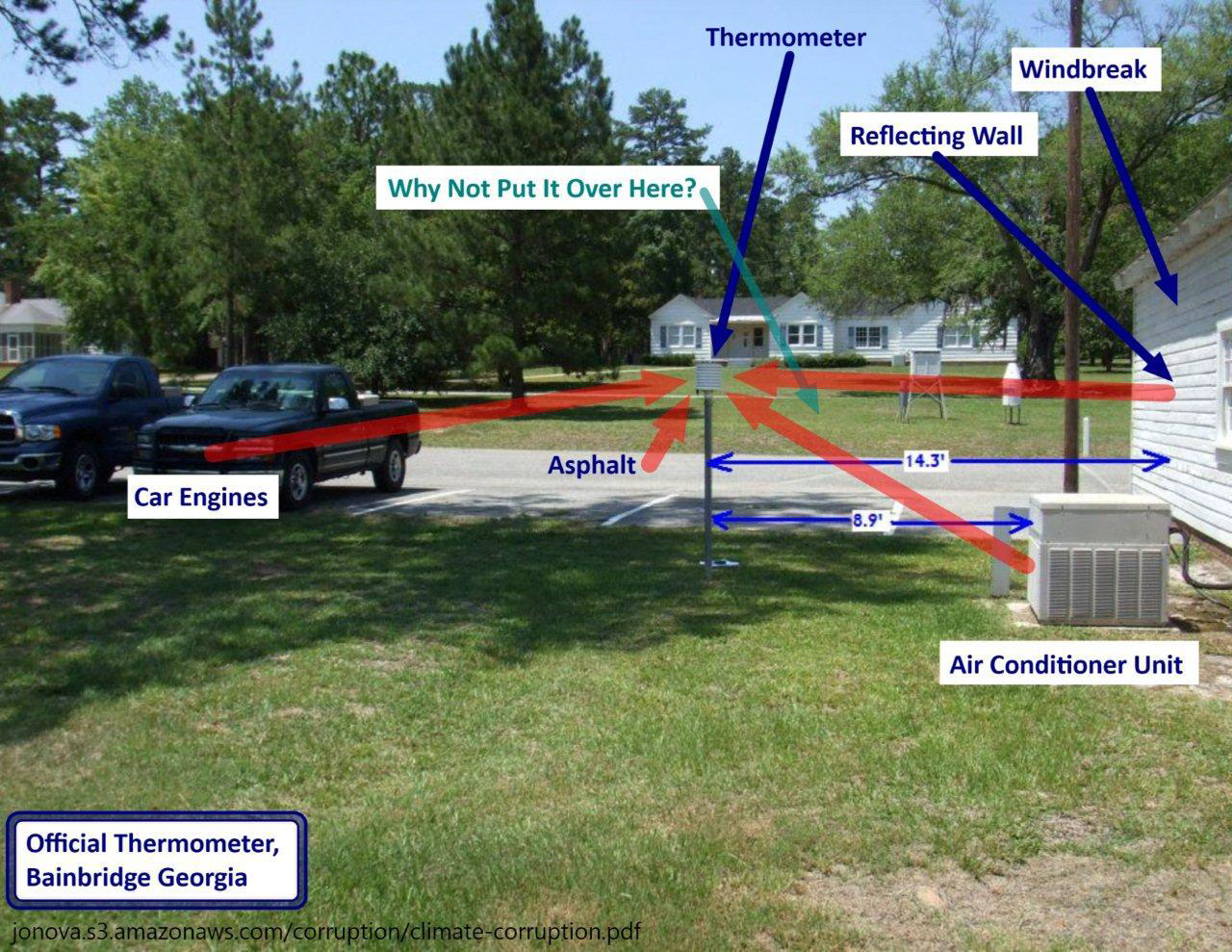
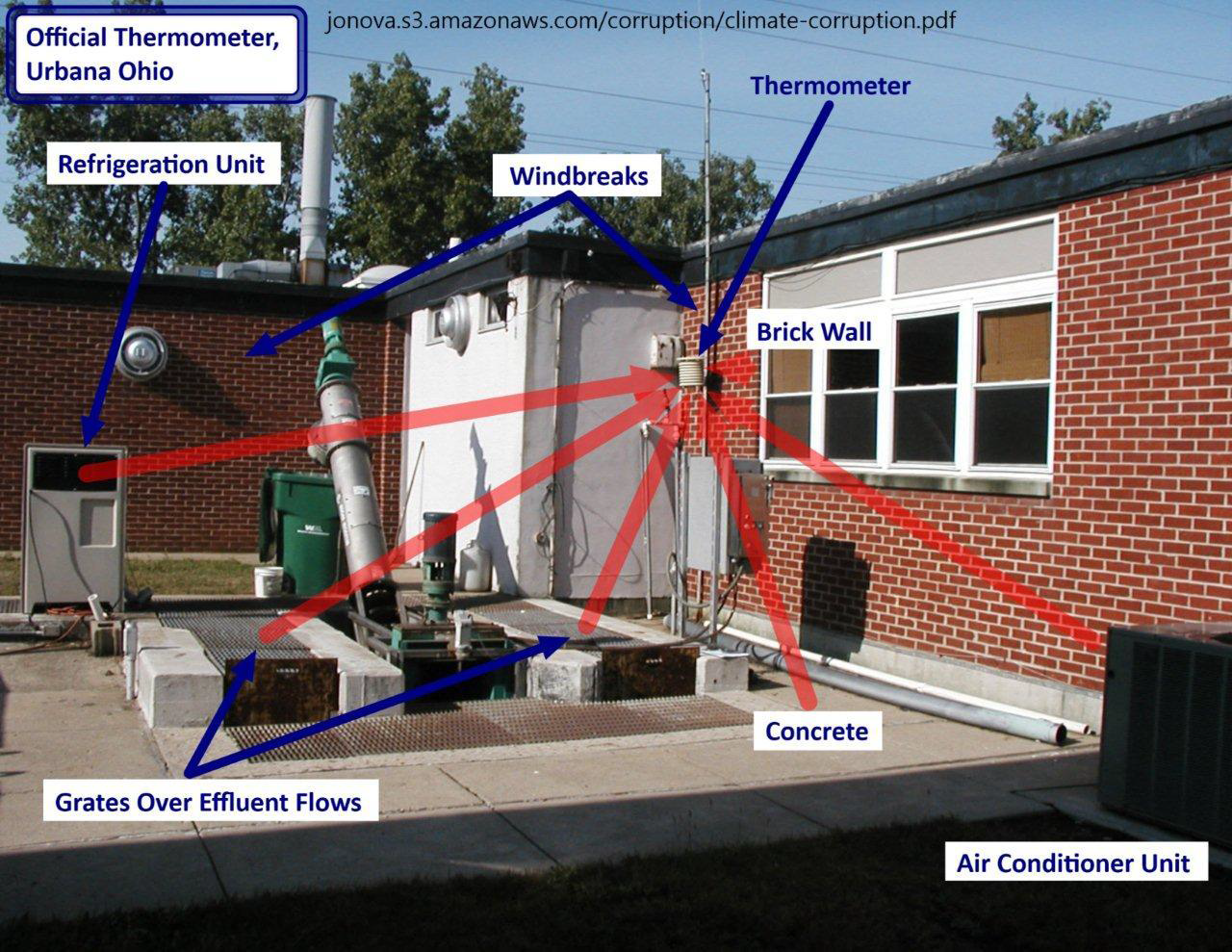
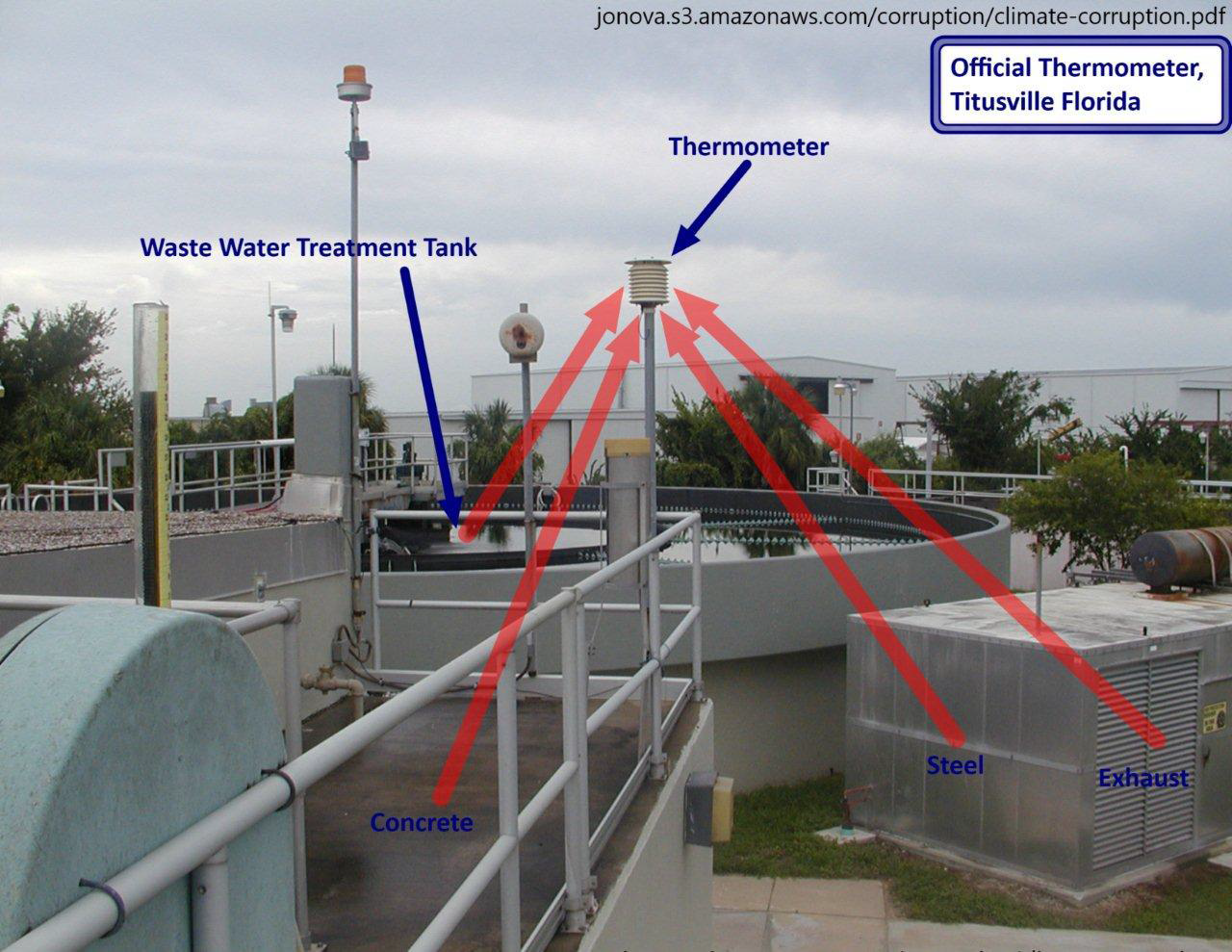
See other examples below of poor placement of temperature reporting stations from “Is the Western Climate Establishment Corrupt?” The public might not understand the science, but they do understand cheating, Dr. David Evans, 11 Nov 2010 (last updated 28 Feb 2011) Web Address: jonova.s3.amazonaws.com/corruption/climate-corruption.pdf

 Urban Heat 4

Urban Heat 1

Urban Heat 2


Urban Heat 3