but is it science
Life in a fossil-fuel-free utopia
Amnesty Report: Green Battery Technology Built on a Foundation of Child Abuse
Child miners aged four living a hell on Earth so YOU can drive an electric car: Awful human cost in squalid Congo cobalt mine that Michael Gove didn’t consider in his ‘clean’ energy crusade
Life on Earth was nearly doomed by too little CO2
Monumental, Unsustainable Environmental Impacts
Tangier Island
Political Corruption of Science Revealed in New Book
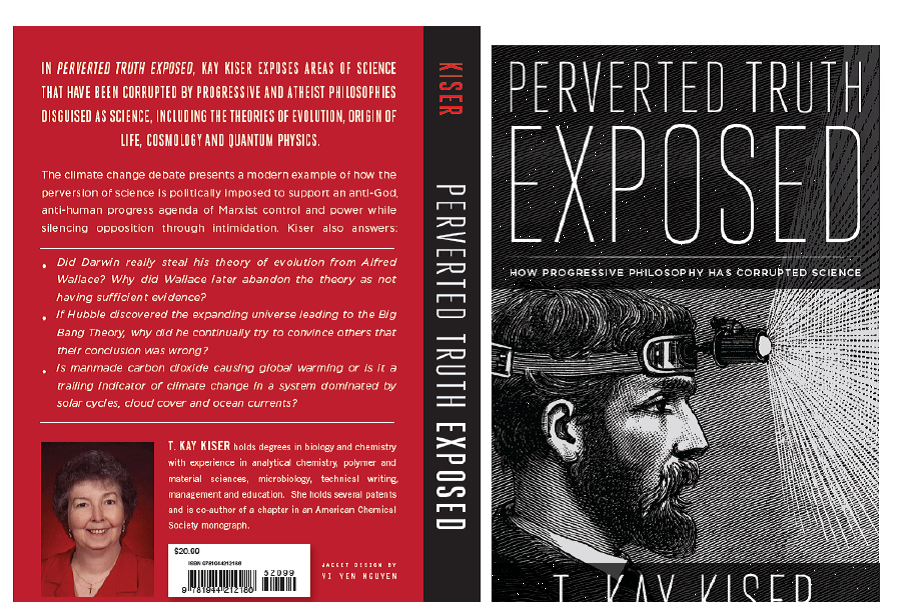
In Perverted Truth Exposed, Kay Kiser exposes areas of science that have been corrupted by progressive and atheist philosophies disguised as science, including evolution, origin of life, cosmology, quantum physics and climate change.
The climate change debate presents a modern example of how the perversion of science is politically imposed to support an anti-God, anti-human progress agenda of Marxist control and power while silencing opposition through intimidation. Kiser also answers:
- Did Darwin really steal his theory of evolution from Alfred Wallace?
- Why did Wallace later abandon the theory as not having sufficient evidence?
- If Hubble discovered the expanding universe leading to the Big Bang Theory, why did he continually try to convince others that their conclusion was wrong?
- Is man-made carbon dioxide causing global warming or is it a trailing indicator of climate change in a system dominated by solar cycles, cloud cover, and ocean currents?
Available online from the following outlets in print and as an eBook.
- World Net Daily Superstore at http://superstore.wnd.com/Perverted-Truth-Exposed-How-Progressive-Philosophy-Has-Corrupted-Science-Paperback
- Amazon.com by Title (print & Kindle)
- Barnesandnoble.com by Title under Books or Nook Books
- booksamillion.com by Title under Books or eBooks
- Signed copies available for $25 from the author at Kay Kiser, P O Box 6052, Kingsport, TN 37663
- See excerpts of this and future books in the Modern Mythology Series at blog: realscienceblog.com
The Truth about AIDS in Africa
The Truth about AIDS in Africa
The Claims: HIV/AIDS from unsafe heterosexual contact is rampant in Africa. Many children are left as orphans because both parents have died from AIDS.
The Truth: While HIV/AIDS is undoubtedly present in Africa and other destitute areas, there are problems with its reported transmission, diagnosis and treatment. HIV infections in the developed world occurs almost exclusively among homosexual males and IV drug users who share needles with infected people, and heterosexual transmission is rare. In Africa, half of those diagnosed with HIV and HIV/AIDS are heterosexual women, so there must be other mitigating circumstances. It is possible that actual infections are acquired through non-sterile injections in contraceptive clinics. This could help to explain why HIV in Africa is diagnosed equally among men and heterosexual women. It is very likely that HIV and HIV/AIDS are over diagnosed in Africa and other poverty stricken areas of the world with or without actual HIV testing. Many cases of AIDS in Africa may have little or no connection to the HIV virus or indiscriminate sexual practices. Those that are malnourished or have chronic diseases such as TB or malaria naturally have compromised immune systems, i.e. Acquired Immune Deficiency Syndrome, AIDS, from these conditions without carrying the actual Human Immunodeficiency Virus (HIV).
Because of poor healthcare facilities and abilities, HIV/AIDS may be diagnosed based on symptoms without HIV testing in many rural and isolated areas. In other areas, where actual testing for HIV antibodies is done, a high incidence of false positives is likely to occur. This is due to the poor specificity of the test and reaction with antibodies from other diseases and conditions. Most of those diagnosed with HIV/AIDS, whether tested or untested for HIV, have been assumed to have full blown HIV/AIDS through disparate symptoms recognized by the UN WHO including fever, headache, rash, sore throat, swollen lymph nodes, weight loss, chronic diarrhea or cough, all of which can be caused by many common parasites or infectious diseases as well as severe illnesses such as malaria and tuberculosis (TB). UN WHO has named TB as a leading indicator of HIV/AIDS and lists TB as causing 2/3 of HIV/AIDS deaths. HIV/AIDS itself does not cause death; it opens the way for other diseases that kill people. Reporting TB deaths as HIV/AIDS deaths without confirmation of HIV bolsters the statistics, as does reporting orphans as AIDS orphans. At this time it is impossible to know how prevalent over diagnosis is in Africa and other poor areas.
Over diagnosis of HIV and HIV/AIDS, when promoted by the international media, paints a picture of Africa that packs a triple whammy for AIDS advocates and international population control governmental and nongovernmental organizations. First, it excuses high death rates and failure to treat endemic diseases; secondly, it incentivizes HIV/AIDS research funding in developed countries by falsely declaring AIDS a heterosexual pandemic; thirdly it has the potential for vindicating population control programs in the minds of potential donors by creating a false picture of rampant immorality and promiscuity. As a bonus, it also encourages the use of condoms that furthers population control agendas.
HIV facts and questions:
HIV causes AIDS: Unlike those who deny that HIV causes AIDS or that it even exists, I do not deny that HIV causes AIDS or that HIV exists. I do question some of the current statistics, testing and treatment options. Because it is politically incorrect to question the UN WHO recommended practices and conclusions, those who question the status quo will undoubtedly be accused of denialism by AIDS advocates in order to conflate, confuse, discredit and silence anyone daring to question the efficacy of the current testing and treatment methods, even when it might lead to better understanding and improved protocols.
Non-HIV AIDS: TB, Malaria, dysentery and other serious chronic diseases cause a more common form of Acquired Immune Deficiency Syndrome, AIDS, that has no connection to HIV/AIDS or sexually indiscriminate behavior. It is well known that anyone who is chronically ill and/ or malnourished naturally has a compromised immune system. Other opportunistic diseases are easily acquired by persons whose immune systems are compromised. By labeling these non-HIV AIDS cases as HIV/AIDS, it can be an excuse for not treating the underlying conditions.
Unfortunately, for USAID, UN WHO and activist NGOs or agencies that provide aid to poor countries, because their emphasis is on required or coerced population control and not on treating disease, many clinics do not have the basic medicines, equipment or facilities to treat endemic diseases, but have store rooms filled with birth control drugs, condoms and other birth control and abortion materials and equipment. This is a human tragedy and a crime against humanity that must be stopped. It is unconscionable that Western aid not be heavily weighted toward supplying medicines and equipment for prevention and treatment of endemic diseases.
Recommendation: In both HIV/AIDS and non-HIV AIDS, treatment should always begin with addressing the presenting diseases and malnutrition. Once the patient is stabilized then HIV/AIDS treatment can begin, but only after further confirmation of the original diagnosis of HIV/AIDS. HIV/AIDS treatment drugs further compromise the immune system so that treatment of weakened, disease ravaged patients and those with non-HIV AIDS using these drugs may do more harm than good.
International aid organizations should be encouraged or required to reverse their decades old practice of oversupplying population control materials and under-supplying needed medicines, facilities, equipment and supplies to treat endemic diseases.
Demographic Shift: HIV/AIDS in developed countries is confined almost exclusively among homosexual men and IV drug users who share needles with HIV infected people. The expected pandemic in developed countries never materialized. According to official statistics, Sub-Saharan Africa accounts for 2/3 of the HIV incidence in the world, with Southern Africa, (South Africa and Botswana), accounting for most of that. 15 to 25% of the South African population has been diagnosed with HIV or HIV/AIDS. More than half of the HIV positive people in South Africa are heterosexual women. Heterosexual contact is blamed for causing the spread of HIV, but in other countries heterosexual transmission is very rare. Unless the HIV virus has mutated, this theory of frequent heterosexual transmission cannot be valid and other mitigating factors must be considered.
Shared needles as a possible source: One theory is that the reuse of hypodermic needles for injected birth control drugs is responsible for the spread of HIV, and, if true, could account for the higher incidence in women in Africa and other poor countries where injected birth control is required or advocated. Injectable birth control drugs such as Depo Provera that must be reinjected every 3 months are sometimes administered in a clinic, but more often the drug and the syringes are given to patients for administration at home. Because viruses do not live very long on surfaces outside the body, HIV could not be transferred unless an HIV infected person has used the needle just prior to reuse by a second person for birth control. This could only happen in a clinic where multiple women are injected one after another without proper sterilization of needles.
How are these in-home administered reused needles causing HIV/AIDS without an immediate HIV contamination source in each case? It is more likely that in-home injections with improperly sterilized needles would transfer opportunistic bacterial infections such as staph and strep. The whole idea of giving hypodermic syringes to uneducated people is ludicrous; it is the worst of the birth control methods, and the best way to spread more disease and misery. Poor women with little or no concept of microbial infective agents are unlikely to discard or destroy needles even if the package instructions say to discard after use.
Recommendation: If this form of birth control must be injected every 3 months, it should only be done by a professional in a clinic with properly sterilized or disposable needles. If birth control is desired, a better alternative would be insertion of an IUD, Intrauterine Device, which does not require regular follow up treatments.
Could Depo-Provera make women more susceptible to HIV infection? According to this theory, the active ingredient in Depo-Provera, (Depo-medroxyprogesterone acetate, aka DMPA), may chemically predispose at risk women to acquiring HIV through sexual contact with infected men, through thinning of vaginal epithelial cells and immunosuppression. Three recent meta-studies[1] show a statistically significant link between use of the drug and incidence of HIV in at risk women. The link to HIV transmission was not established statistically for use of either oral contraceptives or another injectable contraceptive drug, NET-EN, (norethisterone enanthate), in these studies.
Clinical Diagnosis without HIV testing: In rural poor areas of Africa HIV/AIDS may be diagnosed without HIV testing by the clinical indicators listed by WHO such as fever, headache, rash, sore throat, swollen lymph nodes, weight loss, chronic diarrhea or cough. These symptoms may also be caused by endemic diseases such as TB, malaria and other insect borne diseases, dysentery and other water borne diseases, parasites and malnutrition. WHO considers TB to be a leading indicator of HIV/AIDS. Some people diagnosed without HIV testing may instead have non-HIV AIDS caused by these endemic diseases.
Diagnosis with HIV testing: Clinical HIV tests detect antibodies to the virus, not the virus itself. HIV tests have a high incidence of false positives, so that retesting and other confirmation are needed after a positive test result. False positives of HIV testing may be the result of non-HIV AIDS caused by other diseases and pregnancy because the HIV tests are non-specific and may detect antibodies to other diseases or conditions.
Causes of False Positives: HIV testing is not specific to HIV and is prone to false positives. It tests for antibodies to HIV, not the virus itself, but can also detect other antibodies present in chronic diseases or those acquired over a lifetime. There are over 65 documented causes of false positives including TB, malaria, leprosy, hepatitis, Q fever, influenza or colds, herpes simplex, leishmaniosis, and Epstein Barr virus. Pregnancy or prior pregnancies are among factors that can cause false positives due to presence of HLA (human leukocyte antigen). Is it time to question whether HIV testing, without thorough validation, is valid in parts of Africa where the population is routinely exposed to numerous diseases that leave a heavy load of antibodies in their blood?
Validation needed for HIV positives: False positives are common so that, according to manufacturers’ instructions, positive tests must be retested in duplicate and then by another method to verify results, e.g. ELISA twice then Western Blot. ELISA, Enzyme Linked ImmunoSorbent Assay, uses an antigen for the (in this case HIV) antibody bound to a solid surface and an enzyme that causes a color change when the target antibody attaches itself to the antigen. Western Blot actually separates, by gel electrophoresis, each component in a mixture of antibodies bound to specific antigens. Medical testing protocols vary from country to country, so that the same test may be interpreted as positive or negative depending on the protocol. For example, UK does not use the Western Blot verification of duplicate ELISA tests, and different countries require from one to four Western Blot markers to verify and confirm a positive result.
South Africa uses duplicate ELISA only to verify positive HIV tests, resulting in 15-25% of the population testing positive, 60% of which are heterosexual women. South Africa also has a high rate of drug treatment for prevention of mother to child HIV transmission, which may mean that most HIV tests are conducted at gynecological clinics and obstetric hospitals on pregnant women. This is a problem since pregnancy is known to cause false positives. The incidence of HIV and AIDS in most of the other countries in Africa, and indeed the world, ranges from 0.1 to 5.0 percent of the population. South Africa’s 15 – 25% incidence needs a closer look. The fact that over half of these are heterosexual women is also problematic as described above.
Recommendation: South Africans and Botswanans when first diagnosed with HIV or HIV/AIDS need to be retested using a more stringent verification protocol in the future. Unfortunately, the drugs used for treating HIV can cause false negatives, so retesting those already receiving therapy may be useless or at lease confusing.
Opportunistic Diseases: When people sicken and die with HIV/AIDS, it is not the HIV that kills them; it is other opportunistic infections that are able to invade and thrive because HIV has crippled the immune system. TB is the leading cause of death in Africa, with or without HIV/AIDS. A diagnosis of HIV/AIDS can be an excuse not to treat underlying endemic diseases.
Treatment Options: HIV treatment drugs suppress the immune system further than the disease itself. Wouldn’t it make sense to treat the opportunistic diseases and malnutrition more aggressively first before suppressing the immune system further with AIDS treatment drugs? In some areas of Africa, TB and HIV are treated simultaneously, which is a step in the right direction.
Orphans from AIDS? AIDS orphans are defined as anyone 15 years or younger who has lost, depending on the country, their mother, one parent or both parents to “AIDS related diseases.” South Africa includes people up to 18 years old. WHO estimates that 70% of “AIDS orphans” have one living parent. TB is the leading cause of death in Africa and the leading clinical indicator of the presence of AIDS. Since many people in Africa live very short lives, with or without AIDS, how is this any different from the pattern of the past where lifespans are short and teenagers often are orphaned?
[1] References cited in Population Research Institute newsletter article: “While Admitting Risks, WHO Continues to Recommend Injectable Contraceptives for Women at High Risk of Contracting HIV” by Jonathan Abbamonte, April 20, 2017 as follows:
Brind J, Condly SJ, Mosher SW, Morse AR, Kimball J. Risk of HIV Infection in Depot-Medroxyprogesterone Acetate (DMPA) Users: A Systematic Review and Meta-analysis. Issues Law Med 2015; 30(2): 129-39.
Morrison CS, Chen PL, Kwok C, Baeten JM, Brown J, Crook AM, et al. Hormonal contraception and the risk of HIV acquisition: an individual participant data meta-analysis. PLoS Med 2015; 12(1): e1001778.
Ralph LJ, McCoy SI, Shiu K, Padian N. Hormonal contraceptive use and women’s risk of HIV acquisition: a meta-analysis of observational studies. Lancet Infect Dis. 2015; 15(2): 181-9.
Day of Reckoning for DDT Foes? NOT! Junkscience.com 2006
“…terrible toll in human lives (tens of millions dead — mostly pregnant women and children under the age of 5), illness (billions sickened) and poverty (more than $1 trillion dollars in lost GDP in sub-Saharan Africa alone) caused by the tragic, decades-long ban.”
Day of Reckoning for DDT Foes? Reblog from Junkscience.com 2006
By Steven Milloy September 21, 2006, FoxNews.com
Last week’s announcement that the World Health Organization lifted its nearly 30-year ban on the insecticide DDT is perhaps the most promising development in global public health since… well, 1943 when DDT was first used to combat insect-borne diseases like typhus and malaria.
Overlooked in all the hoopla over the announcement, however, is the terrible toll in human lives (tens of millions dead — mostly pregnant women and children under the age of 5), illness (billions sickened) and poverty (more than $1 trillion dollars in lost GDP in sub-Saharan Africa alone) caused by the tragic, decades-long ban.
Much of this human catastrophe was preventable, so why did it happen? Who is responsible? Should the individuals and activist groups who caused the DDT ban be held accountable in some way?
Rachel Carson kicked-off DDT hysteria with her pseudo-scientific 1962 book, “Silent Spring.” Carson materially misrepresented DDT science in order to advance her anti-pesticide agenda. Today she is hailed as having launched the global environmental movement. A Pennsylvania state office building, Maryland elementary school, Pittsburgh bridge and a Maryland state park are named for her. The Smithsonian Institution commemorates her work against DDT. She was even honored with a 1981 U.S. postage stamp. Next year will be the 100th anniversary of her birth. Many celebrations are being planned.
It’s quite a tribute for someone who was so dead wrong. At the very least, her name should be removed from public property and there should be no government-sponsored honors of Carson.
The Audubon Society was a leader in the attack on DDT, including falsely accusing DDT defenders (who subsequently won a libel suit) of lying. Not wanting to jeopardize its non-profit tax status, the Audubon Society formed the Environmental Defense Fund (now simply known as Environmental Defense) in 1967 to spearhead its anti-DDT efforts. Today the National Audubon Society takes in more than $100 million per year and has assets worth more than $200 million. Environmental Defense takes in more than $65 million per year with a net worth exceeding $73 million.
In a February 25, 1971, media release, the president of the Sierra Club stated that his organization wanted “a ban, not just a curb” on DDT, “even in the tropical countries where DDT has kept malaria under control.” Today the Sierra Club rakes in more than $90 million per year and has more than $50 million in assets.
Business are often held liable and forced to pay monetary damages for defective products and false statements. Why shouldn’t the National Audubon Society, Environmental Defense, Sierra Club and other anti-DDT activist groups be held liable for the harm caused by their recklessly defective activism?
It was, of course, then-Environmental Protection Agency administrator William Ruckelshaus who actually banned DDT after ignoring an EPA administrative law judge’s ruling that there was no evidence indicating that DDT posed any sort of threat to human health or the environment. Ruckleshaus never attended any of the agency’s hearings on DDT. He didn’t read the hearing transcripts and refused to explain his decision.
None of this is surprising given that, in a May 22, 1971, speech before the Wisconsin Audubon Society, Ruckleshaus said that EPA procedures had been streamlined so that DDT could be banned. Ruckleshaus was also a member of — and wrote fundraising letters for — the EDF.
My note: This speech was before the seven months long EPA hearings before Judge Sweeney began in fall of 1971, so even though the hearings concluded DDT was not harmful to man or environment, Ruckelshaus already had his mind made up.
The DDT ban solidified Ruckelshaus’ environmental credentials, which he has surfed to great success in business, including stints as CEO of Browning Ferris Industries and as a director of a number of other companies including Cummins Engine, Nordstrom, and Weyerhaeuser Company. Ruckelshaus currently is a principal in a Seattle, Wash., -based investment group called Madrona Venture Group.
Corporate wrongdoers — like WorldCom’s Bernie Ebbers and Tyco’s Dennis Kozlowski — were sentenced to prison for crimes against mere property. But what should the punishment be for government wrongdoers like Ruckleshaus who, apparently for the sake of his personal environmental interests, abused his power and affirmatively deprived billions of poor, helpless people of the only practical weapon against malaria?
Finally, there is the question of the World Health Organization itself. What’s the WHO been doing for all these years? There are no new facts on DDT — all the relevant science about DDT safety has been available since the 1960s. Moreover, the WHO’s strategy of mosquito bednets and malaria vaccine development has been a dismal failure. While the death toll in malarial regions has mounted, the WHO has been distracted by such dubious issues as whether cell phones and French fries cause cancer.
It’s a relief that the WHO has finally come to its senses, but on the other hand, the organization has done too little, too late. The ranks of the WHO’s leadership need to be purged of those who place the agenda of environmental elitists over the basic survival of the world’s needy.
In addition to the day of reckoning and societal rebuke that DDT-ban advocates should face, we should all learn from the DDT tragedy.
With the exception of Rachel Carson (who died in 1964), all of the groups and individuals above mentioned also promote global warming alarmism. If they and others could be so wrong about DDT, why should we trust them now? Should we really put the global economy and the welfare of billions at risk based on their track record?
Steven Milloy publishes JunkScience.com and CSRWatch.com. He is a junk science expert, an advocate of free enterprise and an adjunct scholar at the Competitive Enterprise Institute.
See “DDT: A Case Study in Scientific Fraud” by J. Gordon Edwards, PhD, 2004 at http://www.jpands.org/vol9no3/edwards.pdf
For more information see also my earlier blog – Bring back DDT – Save Africa and other impoverished areas

