AGW Claims vs. Truth – 4. Increased Fossil Fuel use and CO2 level

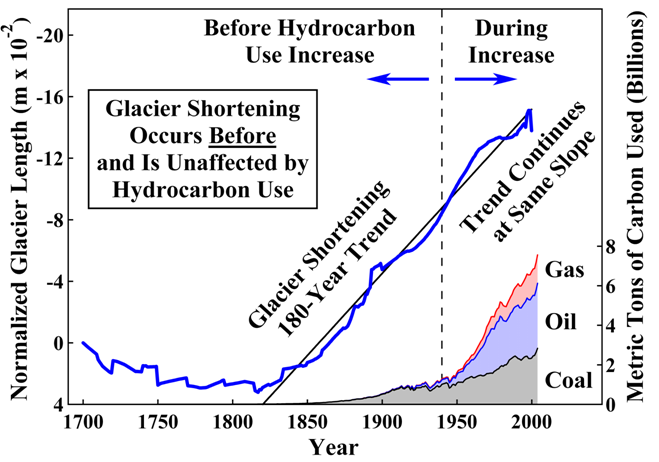
CO2 Increase since 1950 does not track Glacier Shortening
Increase in hydrocarbon use since 1950 does not change Glacier shortening rate since Little Ice Age (indicator of warming climate)

Claim 4. Manmade CO2 levels have been rising rapidly due to increased industrialization and populations since the 1950s.

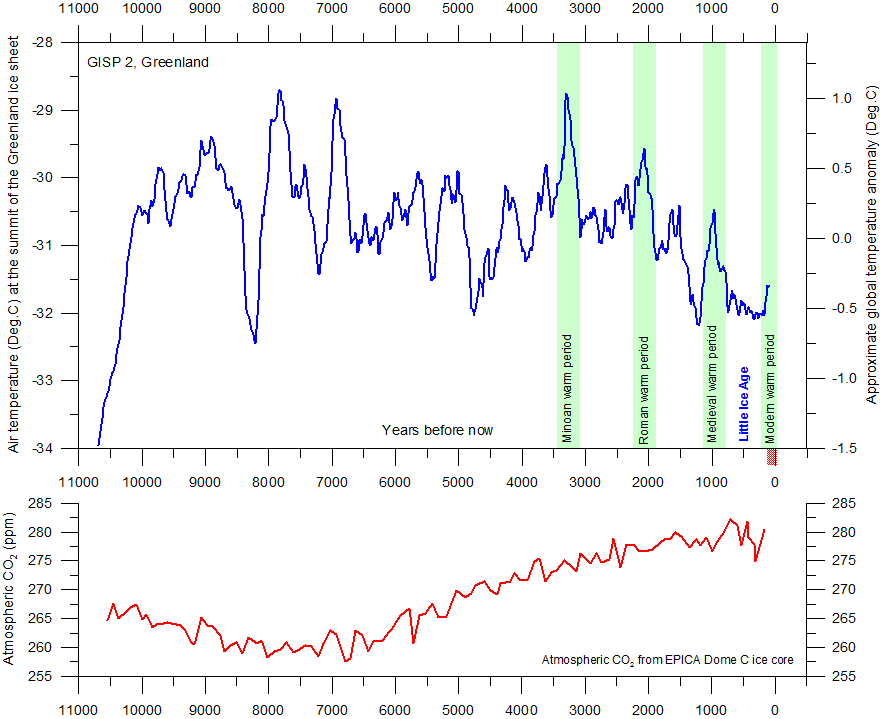
Truth: CO2 levels have been steadily rising along with warming since the Little Ice Age. Recent increases in industrialization and population appear to have contributed to the increase in atmospheric CO2 since the 1950s when fossil fuel consumption began increasing. Rising temperatures have also contributed to increased CO2 because it is less soluble in warmer ocean water and is thus released.  it is unclear how much is from manmade sources and how much is from natural processes, but some estimate put it at 5%. However, if CO2 is not responsible for global warming, (see previous posts) increased levels shouldn’t alarm anyone and in fact increased CO2 should be celebrated as a plant growth promoter.

15 climate chart - 11K yrs vs CO2
Eleven thousand year temperature and CO2 level record from ice cores

AGW Claims vs. Truth -3. Water Vapor Magnifies Warming from Carbon Dioxide

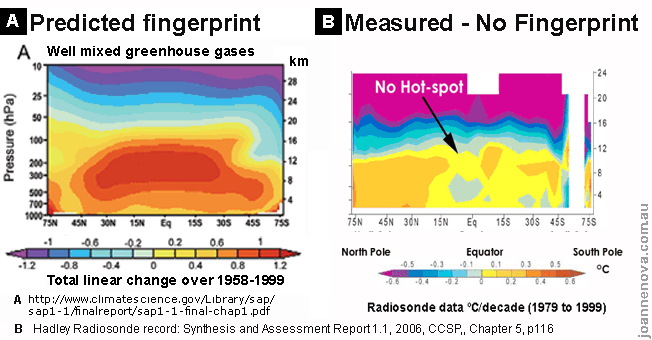
No hot spot - JoNova
Predicted hot spot from water vapor forcing is missing

Claim 3. Carbon dioxide is important because it has a forcing effect on other factors such as water vapor which magnify warming effects.

Truth: Since the atmospheric absorption of CO2 is already near saturation, (see previous post), very little additional heating can take place due to increased CO2. Contrary to AGW advocates, increased water vapor from warming doesn’t stay as vapor to trap heat near the surface. It forms low altitude clouds that strongly reflect solar heat back out into space, overwhelming any trapped re-radiation from the Earth and having an overall cooling effect. The models, which assume water vapor remains as vapor, predict an atmospheric “hot spot” at middle altitudes. Weather balloons and satellites have failed to find this assumed hot spot, which is the signature of atmospheric forcing of global warming in computer models. Due to low altitude clouds reflecting sunlight back into space, any feedback is negative (cooling), not positive (warming) as assumed in computer models.  For earlier posts, go to http:realscienceblog.com

Source of Figure: “The Skeptic’s Handbook” at http://www.Joannenova.com.au


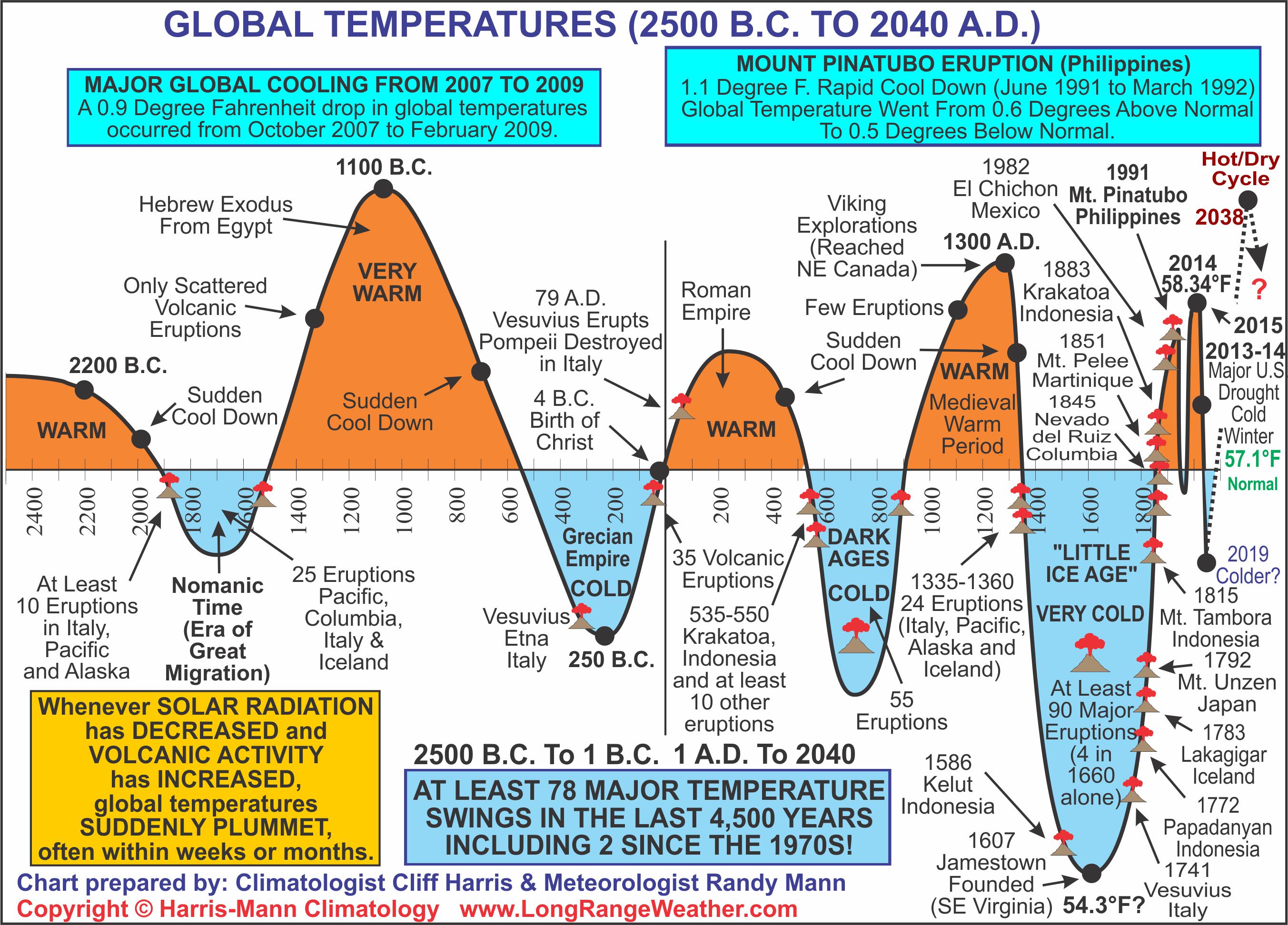
AGW Claims vs Truth – 1b timeline of climate alarms

Global Temperatures 2500 BC to 2040 AD
Global Temperatures 2500 BC to 2040 AD (projected) Note: Temperature range is less than plus or minus 2.5oF (1.4oC) from present.

Part 2 of answers to AGW Claim 1. “Global warming and/or climate change are established facts.”  See “Anthropogenic Global Warming vs. Truth – Part 1” blog post for Part 1.


Quote: “Since 1895, the media has alternated between global cooling and warming scares during four separate and sometimes overlapping time periods. From 1895 until the 1930’s the media peddled a coming ice age. From the late 1920’s until the 1960’s they warned of global warming. From the 1950’s until the 1970’s they warned us again of a coming ice age. This makes modern global warming the fourth estate’s fourth attempt to promote opposing climate change fears during the last 100 years.”

— Senator James Inhofe, Monday, September 25, 2006


Here is a more complete timeline straight from the headlines and texts of leading newspapers and other reliable sources, thanks to http://butnowyouknow.net/those-who-fail-to-learn-from-history/climate-change-timeline/ and other reliable documentation as noted below.

  • 1872 John Tyndall measured the heat absorption of various atmospheric gases over the entire wavelength range of his heat source. He found that water vapor and CO2 absorbed more strongly than other atmospheric gases such as oxygen and nitrogen. Oxygen and nitrogen, major components of the atmosphere, had little or no absorption of heat in the range tested. It is important to note that his experiments did not separate the heat into specific wavelengths. See Claim 2 and its chart in the next blog post.

Quote: “…if, as the above experiments indicated, the chief influence be exercised by the aqueous vapour, every variation of this constituent must produce a change of climate. Similar remarks would apply to the carbonic acid [CO2] diffused through the air… they constitute true causes, the extent alone of the operation remaining doubtful.”

              — John Tyndall,                                                                             Contributions to Molecular Physics in the Domain of Radiant Heat, 1872


  • 1895, February, The New York Times: “Geologists Think the World May Be Frozen Up Again”
  • 1899, Nils Eckholm claims that burning coal will double CO2 and cause climate change. Eckholm and Svante Arrhenius claim that it will prevent a predicted coming Ice Age. From Historical Perspectives on Climate Change by James Rodger Fleming, 1998, Oxford University Press.
  • 1902, Los Angeles Times: “Disappearing Glaciers … persistency that means their final annihilation …”
  • 1912, October, The New York Times: “Prof. Schmidt Warns Us of an Encroaching Ice Age”
  • 1923, Chicago Sun-Times: “Scientist says Arctic ice will wipe out Canada”
  • 1923, The Washington Post: “The discoveries of changes in the sun’s heat and southward advance of glaciers … possible advent of a new ice age.”
  • 1924, September, The New York Times: “MacMillan Reports Signs of New Ice Age”
  • 1929, Los Angeles Times: “Is another ice age coming?” “Most geologists think the world is growing warmer, and that it will continue to get warmer.”
  • 1932, The Atlantic magazine, “This Cold, Cold World”
  • 1933, March, The New York Times, “America in Longest Warm Spell Since 1776; Temperature Line Records a 25-Year Rise.”
  • 1933, National Weather Bureau Monthly Weather Review: “…wide-spread and persistent tendency toward warmer weather … Is our climate changing?”
  • 1938, Royal Meteorological Society Quarterly Journal: (Global warming, caused by man heating the planet with carbon dioxide) “is likely to prove beneficial to mankind …”
  • 1938, Chicago Tribune, “Experts puzzle over 20 year mercury rise … mysterious trend toward warmer climate in the last two decades.”
  • 1939, The Washington Post: “… weather men have no doubt that the world at least for the time being is growing warmer.”
  • 1952, August, The New York Times: “… the world has been getting warmer in the last half century.”
  • 1954, U.S. News and World Report: “… winters are getting milder, summers drier. Glaciers are receding, deserts growing.”
  • 1954. Fortune magazine: “Climate – the Heat May Be Off”
  • 1955, Gilbert Plass predicts 3.6o C (6.8o F) warming if CO2 is doubled.

Quote: “ … average surface temperature of the earth increases 3.6o C if the CO2 concentration in the atmosphere is doubled …” (this is the false assumption on which many computer models rest)

Quote: “The extra CO2, released into the atmosphere by industrial processes and other human activities may have caused the temperature rise during the present century. In contrast with other theories of climate, the CO2 theory predicts that this warming trend will continue, at least for several centuries.”

—Gilbert Plass, 1956, “The Carbon Dioxide Theory of Climatic Change.” [1]


  • 1956, October 28, The New York Times: “Warmer Climate on Earth May Be Due To More Carbon Dioxide in the Air,” by Waldemar Kaempffert in The New York Times “Science in Review”
  • 1959, The New York Times: “Arctic Findings in Particular Support Theory of Rising Global Temperatures”
  • 1969, February, The New York Times: “… the Arctic pack ice is thinning and that the ocean at the North Pole may become open sea within a decade or two.”
  • 1970, The Washington Post: “… get a good grip on your long johns, cold weather haters – the worst may be yet to come … there’s no relief in sight.”
  • 1974, Time magazine: “Global cooling for the past forty years”
  • 1974, The Washington Post: “… weather aberrations they are studying may be the harbinger of another ice age.”
  • 1974, Fortune magazine: “As for the present cooling trend a number of leading climatologists have concluded that it is very bad news indeed.”
  • 1974, The New York Times: “… the facts of the present climate change are such that the most optimistic experts would assign near certainty to major crop failure … mass deaths by starvation, and probably anarchy and violence.” (emphasis added)
  • 1975, The New York Times: “Scientists Ponder Why World’s Climate is Changing; A Major Cooling Widely Considered to Be Inevitable”
  • 1975, Nigel Calder, editor of New Scientist in International Wildlife Magazine: “The threat of a new ice age must now stand alongside nuclear war as a likely source of wholesale death and misery for mankind” (emphasis added)
  • 1976, U.S. News and World Report: “Even US farms may be hit by cooling trend”
  • 1981, The New York Times: (Global Warming) “… of an almost unprecedented magnitude”
  • 1988, James Hansen, Goddard Institute for Space Studies, testifies before Congress that global warming is a fact and that consequences of doing nothing will be dire.
  • IPCC, Intergovernmental Panel on Climate Change, was established by the United Nations in that year with the mission to find a connection between human activity and climate change. (emphasis added)
  • After that, the media blitz of articles supporting the belief in global warming or climate change are too numerous to list in detail here.

Quote: “The 1995 IPCC draft report said, ‘Any claims of positive detection of significant climate change are likely to remain controversial until uncertainties in the total natural variability of the climate system are reduced.’ It also said, ‘No study to date has positively attributed all or part of observed climate changes to anthropogenic causes.’ Those statements were removed, and in their place appeared: ‘The balance of evidence suggests a discernable human influence on climate.'”  (emphasis added)

 — “Aliens Cause Global Warming,” Caltech Michelin Lecture, Michael Crichton, 1/17/2003


Quote: “I readily confess a lingering frustration: uncertainties so infuse the issue of climate change that it is still impossible to rule out either mild or catastrophic outcomes, let alone provide confident probabilities for all the claims and counterclaims made about environmental problems. Even the most credible international assessment body, the Intergovernmental Panel on Climate Change (IPCC), has refused to attempt subjective probabilistic estimates of future temperatures. This has forced politicians to make their own guesses about the likelihood of various degrees of global warming.” (emphasis added)

— Stephen Schneider, (warmist camp), former Professor of Environmental Biology and Global Change at Stanford University, in “Global Warming: Neglecting the Complexities,” Scientific American, January 2002, an article requested by the publisher to critique Bjorn Borg’s book The Skeptical Environmentalist


Quote: “On the one hand, as scientists we are ethically bound to the scientific method, in effect promising to tell the truth, the whole truth, and nothing but — which means that we must include all the doubts, the caveats, the ifs, ands, and buts. On the other hand, we are not just scientists but human beings as well. And like most people we’d like to see the world a better place, which in this context translates into our working to reduce the risk of potentially disastrous climatic change.

To do that we need to get some broadbased support, to capture the public’s imagination. That, of course, entails getting loads of media coverage. So we have to offer up scary scenarios, make simplified, dramatic statements, and make little mention of any doubts we might have. This ‘double ethical bind’ we frequently find ourselves in cannot be solved by any formula. Each of us has to decide what the right balance is between being effective and being honest. I hope that means being both.” (emphasis added. Note that the excuse for dishonesty is based on an unsubstantiated assumption that doing so will result in a better world.)

— Stephen Schneider, (warmist camp), former Professor of Environmental Biology and Global Change at Stanford University, in Discover, 1989


[1] Plass, G. N. (1956), “The Carbon Dioxide Theory of Climatic Change.” Johns Hopkins University Press, Tellus, 8: 140–154. doi: 10.1111/j.2153-3490.1956.tb01206.x


Anti-humanism, Environmentalism and the Overpopulation Myth

The roots of environmentalism go back to the eighteenth century in the form of the overpopulation myth of Malthusianism, which was all about limiting the human population to prevent a predicted Malthusian Catastrophe, i.e. mass starvation, and for genetic purity, especially among supposedly genetically inferior groups e.g. certain races, cultures and the chronically poor. This is based on the progressive beliefs in materialism, (i.e. there is no spiritual side, only the material we can see and touch), and humanism, (i e. man is the measure of everything and determines morals to suit his circumstances).  From these progressive philosophies grew socialism, communism, fascism, the eugenics[1] movement and environmentalism, all of which are about control of the masses by an elite few, and all are basically anti-human, anti-development and anti-freedom.

In 1798 Thomas Malthus published An Essay on the Principles of Population[2]  in which he predicted future starvation based on the assumption that the rate of population growth would far surpass the growth rate of food supplies. Using this, he proposed draconian measures to “fix” an assumed overpopulation problem at a time when world population was below one billion.  Malthus made two major erroneous assumptions:

  1. Genetic inferiority and enhanced fertility of less accomplished peoples
  2. No improvement in crop yields per acre.

He assumed that the only way to grow more food was to increase the number of acres under cultivation, which limited the total “carrying capacity” of any region and indeed the world. We now know that yields have improved by orders of magnitude through things such as introduction of more prolific, disease resistant plant varieties and high yield hybrids, nitrogen and mineral fertilization, mechanization and control of insect and rodent pests. Nor did he foresee the natural reduction of family size that usually occurs when people are raised beyond near-starvation subsistence, and when diseases are controlled so that high childhood mortality is reduced.

Using these false assumptions as a “reason,” he advocated government measures to reduce population growth rates among the poor such as regulating marriage, educating for moral abstinence, as well as birth control and sterilization. However, he opposed nutritional relief and improved hospital access that would have reduced infant mortality and extended life spans among the poor.  In his opinion, helping the poor only made the supposed overpopulation problem worse.  He extended this same philosophy to Africa where he observed that the Tsetse fly and Malaria helped to keep human population numbers and lifespans low, which he saw as a good thing.

This same upside down philosophy persists today among progressives who only typically want to manage the poor while keeping them poor.  Malthus was pushing evolution and eugenics long before Charles Darwin[3] and Frances Galton[4].   In The Descent of Man, Charles Darwin assumed that the superior races (white Europeans) would eventually cause the extinction of the inferior races (black and brown). Francis Galton coined the term eugenics for a theory about improving the human race through selective breeding and exclusion from reproduction of supposedly genetically inferior groups.


“At some future period, not very distant as measured in centuries, the civilized races of man will almost certainly exterminate and replace the savage races throughout the world.

—Charles Darwin, Descent of Man


Because genetic inferiority of certain races, cultures and the poor has largely been rejected by more enlightened geneticists and the public in general, (but apparently not for powerful population control supporters), along with vastly improved food production rates, environmentalism is the latest cause celebre to cover brutal inhumanity to man in the form of forced or coerced population control in places like China, lndia and Africa.  The shift from eugenics or racial purity to environmentalism is based on the false assumption that the world is overpopulated, resulting in harm to the environment.  This makes environmentalism and population control a perfect match and a good fit for the progressive elite seeking control.

Is it true that the world overpopulated? Only if agriculture had remained as it was in the eighteenth century.  However, the advances in crop yields are more than enough to feed the world.  There is more than enough food for all.  The reason for starvation and poor nutrition is usually political mismanagement or worse, such as well-meaning environmental and population control philanthropic societies, NGOs, UN and local governments intentionally keeping the poorest in their disease ridden squalor without adequate infrastructure to provide for basic needs in order to control the people.  A healthy and educated population is much harder for a dictator to control and thereby remain in power.

The best way to stabilize population, if that is the goal, is to raise the standard of living by providing employment, transportation, electricity, medical care, education, clean water and adequate food. It is a well known fact that family size is naturally reduced when living standards are improved beyond the point where excess children are needed to insure replacement of those lost in early childhood to disease and malnutrition.  It can be argued that the population is too low in many areas to provide the cooperation and man power to provide better facilities without outside aid. Only cities are overpopulated, and that is usually by choice. As population numbers have grown, the world has seen an increase in the standard of living, as reflected in the global GDP per capita, due to division of labor and shared responsibility for both agriculture and developing infrastructure.  We should be doing all we can to raise the world’s poor out of poverty. Caring for the environment is the last thing on the minds of people who are having difficulty feeding their children.  Raising their standard of living is the best thing we could do to stabilize the population and protect the environment. Unfortunately, the progressives would rather do the opposite for ideological reasons.

I have seen the benefits of higher population and the negative side of low population myself. I grew up in an area of the Appalachian Mountains where population is low. Services that are available in the cities and towns a couple of hours away are not or only marginally available in these mountainous rural areas.  Even finding a plumber or electrician is difficult.  Although the situation is better now because of improvements in highways, many in the area still must travel to the cities for proper medical care.  Lower population means lower tax basis, fewer businesses, less opportunity. It has been difficult getting businesses, whether they are medical facilities, manufacturing, commercial or food and entertainment,  interested in locating in an area where the customer and workforce base are low.  It has been particularly difficult getting doctors to come and stay.  It hasn’t been that long since the first fast food restaurant came into the area.  I bring this up to illustrate the logic of raising the population to improve living standards.  Granted, this is a far cry from poor villages in other countries, but it still illustrates the point that higher population brings higher living standards.

[1] Eugenics is the “science” of improving the human race by selective breeding of genetically superior people and preventing supposedly genetically inferior people from reproducing.

[2] Thomas Robert Malthus, An Essay on the Principles of Population, 1798, London

[3] Charles Darwin, On the Origin of Species , 1858, London, The Descent of Man, 1871

[4] Francis Galton, 1865 article “Hereditary Talent and Character”, Hereditary Genius., 1869, Inquiries into Human Faculty and Its Development, 1883.

WHERE DO WE GO FROM HERE?

The problem:

A progressive, anti-God mindset has come to dominate science and many other aspects of our world. Magical thinking, hidden agendas and protection of turf have replaced the need and the pursuit of truth.

The progressive monopoly relies on three things: academia, media and government funding. Academia, rather than being the open forum for discussing diverse ideas it should be, has become a closed priesthood where dissenting opinions are repressed, punished and blocked from funding and from academic publication by biased editors and peer reviewers. The popular press, whether print or electronic, is gullible and all too eager to parrot the standard line of SQR (Status Quo Regurgitators) without question. This includes the entertainment industry. Government funding grants aimed at supporting the standard line and controlled by SQR department heads, control what research can and cannot be done.

Solutions:

A public awareness of the problems is needed, leading to an open debate and holding accountable those blocking the free pursuit of truth. More, not less, research and discovery would result. Daylight is a good disinfectant.

  • It will be very difficult to break through the progressive monopoly and inform the people of the problem so it may take a generation. That is why books like this are important. It is one more way to chip away at the imposing edifice of the progressive monopoly.
  • The public must demand that academic departments allow and encourage questions, debates and alternative research.
  • Peer reviewed publications must be held accountable for bias and advocacy that blocks publication of valid research based on alternative views.
  • The popular press and the entertainment industries must be held accountable by an informed public for biased reporting and propaganda disguised as entertainment.
  • Government funding should be minimized and scrutinized to assure that meaningful research is done and that outcomes reflect the unbiased truth.

Educate yourself so you can use logic and facts, not emotional appeals in the debate. Arguing based on the Bible won’t help your case with those that don’t believe; it will only give your opponents ammunition to claim that you are anti-science and superstitious. Stick to facts and logic. Find and support those publications, websites and blogs that point out bias and give voice to alternative views as one way of educating yourself. Be discerning about internet information sources so you don’t get misled by illogical, unsupported wild speculation on either side. Learn to recognize the difference between opinion and facts. Start blogs of your own to give others an outlet for dissent. Read the books and visit the websites in the bibliography of this book.

Tactics – Direct Confrontation:

This new challenge for each of us to reveal the truth won’t be easy. As a matter of fact, because of the typically harsh and defensive responses of the progressives, it will sometimes be downright unpleasant. Most people will avoid confrontation on those grounds, preferring to avoid conflict and remain silent. Many are aware of the problem, or at least some part of it, but few are bold enough to stand up to the elitist bullies who call them names, disparage their character and engage in hate-filled diatribes. Remember, it’s not about you. It’s about them defending their fragile egos, their territories and their control of the situation.

They will try to make you defensive and emotional like they are by attacking your character and intelligence. The key to discussing anything with them, assuming they are at all willing, is to remain calm and logical, not emotional (offended, hurt, angry, etc.). Don’t let them put you on the defensive. Stand your ground and continue to ask your questions and make your logical points in a relatively nonthreatening manner. As long as they don’t actually hit you, their tantrums and accusations mean nothing. If they manage to get you to address the issue emotionally, you have lost at least half of your argument. Not only will you be mischaracterized, but in any argument (discussion) when emotion enters, logic goes out the window.

For those of you who are confident enough, I would encourage you to enter those very debates without fear or dread with business-like or diplomatic composure. It may be useful to start with quiet discussions on milder aspects of their beliefs in private so they do not feel obligated to defend themselves in public. By all means, don’t try to defend yourself or give them counter examples to illustrate that you are not guilty of whatever their accusations are. You would be wasting your breath, falling into their trap and giving them ammunition to shoot back at you. By putting you on the defensive they have achieved half of their goal of sidetracking the discussion and making you look foolish. Their favorite game is “Got Ya!”

Let the vitriol flow over you without obvious effect. Address the facts and the possibility that their thinking might have some logical flaws or blind spots. When they lose their composure or spew slanderous remarks, that is a sign that you are on the right track because they are attempting to use intimidation to shut you up. Remain calm and repeat your point in a gentle, composed manner. Point out the logic of both points of view without sinking to their emotional level. Whatever the outcome, thank them for being willing to discuss the issue.

If you are a student, you may have to repeat the status quo line and not be too outspoken until after you get your passing grade. Remember, the professor is protecting his image to the rest of the class. In those cases, it is probably best to wait until the class is over to raise your questions in private and in a relatively non-threatening way if at all. You will have to gradually judge their tolerance for dissenting voices to see how far you can go in educating them. Some have such fragile egos that you will not be able to engage them at all. They may be unwilling to discuss their beliefs, so some finesse may be required to keep the door to communication open. Some, however, will be at least somewhat open to discussion of their beliefs.

Department heads or deans need to hear from students about those professors who are abusing their positions to proselytize or indoctrinate instead of teach. If no one complains, these leaders really don’t know what is going on. One complaint may not have any effect, but complaints from numerous students may have some effect in reining in such abuse. Talk among other students and compare notes about the professor’s behavior. Encourage others to also complain, preferably after the course is completed.

Tactics – Indirect Campaigns:

Start contacting those who control the message and the money. Write letters, emails, comment on social media, websites or blogs and phone those who can affect change. Contact members of Congress, heads of government departments, academic deans and heads of academic departments, media producers and editors, as well as advertisers of biased media. Let them know that you do not accept the bias that is exhibited. Give logical arguments for free exchange of ideas and discussions of logical alternatives. One person contacting them may not have much effect, but numerous contacts cannot be ignored. Most of these leaders and politicians assume that one letter from a proactive person represents opinions of many others not willing or able to speak out.

Evolution: Setting the Stage, Part 2

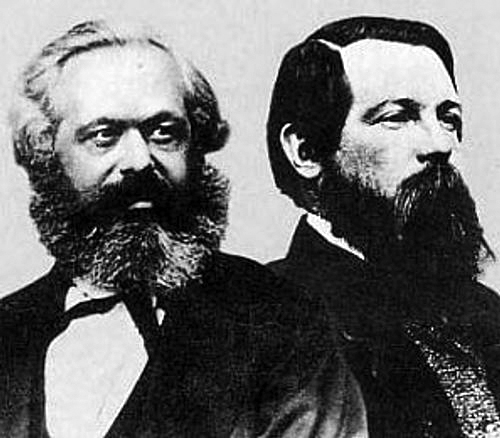
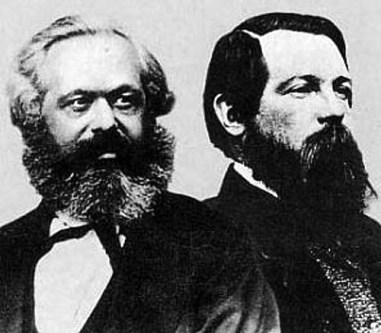
Marx_and_Engels

Karl Marx and Fredrick Engels    Source:  Wikipedia, Public Domain

Socialism / Communism

Socialist thought began to be accepted in the 17th century (or even earlier) and flourished in the 19th and early 20th centuries. Socialism is actually a kind of social Darwinism or social engineering. It is based on a misunderstanding of human nature and a belief that man’s very nature could be molded and improved. This was based on the belief that the world is naturally progressive and everything, including human nature, is being continually improved throughout time.

The socialist dream sounds wonderful: everyone working for the common good and no one going without. Unfortunately, this belief has proven again and again to be wrong. Human nature is basically Self-centered, and in general man is generous and altruistic only after personal needs and desires are met. Humans are motivated by a focus on Me first, then spouse and children, then extended family, then friends, then local tribe and only then extending to local and state authority, to country and to the greater global society last.

Man naturally is very compassionate and generous toward those in need of charity, but only after his basic needs are met. Socialism requires that man’s focus be on the state (or society as a whole), while putting himself and his own interests last. This is the exact opposite of man’s true, unchanging nature. Habits and attitudes can be taught to a certain degree, but it has been demonstrated many times that man’s basic selfish and imperfect nature cannot be changed.

As the Plymouth colony learned, (see Part 1), without personal rewards for his achievements, a person’s motivation to produce is reduced or eliminated along with most of his creativity and efficiency. At the same time, his selfishness, envy, resentment and deceit grow as a result of perceived inequities. In such a society, the lazy person who hardly contributes at all gets as much as the hard working person who produces most of what is shared.

In labor unions where all members are rewarded equally whether they are cracker-jack contributors or space filling dead wood, resentment is rampant and efficiency and productivity suffer. Such unions discourage excellence and encourage minimal or status quo contributions. In the absence of an overarching internally motivated altruism, socialist societies must be tightly and thoroughly controlled by the state, ultimately resulting in totalitarian dictatorships or at best dictatorial bodies of an elite class in order to force people to behave as is required to maintain the society.

Unfortunately, socialism/communism also leads to moral degradation wherein cheating, lying and other forms of deceit are used to gain perceived or actual basic needs or an advantage over others. A prime example is the old Soviet Union, where morals and ethics have suffered greatly from real or perceived deprivations. As a general rule, needy is greedy. Everyone may be equal, but everyone, except the elite, is poorer for it.

Essentially we are back to monarchies and privileged gentry oppressing serfs or slaves “for their own good.” So much for equality as espoused by socialism, communism and their ilk. It is a very old, very bad idea that results in a return to old oppressions and a loss of basic freedoms and inalienable human rights “endowed by our Creator.”

But wait, what about the utopian dream? Marx presented his philosophy as a series of steps where, through the principles of dialectical materialism[1], society progresses from original oppression by the bourgeois[2] under capitalism[3] through struggle to a “dictatorship of the proletariat[4]” to a utopian state where governments are unnecessary and fade away on their own. Unfortunately, it never goes beyond the dictatorship stage because the utopian dream is totally unrealistic, unworkable and unsustainable in the real world due to the inherent and unchangeable nature of man and to reality in general. Marx never explained how the society would take that final step from dictatorship to utopia. People in power want to stay in power. It is totally unrealistic to expect them to voluntarily give that up.

Even if utopia were attained, how would the utopian society be organized and maintained without essentially robotic altruism to the society[5] by every individual and (again) strict control from the top to keep it all going? Like monarchies and dictatorships it is still all about control by an elite group. In recent fiction, Star Trek is a model of a utopian society. Poverty has been eliminated and altruism is the norm. No one is envious or resentful of others’ successes, and everyone gladly obeys orders from a wise and benign leader toward a common goal. However, the real world is more like Babylon 5 with all of its intrigues, envy, resentment, prejudices, hatreds and inequities. Man’s nature cannot be denied, and control through coercion and rewards is necessary for even a “utopian” society to function. Heaven on earth is impossible as long as imperfect people are involved.

Unfortunately, even today there are those who would throw away their freedom, in the form of excessive regulation and government control, to gain a (false) sense of security under the control of a supposedly wiser elite. It seems there are some who are uncomfortable with freedom, with all its risks and opportunities, and who desire a nice safe cage. (Some intellectuals and elitists who espouse the socialist philosophy assume that they will be among the elite and are only uncomfortable that others are not controlled. However, most of these people will end up being the controlled, not the controllers.)


They, who can give up essential liberty to obtain a little temporary safety,  deserve neither liberty nor safety.                    —Benjamin Franklin


Christianity is built on the value and importance of the individual whereby everyone benefits freely as a result of freely practiced moral values such as duty, honor, charity, respect and equality of opportunity (not outcome, which is unrealistic)[6]. Socialism in its many forms, does not value the individual but rather sees people as groups that should (be compelled to) work for the greater good of the whole, regardless of whether it is good for any one individual. These two philosophies are diametrically opposed. Socialism can only succeed if Christianity is either eliminated or tightly controlled as a purely social ritual. That is why socialism and atheism are such good partners, and behind socialism is the ever-present progressivism.

The belief in a naturally progressive universe says that everything from the universe to molecules is evolving toward perfection, with no room for absolutes, not even moral ones.   If the entire universe is believed to be naturally progressive, then there is no need for a God to have caused or influenced it. It is its own reason for being. To those who espouse atheism or socialism in its various forms, progressivism is what gives meaning to life and their cause, essentially replacing God. It gives them a purpose and a satisfaction in furthering that assumed natural progress. That is why it has such a strong hold on its believers, especially those who wish to engineer a socialist utopia or stop evolution in its tracks to “save the planet.”

The progressive universe itself becomes their de facto god, and social change toward a dreamed-of perfect utopian paradise becomes the goal and their purpose in life. Since no cultural or social system has ever achieved the perfection envisioned, to the progressive the present system, whatever it may be, must be changed to further that perceived progress. This makes it a perfect philosophy for young radicals who wish things were better but lack the life experiences to see the broader picture or the unintended consequences of rampant social change.

However, remember the maxim: all progress is change, but all change is not progress. That is, unless you believe that progress is inevitable as do the progressives. But progress requires work while regress is the natural state of things. A boulder perched on the edge of a cliff, given enough time and erosion, will naturally roll down (regress) by necessity, but pushing it back up to the top (progress) requires work. Progress is not a natural thing; it must force its way against the regressive nature of the universe. The Second Law of Thermodynamics states that entropy always increases – that chaos or disorder always increases and usable energy always decreases. This is the opposite of the progressive philosophy. Dust, death and decay are natural results of the real world.

If the universe is naturally progressive, then everything must be interpreted as progressing or “evolving” toward perfection, whether it is molecules, life, earth, stars, galaxies or the universe.   The fixed laws and values of basic physics, such as the force of gravity or the mass of the proton, are a great mystery to those who reject all absolutes in favor of universal progress. These values are under constant attack by theorists using deductive reasoning, i.e. “pure” reason, rather than inductive reasoning based on reality, experiments and observation.

This is the case of cosmology and particle physics today. They start with an a priori[7] hypothesis, based on assumptions about how the universe must behave, and produce complex mathematical equations to model an imagined perfectly symmetrical, homogeneous and beautifully progressive universe. In areas where reality conflicts with the theory that is based on pure mathematics, the facts are either ignored as anomalies, reinterpreted to make them fit or new layers of complexity are added to their calculations. Never is the theory questioned.

Why all the expounding on progressivism and its partner socialism with its unrealistic view of human nature, and ultimately its tragic results? First of all, it is a perspective on the pseudoscientific theories discussed in this blog that are all about control of thought by an elite class of “experts” who are not to be questioned. Progressivism and Socialism have influenced or control the foundations of most of modern science and academia today.

That does not mean that real scientific achievement is not valid or does not advance our knowledge of our world; it means that real results are often interpreted to fit the prevailing progressive paradigm. For instance, if DNA of similar organisms is less different than dissimilar ones, which is expected if DNA determines form and function, it is not acceptable to just state the known facts and note the similarities and differences. The very real data must be fitted into the evolution paradigm by concluding that similar DNA means that they must have evolved from a common ancestor. While this may or may not be true, it is far from proven. It is a leap of faith and a philosophy based on existing paradigms.

Secondly, Darwinism and Eugenics[8]specifically have been used as tools and extensions of socialist philosophy throughout its history. Pre-Marx progressive socialist thought itself nurtured Darwinism. Darwin’s theory of Evolution by survival of the fittest (class struggle in socialist parlance) through natural selection arose amidst this nineteenth century pre-Marxist socialist-progressive era. In the context of the prevailing philosophies, this meant to the materialists and humanists that once and for all religion could be eliminated. It seemed to confirm their social ideas that the world was naturally progressive and did not need any outside forces to bring it about. Using the theory of Evolution, religion could be replaced by materialism, humanism and socialism as the new “religion” of the people.

[1] Dialectical materialism supposedly progresses from thesis (original idea) through antithesis (opposition) to synthesis (final form).

[2] Bourgeois (originally a resident of a town or burgh) is defined in Marxism as the (supposed oppressor) upper and middle classes as opposed to the Proletariat defined as the (supposedly oppressed) lower classes. (Proletariat is originally from the Latin proletarius, for citizens lacking property that were exempted from taxes and military service and could only contribute to the state by having children.) This assumes that there is a strict class order rather than a fluid classless society whereby individuals assume ever changing positions based on effort and ability.

[3] Capitalism was coined by early socialists from capital, which originally meant head and later meant property or money.

[4] Dictatorship of the proletariat is really a dictatorship by elites with special privileges over the masses which are tightly controlled.

[5] Only colony animals such as ants, bees and a few rare vertebrates behave like that without coercion.

[6] To be a Christian is to believe in Jesus Christ, repent of sins and rely on Him. Unlike all other religions, it is a religion of Faith, not works. The Christian does good works not to ensure his salvation, but to emulate Jesus, follow His teachings and please God, all done out of gratitude for salvation already gained through simple Faith.

[7] A priori means presumed from the beginning; self-evident; intuitively obvious.

[8] Eugenics is a “science” that deals with the improvement (as by control of human mating) of hereditary qualities of a race or breed. Systematized by Francis Galton, Charles Darwin’s half-cousin in the late 19th century in which he advocated controlled breeding to prevent mankind from falling into mediocrity by regression towards the mean. This system was later used by the Nazis (National Socialist Party) in their pursuit of the master race, and was used to justify the elimination of Jews and other “undesirables”.
Why CO2 is not the cause of climate change

Does Carbon Dioxide cause climate change?

a) Carbon dioxide is a minor player in any further warming. It is uniformly distributed in the atmosphere but only absorbs infrared (heat) in a very narrow wavelength range. The CO2 wavelength range is outside the range of most of the solar radiance that penetrates our atmosphere. It falls roughly inside the wavelength range of temperatures re-radiated when solar radiation heats the earth’s surface. The atmospheric CO2 already absorbs almost all of the radiation that it can in that range. Most of the warming effect of CO2 has already occurred in the past and is one of the reasons our planet is not a frozen wasteland. Any increase in CO2 will have a very minor effect. With CO2 absorption near saturation, almost all of the re-radiated heat in that wavelength range is already being trapped, so it can have little or no effect on future increases in temperature or supposed forcing of water vapor. With CO2 essentially eliminated as a source, any increases in temperature must be from some other source.

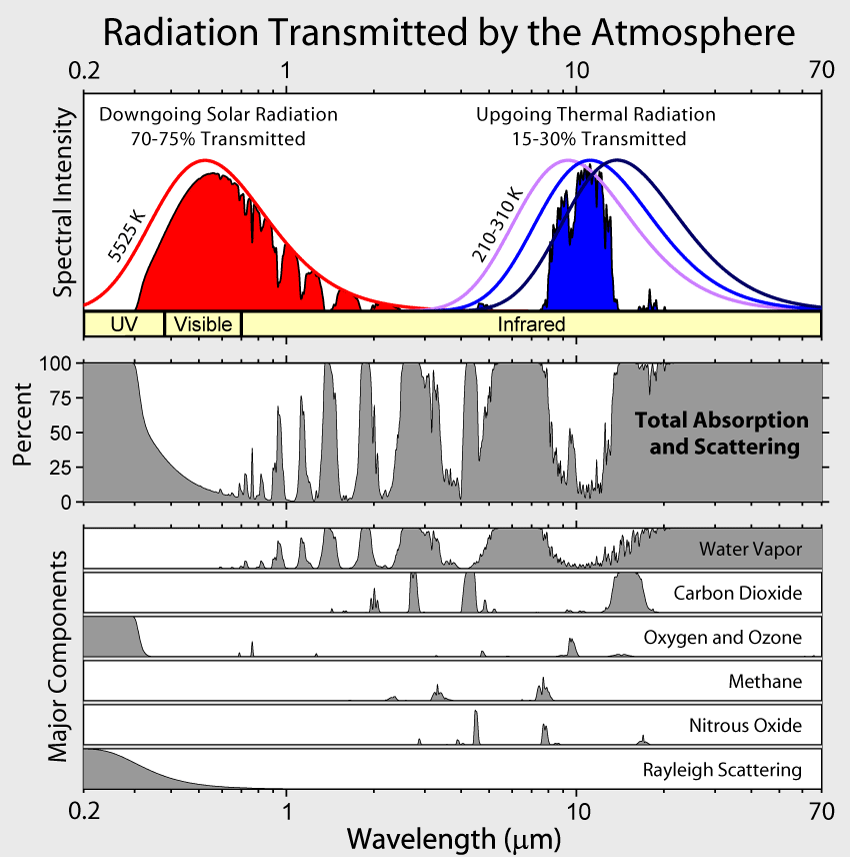
Absorption of gases – note narrow CO2 bands & broad water bands.

http://www.globalwarmingart.com/wiki/File:Atmospheric_Transmission_png

Source: Robert A. Rohde (Dragons flight at English Wikipedia) – This figure was created by Robert A. Rohde from published data and is part of the Global Warming Art project. http://www.atmo.arizona.edu/stud

This figure requires a bit of explaining. The top spectrum shows the wavelengths at which the atmosphere transmits light and heat as well as the “black body” idealized curves for no absorption. It is a little misleading because the data is not based on actual solar and earth data. It is based on two experimental heat sources, one centered at 5525 K (5252o C or 9485o F), the approximate temperature of solar radiation, and one centered in the range of 210 to 310 K (-63o C to 36.8o C or -82oF to 98o F), the approximate temperature range of re-radiated heat from the earth. In reality solar radiation power, (Watts/m2/micron), shown in red, is six million times as strong as the power of re-radiated heat from the earth, shown in blue.

The other spectra are absorption[1] spectra. The top one shows the relative percent absorption by total atmospheric gases at various wavelengths, (note that this spectrum is practically the inverse of the transmission spectrum above it), and the spectra below that show the absorption wavelength ranges of individual atmospheric gases, but not the relative strength of that absorption in reality. As experimental, not real atmospheric, data they can only tell us the wavelength ranges of the absorption, not their relative strengths.

Note that CO2 absorbs in the 15 micron range[2], which is within both the range of re-radiated heat and the strong absorption by water vapor of which the CO2 peak forms a mere shoulder. This is used to claim forcing of water vapor by CO2, without regard to the near-saturation level of CO2. Lesser CO2 peaks in the 2.7 and 4.3 micron ranges also only contribute in a minor way, the first is completely covered by a water vapor absorption peak and the second forms a shoulder in another water vapor peak. These minor peaks occur in a region where both solar radiation and re-radiation are minimized. Methane and nitrous oxide are also shown to be minor players, having narrow absorption ranges and low concentrations. Note too that ozone blocks most of the ultraviolet light from the sun.

b.) Water is by far the most important greenhouse gas/liquid in the form of vapor, high and low altitude clouds, rain and snow, which both absorb and reflect sunlight and re-radiated heat from the surface. Water vapor is not uniformly distributed in the atmosphere, being concentrated near the earth, but strongly absorbs heat in a wide range of wavelengths. More heat means more water vapor evaporating from the oceans. Sounds pretty scary, doesn’t it? Contrary to what is assumed by climate modelers, who use this to claim forcing by CO2, the extra vapor doesn’t remain as vapor. It quickly forms low altitude clouds that strongly reflect in-coming sunlight and heat into space. Any re-radiated heat from the surface that may be trapped by clouds is a small fraction compared to the in-coming solar radiation, so blocking solar radiance has a net cooling effect that overwhelms any increases in trapped re-radiation. High altitude clouds tend to trap heat from being re-radiated into space, but have little effect because the increases in cloud cover due to warming are mostly in low altitude clouds.

[1] Transmission and Absorption are inversely related by the formula A = 1/log T.

[2] The horizontal axis is a log scale in microns so that the 1 to 10 range is in units of 1 and the 10 to 70 range is in tens.

NOTE: Republished from July 22, 2015 Post (media link broken and here restored)


Want to know more about this and other Modern Myths including climate change, evolution, origin of life, Big Bang cosmology or quantum physics? See related posts on this website or buy the book Perverted Truth Exposed: How Progressive Philosophy Has Corrupted Science in print or as e-book/Kindle on line at WND Superstore (the publisher) or at Amazon, Books-a-Million or Barnes & Noble .

What about Climate Change?

CLIMATE CHANGE: PHILOSOPHY DISGUISED AS SCIENCE

For a current example of philosophy and/or politics disguised as science, we need look no further than the climate change debate. Regardless of the merits of the case for the Anthropogenic Global Warming or AGW theory that manmade carbon dioxide is the cause of climate change, the way it has been advocated is more akin to a political campaign than to a dispassionate search for truth. Political action is advocated that would drastically change our world, crippling industry and technological progress while leaving developing nations to flounder in their poverty. The two pronged approach of this philosophy is to curtail both technology and population.

Developed countries are said to hog all the resources at the expense of developing countries. People are said to be the problem, and advanced societies must be brought down to near subsistence levels while primitive societies are not raised from their squalor. But is any of this true? Is it science or is it politics? Unfortunately, it is more about politics, philosophy and belief than about science. Are there too many people, and are subsistent societies cleaner and less ecologically harmful? Are developed nations really hogging all of the resources at the expense of developing ones? The answer to each of these questions is NO.

Typical political tactics employed include:

  1. Appeal to authority, (a logical fallacy): the “consensus of scientists” with only a very small, elite group deemed qualified to understand or comment on it.

2.  Appeal to ignorance(a logical fallacy): It must be increasing CO2 (Carbon Dioxide) because we can’t find any other cause – but we aren’t looking very hard at things like wind and water cycles or solar activity.

3.  Depend on statistics and computer models instead of real historical facts and experimental data. Remember GIGO – Garbage In, Garbage Out. A model is only as good as the data used or left out, the type of mathematical calculations based on that data and assumptions and conclusions made.

4.  Use fear to sell the agenda: Use warnings of catastrophic consequences if action is not taken immediately by governments, industry and individuals based on models of a poorly understood atmospheric and planetary system. (The Con: “special today just for you but you must call within the next 30 minutes or you’ll miss out.” or “You can save the planet, so call your congressman today before it’s too late.”)

5.  Use guilt and shame to get people, governments and industries to “go green” and curtail the activities that use fossil fuels or otherwise emit CO2.

    1. Do you use incandescent light bulbs? Then you’re killing the planet because you’re consuming power from fossil fuel driven power plants. The government must phase out incandescent light bulbs in favor of LED or compact fluorescents, (which contain mercury, a primary pollutant); we must regulate power plants to insure maximum efficiency regardless of increased cost to the consumer, which hurts the poor most.
    2. Do you eat beef? You’re killing the planet because of methane from cows. The government must regulate the methane from cows.
    3. Do you Fly, drive or use a ferry or train?  You’re killing the planet because of fossil fuel consumption. The government must demand more efficient transportation – even if CAFE[1] standards demand lighter and less safe vehicles that are killing people.
    4. Do you use manmade fibers or plastics in any form? You’re killing the planet because it takes fossil fuels to produce them – never mind that most of these things get put in a landfill, which is a form of sequestering carbon. The government must regulate the industries that produce them – and the landfills, too.
    5. Do you use paper products? You’re killing the planet because trees that could consume CO2 are cut down to produce paper. Never mind that trees are farmed and harvested and new trees are planted to more than replace those used. Younger trees consume CO2 at a faster rate per ton than older trees.

6.  Use the press to promote their views and disparage the opposition in the form of propaganda. (TV, radio, internet, movies, books, magazine and journal articles, newspapers)

    1. Present a parade of “experts” and dire predictions as absolute settled facts, not as projections of a computer model.
    2. Sensationalize and exaggerate any “fact” that supports the global warming theme and downplay or fail to report on things that don’t.
    3. Declare that the polar bears are drowning because the sea ice is melting. Never mind that polar bears can swim up to 60 miles between feeding areas, that there is no net loss of sea ice over time and that polar bear numbers are increasing.
    4. Have a storm, flood or drought? Blame it on Climate Change. Make it sound biblical in proportions and the worst in history.
    5. Have a problem with mosquitos because of a particularly wet spring? It must be Global Warming.
    6. Are the seas rising at the same rate they have been rising for centuries[2]? Oh, my God, our cities will soon be underwater and we’re all going to drown!

7.  Demonize anyone who disagrees as “deniers” with the unspoken implication that they are on a moral level with holocaust deniers. Climate experts that aren’t on board with the whole global warming scenario and who have DATA to back it up are called “just weathermen” who are unqualified to comment, even though many of them have better credentials than many of the AGW proponents.

8.  Exclude from publication or grants, any research that doesn’t agree with their conclusions, and then declare that there are few peer reviewed papers on the other side. Never mind that government funding is overwhelmingly on one side. Journals such as Science and Nature have become advocates instead of unbiased scientific publications.

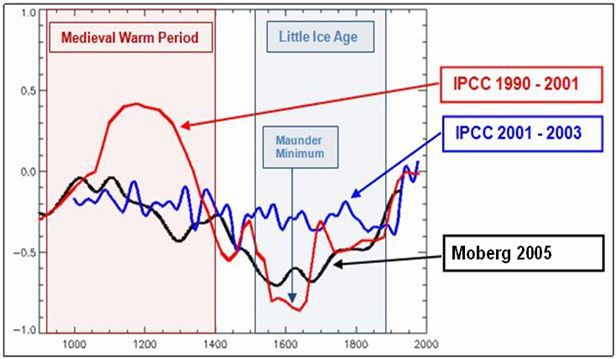
9.  Hide raw and analyzed data and analysis methods from other researchers who wish to verify the work. Real science always shares data and methods with other researchers so their results can be verified. This one includes the “massaging” of the data to say something it doesn’t. The Climate-gate scandal was all about hiding the data and massaging it to eliminate the Medieval Warm Period and the Little Ice Age and to create a “hockey stick” that was used to alarm governments into drastic control measures.   When other researchers finally got hold of the (massaged) data[3] and analysis methods, it was discovered that any random set of numbers, when plugged into the formula, produced a similar “hockey stick.” This showed that the analysis algorithm on which the computer models were based was worse than worthless.

Recorded temperature throughout history (red) vs. IPCC model (blue)

Comparison of graphs published by earlier and later versions of the IPCC Assessment on Climate Change. Note that the later graph eliminated both the Medieval Warm Period and the Little Ice Age.  Source: http://wattsupwiththat.com/2010/03/10/when-the-ipcc-disappeared-the-medieval-warm-period/  Note also that the vertical temperature scale is less than a degree above and below today’s temperature, which is set near zero on the graph.

  • The data for the line marked Moberg is available through NOAA website and is from “Highly variable Northern Hemisphere temperatures reconstructed from low- and high-resolution proxy data” Nature, Vol. 433, No. 7026, pp. 613 – 617, 10 February 2005. Anders Moberg1, Dmitry M. Sonechkin2, Karin Holmgren3, Nina M. Datsenko2 & Wibjörn Karlén3 1 Department of Meteorology, Stockholm University, SE-106 91 Stockholm, Sweden 2 Dynamical-Stochastical Laboratory, Hydrometeorological Research Centre of Russia, Bolshoy Predtechensky Lane 11/13, Moscow 123 242, Russia 3 Department of Physical Geography and Quaternary Geology, Stockholm University, SE-106 91 Stockholm, Sweden

10.  Ignore other factors that may contribute to or mediate the supposed effects of manmade carbon dioxide (such as water vapor, high and low altitude clouds, methane, increased plant growth, ocean sequestering or release, solar activity cycles, precession of earth’s tilt, Pacific Decadal Oscillation, etc.)

Manmade global warming or climate change as it has come to be called[4] is said to be an established fact, and the consequences are dire unless global governments act now to mitigate its effects. The polar ice caps and glaciers will melt away; the oceans will rise and drown coastal and island regions; droughts, floods, storms and temperatures will all increase and millions, dare I say billions, will die. But is any of it true, and is it science? The answer is NO. While there has been general warming since the “Little Ice Age” of the 17th and 18th centuries overlain with periods of lesser heating and cooling, is the change good or bad? Is it unusually rapid now and will these alleged trends continue into the future? Is it extreme enough to cause the dire effects predicted and should global governments act now to prevent the predicted disastrous consequences? It is important to know if these modeled projections are reliable predictions and if real, is real science involved in any meaningful way. What do we really know about it?

NOTE: IPCC temperature chart was reinserted 8/22/2020 due to broken original link.

[1] CAFE Standards are Corporate Average Fuel Economy Standards first mandated by Congress in 1975 during the energy crisis. These standards have been continually tightened for even greater fuel efficiency. The result is lighter, smaller, less protective and less safe cars that are contributing to highway crash deaths.

[2] Seas have been rising since the Little Ice Age in the 17th and 18th centuries at about 7 inches per century.

[3] Raw data was actually destroyed to prevent others from getting it through a Freedom on Information request.

[4] Recently there have been efforts to define it as climate disruption or climate catastrophe, implying that a tipping point is near