Claim 6. Temperatures are hotter now than they have been in the last 100,000 years
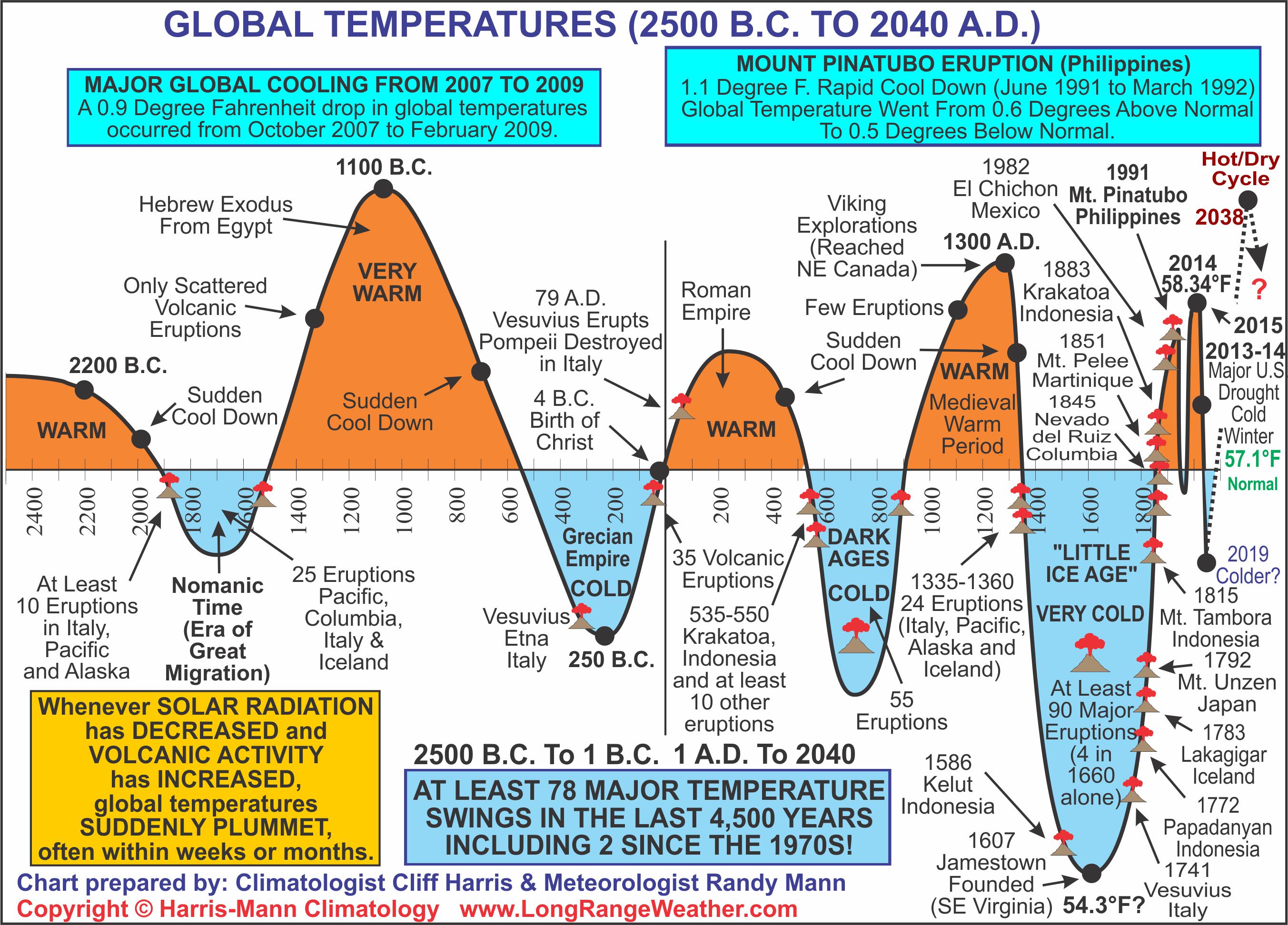
Truth: This is clearly an unsubstantiated myth meant to scare people into compliance with drastic environmental regulations. The climate modelers have eliminated the Medieval Warm Period, which was hotter than it is today, and it was a time of prosperity. It was hotter in the 1930s than it is today. However, the American “Dust Bowl” of the 1930s was not due to warming. It was caused by opening up vast areas to farming that were poorly suited to it and a years-long severe drought. Based on historical accounts, ice cores and tree rings, modelers have dismissed the Medieval Warm Period and the Little Ice Age by claiming that they were not global phenomena but were limited to Europe and North America. More recent and more detailed ice core studies, etc. have shown that both of these periods were indeed global. Over the last 100,000 years, temperatures have been far hotter and far colder than the present. Who can say what “normal” global temperature is when it is always changing? Should we attempt to freeze the present day conditions as the ideal, or should we take a more reasonable approach to an ever changing climate?
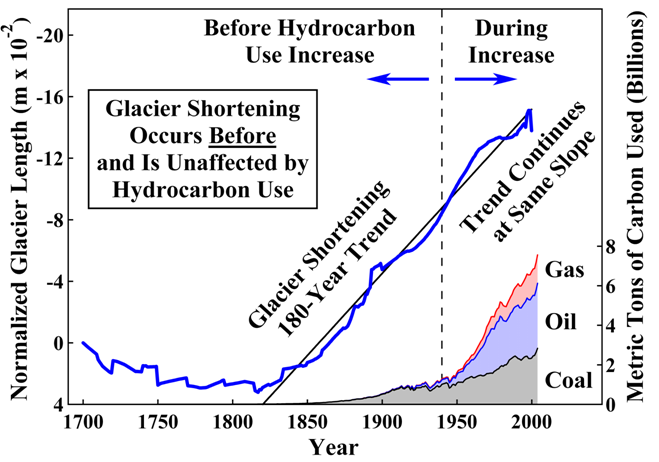
Increase in hydrocarbon use since 1950 does not change Glacier shortening rate since Little Ice Age (indicator of warming climate)
Claim 4. Manmade CO2 levels have been rising rapidly due to increased industrialization and populations since the 1950s.
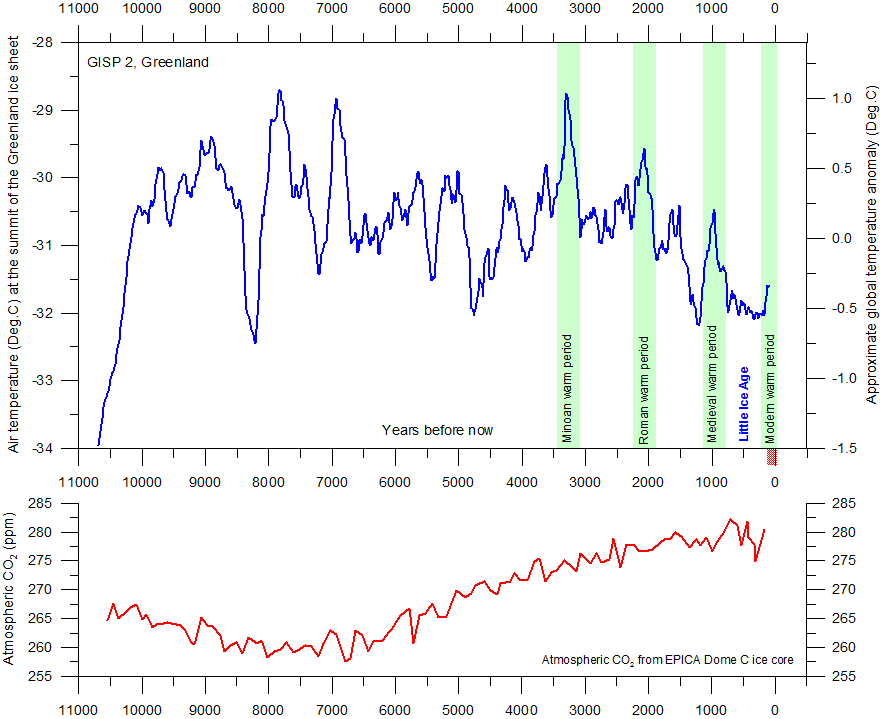
Truth: CO2 levels have been steadily rising along with warming since the Little Ice Age. Recent increases in industrialization and population appear to have contributed to the increase in atmospheric CO2 since the 1950s when fossil fuel consumption began increasing. Rising temperatures have also contributed to increased CO2 because it is less soluble in warmer ocean water and is thus released. it is unclear how much is from manmade sources and how much is from natural processes, but some estimate put it at 5%. However, if CO2 is not responsible for global warming, (see previous posts) increased levels shouldn’t alarm anyone and in fact increased CO2 should be celebrated as a plant growth promoter.
Eleven thousand year temperature and CO2 level record from ice cores
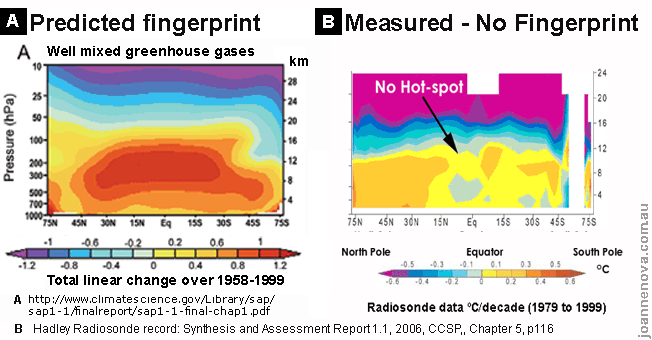
Predicted hot spot from water vapor forcing is missing
Claim 3. Carbon dioxide is important because it has a forcing effect on other factors such as water vapor which magnify warming effects.
Truth: Since the atmospheric absorption of CO2 is already near saturation, (see previous post), very little additional heating can take place due to increased CO2. Contrary to AGW advocates, increased water vapor from warming doesn’t stay as vapor to trap heat near the surface. It forms low altitude clouds that strongly reflect solar heat back out into space, overwhelming any trapped re-radiation from the Earth and having an overall cooling effect. The models, which assume water vapor remains as vapor, predict an atmospheric “hot spot” at middle altitudes. Weather balloons and satellites have failed to find this assumed hot spot, which is the signature of atmospheric forcing of global warming in computer models. Due to low altitude clouds reflecting sunlight back into space, any feedback is negative (cooling), not positive (warming) as assumed in computer models. For earlier posts, go to http:realscienceblog.com
AGW Claim 2. Manmade carbon dioxide (CO2) is the main cause of global warming
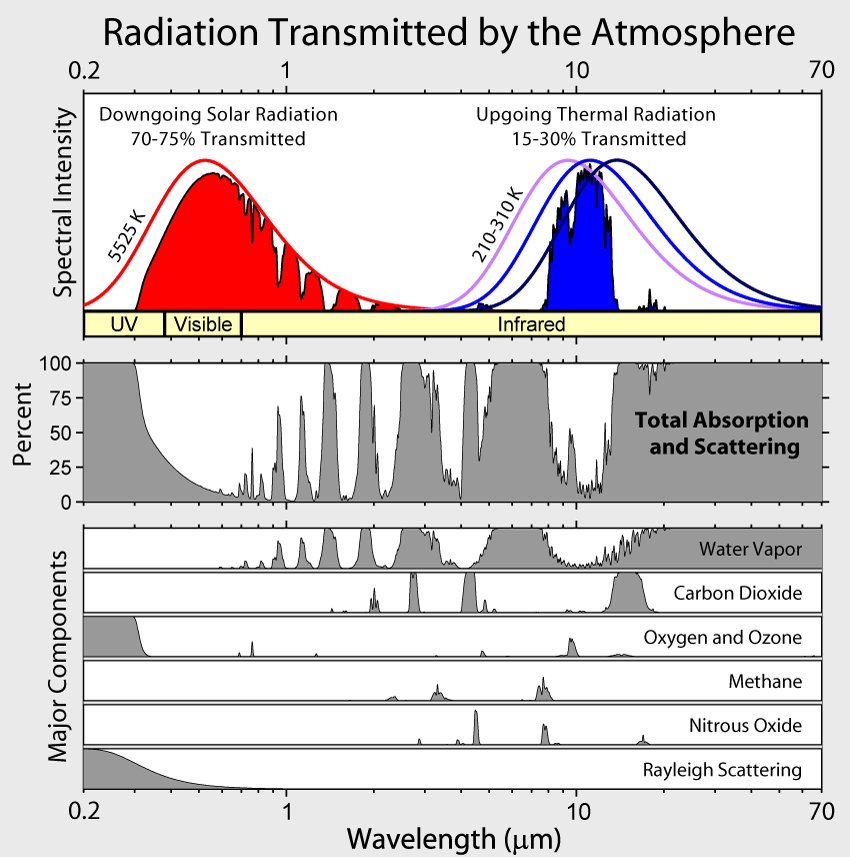
Truth: a.) Carbon dioxide is a minor player in any further warming. It is uniformly distributed in the atmosphere but only absorbs infrared (heat) in a very narrow wavelength range. The CO2 wavelength range is outside the range of most of the solar radiance that penetrates our atmosphere. It falls roughly inside the wavelength range of temperatures re-radiated when solar radiation heats the Earth’s surface.
The atmospheric CO2 already absorbs almost all of the radiation that it can in that wavelength range. Most of the warming effect of CO2 has already occurred in the past and is one of the reasons our planet is not a frozen wasteland. Any increase in CO2 will have a very minor effect. With CO2 absorption near saturation, almost all of the re-radiated heat in that wavelength range is already being trapped, so it can have little or no effect on future increases in temperature or supposed forcing of water vapor. (will be explained in claim 3 analysis in future posts.) With CO2 essentially eliminated as a source, any increase in temperature must be from other sources.
This figure above requires a bit of explaining. The top spectrum shows the wavelengths at which the atmosphere transmits light and heat as well as the blackbody idealized curves for no absorption. It is a little misleading because the data is not based on actual solar and earth data. It is based on two experimental heat sources, one centered at 5525 K (5252o C or 9485o F), the approximate temperature of solar radiation, and one centered in the range of 210 to 310 K (-63o C to 36.8o C or -82oF to 98o F), the approximate temperature range of re-radiated heat from the earth. In reality, solar radiation power, (Watts/m2/micron), is six million times as strong as the power of re-radiated heat from the Earth.
The other spectra are absorption[1] spectra. The first one shows the relative percent absorption by total atmospheric gases at various wavelengths, (note that this spectrum is practically the inverse of the transmission spectrum above it), and the spectra below that show the absorption wavelength ranges of individual atmospheric gases, (but not the relative strength of that absorption in reality). As experimental, not real atmospheric, data they can only tell us the wavelength ranges of the absorption, not their relative strengths in the atmosphere.
Note that CO2 absorbs in the 15 micron range[2], which is within both the range of re-radiated heat and the strong absorption by water vapor, of which the CO2 peak forms a mere shoulder. CO2, in the atmosphere is evenly distributed and is near-saturation level at this wavelength. That means that little if any re-radiated heat can escape through the blanket of CO2, which is why our earth is not a frozen wasteland. This also mean that adding more CO2 will have little effect on future temperatures. Lesser CO2 peaks in the 2.7 and 4.3 micron ranges only contribute in a minor way. The first is completely covered by a water vapor absorption peak and the second forms a shoulder in another water vapor peak. These minor peaks occur in a region where both solar radiation and re-radiation are minimized. Methane and nitrous oxide are also shown to be minor players, having narrow absorption ranges and are at low concentrations in the atmosphere. Note too that ozone blocks most of the ultraviolet light from the sun.
b.) Water is by far the most important greenhouse gas/liquid in the form of vapor, high and low altitude clouds, rain and snow, which both absorb and reflect in-coming sunlight and re-radiated heat from the surface. Water vapor is not uniformly distributed in the atmosphere, being concentrated near the earth, it strongly absorbs heat in a wide range of wavelengths. More heat means more water vapor evaporating from the oceans. Sounds pretty scary, doesn’t it? Contrary to what is assumed by climate modelers, who use this to claim forcing by CO2, the extra vapor doesn’t remain as vapor. It quickly forms low altitude clouds that strongly reflect in-coming sunlight and heat into space. Any re-radiated heat from the surface that may be trapped by clouds is a small fraction compared to the in-coming solar radiation, so blocking solar radiation has a net cooling effect that overwhelms any increases in trapped re-radiation. High altitude clouds tend to trap heat from being re-radiated into space, but have little effect because the increases in cloud cover due to warming are mostly in low altitude clouds.
c.) Methane, like CO2, only absorbs heat in narrow wavelength ranges far from most of solar heat radiance, so that water, with its broad absorbance spectrum, trumps all other greenhouse gases. Like CO2, methane is at or near its absorbance saturation point in the atmosphere so that increases would have little effect. While it is true that continued warming could result in release of methane from melting permafrost, it would have a relatively minor effect on global temperatures. Methane is derived mostly from decaying organic material and from natural seeps on the land and under the sea, as well as termites and ruminant flatulence. Methane absorbs 29 times as much heat per volume as carbon dioxide but at 1.8 ppbv[3], (.00000018 percent), compared to CO2 at 380 ppmv[4], (0.038 percent), it is recognized as a minor player in greenhouse warming along with Ozone (O3) and Nitrous Oxide (N2O).
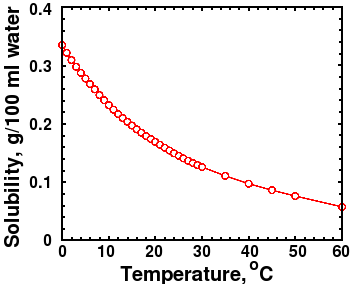
CO2 Solubility in Water vs Temperature
d.) Manmade carbon dioxide is estimated to be about 5 percent (1/20th) of the total CO2 emitted. Animals and man are relatively minor contributors. Decaying organic matter is the major source, followed by volcanic activity and release from warmer oceans. Warmer water releases more CO2 than cooler water due to decreased solubility of CO2 with rising temperature. Many studies show that atmospheric CO2 concentration rises AFTER warming, not before. So which is the cause and which is the effect?
See next post for the beneficial effects of CO2 on plant life.
[1] Transmission and Absorption are inversely related by the formula A = 1/log T.
[2] The horizontal axis is a log scale in microns so that the 1 to 10 range is in units of 1 and the 10 to 70 range is in tens.
Global Temperatures 2500 BC to 2040 AD (projected) Note: Temperature range is less than plus or minus 2.5oF (1.4oC) from present.
Part 2 of answers to AGW Claim 1. “Global warming and/or climate change are established facts.” See “Anthropogenic Global Warming vs. Truth – Part 1” blog post for Part 1.
Quote: “Since 1895, the media has alternated between global cooling and warming scares during four separate and sometimes overlapping time periods. From 1895 until the 1930’s the media peddled a coming ice age. From the late 1920’s until the 1960’s they warned of global warming. From the 1950’s until the 1970’s they warned us again of a coming ice age. This makes modern global warming the fourth estate’s fourth attempt to promote opposing climate change fears during the last 100 years.”
— Senator James Inhofe, Monday, September 25, 2006
1872 John Tyndall measured the heat absorption of various atmospheric gases over the entire wavelength range of his heat source. He found that water vapor and CO2 absorbed more strongly than other atmospheric gases such as oxygen and nitrogen. Oxygen and nitrogen, major components of the atmosphere, had little or no absorption of heat in the range tested. It is important to note that his experiments did not separate the heat into specific wavelengths. See Claim 2 and its chart in the next blog post.
Quote: “…if, as the above experiments indicated, the chief influence be exercised by the aqueous vapour, every variation of this constituent must produce a change of climate. Similar remarks would apply to the carbonic acid [CO2] diffused through the air… they constitute true causes, the extent alone of the operation remaining doubtful.”
— John Tyndall, Contributions to Molecular Physics in the Domain of Radiant Heat, 1872
1895, February, The New York Times: “Geologists Think the World May Be Frozen Up Again”
1899, Nils Eckholm claims that burning coal will double CO2 and cause climate change. Eckholm and Svante Arrhenius claim that it will prevent a predicted coming Ice Age. From Historical Perspectives on Climate Change by James Rodger Fleming, 1998, Oxford University Press.
1902, Los Angeles Times: “Disappearing Glaciers … persistency that means their final annihilation …”
1912, October, The New York Times: “Prof. Schmidt Warns Us of an Encroaching Ice Age”
1923, Chicago Sun-Times: “Scientist says Arctic ice will wipe out Canada”
1923, The Washington Post: “The discoveries of changes in the sun’s heat and southward advance of glaciers … possible advent of a new ice age.”
1924, September, The New York Times: “MacMillan Reports Signs of New Ice Age”
1929, Los Angeles Times: “Is another ice age coming?” “Most geologists think the world is growing warmer, and that it will continue to get warmer.”
1932, The Atlantic magazine, “This Cold, Cold World”
1933, March, The New York Times, “America in Longest Warm Spell Since 1776; Temperature Line Records a 25-Year Rise.”
1933, National Weather Bureau Monthly Weather Review: “…wide-spread and persistent tendency toward warmer weather … Is our climate changing?”
1938, Royal Meteorological Society Quarterly Journal: (Global warming, caused by man heating the planet with carbon dioxide) “is likely to prove beneficial to mankind …”
1938, Chicago Tribune, “Experts puzzle over 20 year mercury rise … mysterious trend toward warmer climate in the last two decades.”
1939, The Washington Post: “… weather men have no doubt that the world at least for the time being is growing warmer.”
1952, August, The New York Times: “… the world has been getting warmer in the last half century.”
1954, U.S. News and World Report: “… winters are getting milder, summers drier. Glaciers are receding, deserts growing.”
1954. Fortune magazine: “Climate – the Heat May Be Off”
1955, Gilbert Plass predicts 3.6o C (6.8o F) warming if CO2 is doubled.
Quote: “ … average surface temperature of the earth increases 3.6o C if the CO2 concentration in the atmosphere is doubled …” (this is the false assumption on which many computer models rest)
Quote: “The extra CO2, released into the atmosphere by industrial processes and other human activities may have caused the temperature rise during the present century. In contrast with other theories of climate, the CO2 theory predicts that this warming trend will continue, at least for several centuries.”
—Gilbert Plass, 1956, “The Carbon Dioxide Theory of Climatic Change.” [1]
1956, October 28, The New York Times: “Warmer Climate on Earth May Be Due To More Carbon Dioxide in the Air,” by Waldemar Kaempffert in The New York Times “Science in Review”
1959, The New York Times: “Arctic Findings in Particular Support Theory of Rising Global Temperatures”
1969, February, The New York Times: “… the Arctic pack ice is thinning and that the ocean at the North Pole may become open sea within a decade or two.”
1970, The Washington Post: “… get a good grip on your long johns, cold weather haters – the worst may be yet to come … there’s no relief in sight.”
1974, Time magazine: “Global cooling for the past forty years”
1974, The Washington Post: “… weather aberrations they are studying may be the harbinger of another ice age.”
1974, Fortune magazine: “As for the present cooling trend a number of leading climatologists have concluded that it is very bad news indeed.”
1974, The New York Times: “… the facts of the present climate change are such that the most optimistic experts would assign near certainty to major crop failure … mass deaths by starvation, and probably anarchy and violence.” (emphasis added)
1975, The New York Times: “Scientists Ponder Why World’s Climate is Changing; A Major Cooling Widely Considered to Be Inevitable”
1975, Nigel Calder, editor of New Scientist in International Wildlife Magazine: “The threat of a new ice age must now stand alongside nuclear war as a likely source of wholesale death and misery for mankind” (emphasis added)
1976, U.S. News and World Report: “Even US farms may be hit by cooling trend”
1981, The New York Times: (Global Warming) “… of an almost unprecedented magnitude”
1988, James Hansen, Goddard Institute for Space Studies, testifies before Congress that global warming is a fact and that consequences of doing nothing will be dire.
IPCC, Intergovernmental Panel on Climate Change, was established by the United Nations in that year with the mission to find a connection between human activity and climate change. (emphasis added)
After that, the media blitz of articles supporting the belief in global warming or climate change are too numerous to list in detail here.
Quote: “The 1995 IPCC draft report said, ‘Any claims of positive detection of significant climate change are likely to remain controversial until uncertainties in the total natural variability of the climate system are reduced.’ It also said, ‘No study to date has positively attributed all or part of observed climate changes to anthropogenic causes.’ Those statements were removed, and in their place appeared: ‘The balance of evidence suggests a discernable human influence on climate.'” (emphasis added)
— “Aliens Cause Global Warming,” Caltech Michelin Lecture, Michael Crichton, 1/17/2003
Quote:“I readily confess a lingering frustration: uncertainties so infuse the issue of climate change that it is still impossible to rule out either mild or catastrophic outcomes, let alone provide confident probabilities for all the claims and counterclaims made about environmental problems. Even the most credible international assessment body, the Intergovernmental Panel on Climate Change (IPCC), has refused to attempt subjective probabilistic estimates of future temperatures. This has forced politicians to make their own guesses about the likelihood of various degrees of global warming.” (emphasis added)
— Stephen Schneider, (warmist camp), former Professor of Environmental Biology and Global Change at Stanford University, in “Global Warming: Neglecting the Complexities,” Scientific American, January 2002, an article requested by the publisher to critique Bjorn Borg’s book The Skeptical Environmentalist
Quote: “On the one hand, as scientists we are ethically bound to the scientific method, in effect promising to tell the truth, the whole truth, and nothing but — which means that we must include all the doubts, the caveats, the ifs, ands, and buts. On the other hand, we are not just scientists but human beings as well. And like most people we’d like to see the world a better place, which in this context translates into our working to reduce the risk of potentially disastrous climatic change.
To do that we need to get some broadbased support, to capture the public’s imagination. That, of course, entails getting loads of media coverage. So we have to offer up scary scenarios, make simplified, dramatic statements, and make little mention of any doubts we might have. This ‘double ethical bind’ we frequently find ourselves in cannot be solved by any formula. Each of us has to decide what the right balance is between being effective and being honest. I hope that means being both.” (emphasis added. Note that the excuse for dishonesty is based on an unsubstantiated assumption that doing so will result in a better world.)
— Stephen Schneider, (warmist camp), former Professor of Environmental Biology and Global Change at Stanford University, in Discover, 1989
[1] Plass, G. N. (1956), “The Carbon Dioxide Theory of Climatic Change.” Johns Hopkins University Press, Tellus, 8: 140–154. doi: 10.1111/j.2153-3490.1956.tb01206.x
For a current example of philosophy and/or politics disguised as science, we need look no further than the climate change debate. Regardless of the merits of the case for the Anthropogenic Global Warming or AGW theory that manmade carbon dioxide is the cause of climate change, the way it has been advocated is more akin to a political campaign than to a dispassionate search for truth. Political action is advocated that would drastically change our world, crippling industry and technological progress while leaving developing nations to flounder in their poverty. The two pronged approach of this philosophy is to curtail both technology and population.
Developed countries are said to hog all the resources at the expense of developing countries. People are said to be the problem, and advanced societies must be brought down to near subsistence levels while primitive societies are not raised from their squalor. But is any of this true? Is it science or is it politics? Unfortunately, it is more about politics, philosophy and belief than about science. Are there too many people, and are subsistent societies cleaner and less ecologically harmful? Are developed nations really hogging all of the resources at the expense of developing ones? The answer to each of these questions is NO.
Typical political tactics employed include:
Appeal to authority, (a logical fallacy): the “consensus of scientists” with only a very small, elite group deemed qualified to understand or comment on it.
2. Appeal to ignorance(a logical fallacy): It must be increasing CO2 (Carbon Dioxide) because we can’t find any other cause – but we aren’t looking very hard at things like wind and water cycles or solar activity.
3. Depend on statistics and computer models instead of real historical facts and experimental data. Remember GIGO – Garbage In, Garbage Out. A model is only as good as the data used or left out, the type of mathematical calculations based on that data and assumptions and conclusions made.
4. Use fear to sell the agenda: Use warnings of catastrophic consequences if action is not taken immediately by governments, industry and individuals based on models of a poorly understood atmospheric and planetary system. (The Con: “special today just for you but you must call within the next 30 minutes or you’ll miss out.” or “You can save the planet, so call your congressman today before it’s too late.”)
5. Use guilt and shame to get people, governments and industries to “go green” and curtail the activities that use fossil fuels or otherwise emit CO2.
Do you use incandescent light bulbs? Then you’re killing the planet because you’re consuming power from fossil fuel driven power plants. The government must phase out incandescent light bulbs in favor of LED or compact fluorescents, (which contain mercury, a primary pollutant); we must regulate power plants to insure maximum efficiency regardless of increased cost to the consumer, which hurts the poor most.
Do you eat beef? You’re killing the planet because of methane from cows. The government must regulate the methane from cows.
Do you Fly, drive or use a ferry or train? You’re killing the planet because of fossil fuel consumption. The government must demand more efficient transportation – even if CAFE[1] standards demand lighter and less safe vehicles that are killing people.
Do you use manmade fibers or plastics in any form? You’re killing the planet because it takes fossil fuels to produce them – never mind that most of these things get put in a landfill, which is a form of sequestering carbon. The government must regulate the industries that produce them – and the landfills, too.
Do you use paper products? You’re killing the planet because trees that could consume CO2 are cut down to produce paper. Never mind that trees are farmed and harvested and new trees are planted to more than replace those used. Younger trees consume CO2 at a faster rate per ton than older trees.
6. Use the press to promote their views and disparage the opposition in the form of propaganda. (TV, radio, internet, movies, books, magazine and journal articles, newspapers)
Present a parade of “experts” and dire predictions as absolute settled facts, not as projections of a computer model.
Sensationalize and exaggerate any “fact” that supports the global warming theme and downplay or fail to report on things that don’t.
Declare that the polar bears are drowning because the sea ice is melting. Never mind that polar bears can swim up to 60 miles between feeding areas, that there is no net loss of sea ice over time and that polar bear numbers are increasing.
Have a storm, flood or drought? Blame it on Climate Change. Make it sound biblical in proportions and the worst in history.
Have a problem with mosquitos because of a particularly wet spring? It must be Global Warming.
Are the seas rising at the same rate they have been rising for centuries[2]? Oh, my God, our cities will soon be underwater and we’re all going to drown!
7. Demonize anyone who disagrees as “deniers” with the unspoken implication that they are on a moral level with holocaust deniers. Climate experts that aren’t on board with the whole global warming scenario and who have DATA to back it up are called “just weathermen” who are unqualified to comment, even though many of them have better credentials than many of the AGW proponents.
8. Exclude from publication or grants, any research that doesn’t agree with their conclusions, and then declare that there are few peer reviewed papers on the other side. Never mind that government funding is overwhelmingly on one side. Journals such as Science and Nature have become advocates instead of unbiased scientific publications.
9. Hide raw and analyzed data and analysis methods from other researchers who wish to verify the work. Real science always shares data and methods with other researchers so their results can be verified. This one includes the “massaging” of the data to say something it doesn’t. The Climate-gate scandal was all about hiding the data and massaging it to eliminate the Medieval Warm Period and the Little Ice Age and to create a “hockey stick” that was used to alarm governments into drastic control measures. When other researchers finally got hold of the (massaged) data[3] and analysis methods, it was discovered that any random set of numbers, when plugged into the formula, produced a similar “hockey stick.” This showed that the analysis algorithm on which the computer models were based was worse than worthless.
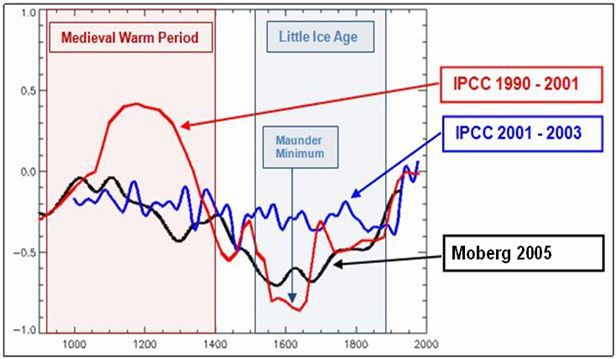
Recorded temperature throughout history (red) vs. IPCC model (blue)
Comparison of graphs published by earlier and later versions of the IPCC Assessment on Climate Change. Note that the later graph eliminated both the Medieval Warm Period and the Little Ice Age. Source: http://wattsupwiththat.com/2010/03/10/when-the-ipcc-disappeared-the-medieval-warm-period/ Note also that the vertical temperature scale is less than a degree above and below today’s temperature, which is set near zero on the graph.
The data for the line marked Moberg is available through NOAA website and is from “Highly variable Northern Hemisphere temperatures reconstructed from low- and high-resolution proxy data” Nature, Vol. 433, No. 7026, pp. 613 – 617, 10 February 2005. Anders Moberg1, Dmitry M. Sonechkin2, Karin Holmgren3, Nina M. Datsenko2 & Wibjörn Karlén31 Department of Meteorology, Stockholm University, SE-106 91 Stockholm, Sweden 2 Dynamical-Stochastical Laboratory, Hydrometeorological Research Centre of Russia, Bolshoy Predtechensky Lane 11/13, Moscow 123 242, Russia 3 Department of Physical Geography and Quaternary Geology, Stockholm University, SE-106 91 Stockholm, Sweden
10. Ignore other factors that may contribute to or mediate the supposed effects of manmade carbon dioxide (such as water vapor, high and low altitude clouds, methane, increased plant growth, ocean sequestering or release, solar activity cycles, precession of earth’s tilt, Pacific Decadal Oscillation, etc.)
Manmade global warming or climate change as it has come to be called[4] is said to be an established fact, and the consequences are dire unless global governments act now to mitigate its effects. The polar ice caps and glaciers will melt away; the oceans will rise and drown coastal and island regions; droughts, floods, storms and temperatures will all increase and millions, dare I say billions, will die. But is any of it true, and is it science? The answer is NO. While there has been general warming since the “Little Ice Age” of the 17th and 18th centuries overlain with periods of lesser heating and cooling, is the change good or bad? Is it unusually rapid now and will these alleged trends continue into the future? Is it extreme enough to cause the dire effects predicted and should global governments act now to prevent the predicted disastrous consequences? It is important to know if these modeled projections are reliable predictions and if real, is real science involved in any meaningful way. What do we really know about it?
NOTE: IPCC temperature chart was reinserted 8/22/2020 due to broken original link.
[1] CAFE Standards are Corporate Average Fuel Economy Standards first mandated by Congress in 1975 during the energy crisis. These standards have been continually tightened for even greater fuel efficiency. The result is lighter, smaller, less protective and less safe cars that are contributing to highway crash deaths.
[2] Seas have been rising since the Little Ice Age in the 17th and 18th centuries at about 7 inches per century.
[3] Raw data was actually destroyed to prevent others from getting it through a Freedom on Information request.
[4] Recently there have been efforts to define it as climate disruption or climate catastrophe, implying that a tipping point is near

 Science is distorted by progressive philosophy