Dreaming of Carbon Free Living?

To the Student who is dreaming of a Carbon free life

  • First, sell your car, bicycle or other means of transportation – they were made using carbon based fuels, cars use fossil fuels and even crude handmade carts drawn by animals use and emit carbon (fodder – excrement & CO2). Even electric cars were made with carbon based fuels and use electricity from fossil fueled power plants.
  • Never buy or use solar panels or wind generators – they were produced using carbon based fuels and require fossil fueled power plants as back-up when sun and wind are absent.
  • Sell your house or give up your apartment – it was made by using carbon based fuels, uses fossil fuels to heat and cool, whether with carbon based electricity or directly from oil, gas, coal, wood. Never shelter from weather or use any heat in cold weather.
  • Sell your household goods – Chairs, tables, beds, sheets, towels, etc. – all were made using fossil fuels.
  • Sell your appliances and electronic gadgets – they were made using carbon based fuels and get their electricity from fossil fueled power plants.
  • Never drink purified water from a water system – pumps and purification all run on and were made using fossil fuels. Drink only “natural” water from streams, complete with parasites, bacteria and viruses.
  • Never buy or use any paper, plastic, cloth, wood, metal or glass products, including books and paper money, pens, pencils, dishes, pans, etc. –all are produced by using fossil fuels.
  • Never use any cleaning products, soap, cosmetics or shaving or hair care materials or implements – they were all made from and with carbon based fuels.
  • Remove and give away all of your clothes and shoes – they were made using fossil fuels, use water, detergents and electricity for cleaning and ironing.
  • Don’t buy food from stores – it was transported, processed and kept fresh using fossil fuels.
  • Never cook your food – it takes heat ultimately produced by carbon based fuels.
  • Stop eating – you are using carbon based foods and excrete carbon pollutants.
  • Stop breathing – you are emitting CO2.
  • Your short, miserable life is now over and your dead body is now polluting the planet.


AGW Claims vs. Truth – 5. Developed countries are to blame for increased manmade carbon dioxide because they use most of the fossil fuels.

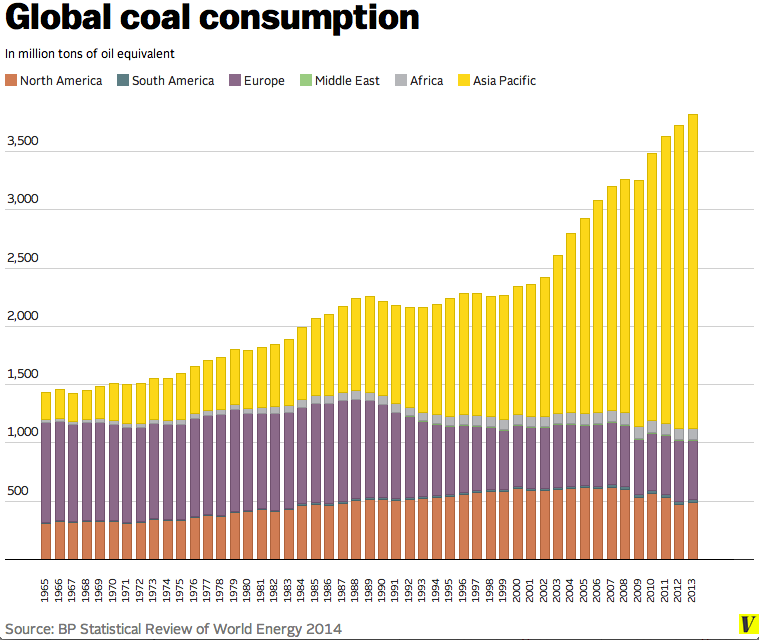
Global coal consumption

Truth: This is partially true. Industrialization is steadily increasing in developed and developing countries such as China and India. While developed countries are putting restrictions on themselves, international agreements exempt developing countries from such restrictions. These increases more than offset any gains from restrictions on developed countries.  However, see previous post AGW Claims vs. Truth – 2 & 2b for why we shouldn’t worry about increased CO2

In addition to industrialization, increased cooking fires and subsistence agriculture to feed an increasing population are also significant contributing factors. CO2 is CO2. There is no escape clause for renewable sources. It doesn’t matter whether it is from fossil fuels or burning dung or wood. Increased population in developing countries means more slash and burn agriculture and more cooking and heating by burning organic material. The modelers assume that renewable sources are exempt as causes because it is a renewable source. This is faulty thinking. Slash and burn agriculture of one acre releases a tenth of the carbon dioxide as ten acres. Subsistence agriculture is harmful to the environment because it results in depletion of soils so that it is necessary to clear more forest lands.

Subsistence farming requires burning to release the nitrogen for crops. Modern agriculture releases far less carbon dioxide than subsistence farming, so keeping people in poverty makes no sense unless your aim is to control or reduce the population in developing countries. It would be better if we helped developing countries develop modern agriculture and industry so they can clean up their act. When people are worried about how to feed their families, there is little time or incentive to do anything about pollution or the environment. In many underdeveloped countries the tradition of having as many children as possible is mostly due to the high rate of mortality in infancy and childhood from unchecked diseases, poor diet, indoor air pollution and poverty. Without the incentive of high infant and childhood mortality, family size and populations could naturally stabilize.

World Life Expectancy Map
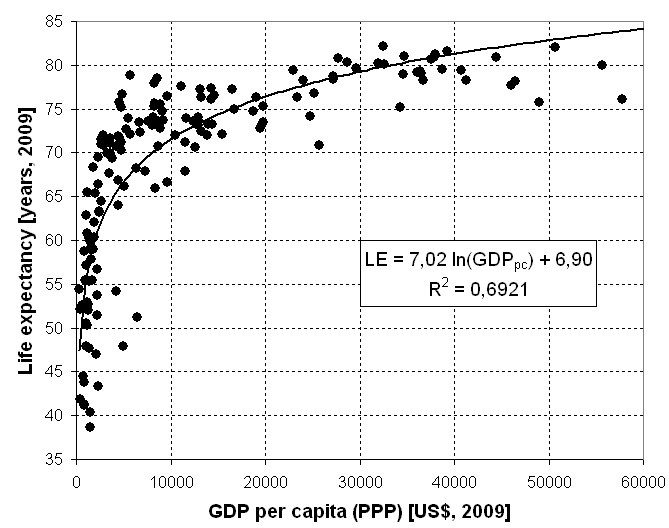
World Life Expectancy Map which tracks well with Poverty Rates
LifeExpectancy_GDPperCapita - wiki
Life Expectancy vs. GDP per capita, 2009, World Bank


The Necessity of God

Philosophically there are only three reasons for existence or action: necessity, chance and design.

Everything in the physical realm has a beginning, an end and a cause.  Nothing physical is permanent.  Everything changes as a result of causes and are thus contingent on preceding events.  If everything has a cause, then an endless series of causes into the past is the result.  Of necessity, there must have been a beginning of the series of causes and effects.  But what started the series?  If everything in the physical universe has a cause, then something outside of the physical universe, by necessity, must have started the series of causes.  Why is there something instead of nothing?  Why does anything exist?  It must have been caused by something.  God or The Creator, by whatever name you wish to use, is the necessary first cause, the uncaused cause and everything else is contingent on it.   Therefore God is a necessary being that is eternal, having no cause, no beginning, and no end.

Since something outside the physical universe necessarily started the series of cause and effect, it also voids the assumption of the materialists that the physical universe is all there is; that the non-physical or spiritual only exists in our imagination. Of necessity, there must be a spiritual realm because, of necessity, something outside the physical must have started the series of causes.  This is a very old, but very valid argument for the necessary existence of God.  Atheists and materialists will dismiss it as “old news” but it is as valid today as it was when St. Thomas Aquinas included it in his Summa Theologica as one of the proofs of God.

If God started the whole thing, including existence, was it a singular act of creation which was then left to develop by itself without guidance? It can be argued that the present form of the universe is a matter of chance and only LOOKS designed.  It can also be argued that life came about by chance through some undefined “Life Principle” and only LOOKS designed.  Neither of these chance occurrences holds up to scientific or statistical scrutiny.  The physical universe is so finely tuned that if any of the fundamental forces or particles were changed by an infinitesimal amount, then stable galaxies, stars, planets and life would not have formed.

Life is a particularly complex and fine-tuned process and we are only just beginning to explore the workings of living creatures. For example, the probability of assembling one specific protein chain of 200 readily available amino acid units, from the 20 left-handed amino acids used in living systems is 1 in 20200.  To be plausible, the number of attempts must be in the ballpark of the odds.  If the universe is 13.7 billion years old, there have been 4.32 x 10¹⁷ seconds since it began. We would need to make 231.4 x 10180 attempts each second since the beginning of the universe to make the random assembly of even this one specific protein plausible.

If we assume that life molecules were assembled on Earth, which is thought to be only 4.5 billion years old, and evidence of life was present 3.8 billion years ago, then the number of attempts per second rises to even more impossible levels. And that is just for one protein enzyme assembled from readily available units, excluding interfering molecules, and under the ideal conditions for assembly and preservation. Already we are seeing the extreme odds against a specific enzyme being produced. If we look at what it would take to produce by chance the thousands of different specific enzymes necessary for metabolism, the probability of random assembly of the correct mix would be (20200)3000 for a simple bacterium with 3,000 enzymes, or 1 in 10780,000; that’s a 1 with 780,000 zeros after it. The terms impossible and miracle come to mind.

If chance is so improbable, then design or intent is a more plausible explanation for life and, indeed, the universe. The argument for intelligent design is that of impossibly high odds against the specified complexity we find.  A design necessarily implies a designer.  Not just any enzyme would perform the metabolic functions of even the simplest living being.  It must be a specific mix of specific enzymes with specific functions. That does not even address the formation of a living being, which is many orders of magnitude more complex than the formation of simple enzymes or structural proteins or DNA.

Conclusions:

  1. God necessarily exists.
  2. The spiritual realm really exists.
  3. God has remained involved in the universe.

Some Logical Fallacies

Logical Fallacy Definition:  A statement that appears to be logical but does not meet the requirements of valid logical arguments or induction.

SOME Logical Fallacies

Appeal to Authority – (Argument from Authority)  If an authority, leader or expert says it is true, it must be true.  That all depends on the authority, his knowledge of the subject, his agenda and his belief system.  This argument goes: if Einstein or (fill in the blank) said it, then it must be true.  Another form of this is the consensus of experts.   Yes, a whole cadre of experts can be wrong if the framework (or paradigm) in which they believe is false or incomplete.  Also, remember that being an expert in one field of science or being accomplished in any field does not qualify for expert status in another, sometimes related, field.   We are all ignorant in more areas than those in which we are well versed.  I wouldn’t want a physicist or engineer performing surgery on me, even if he is world renowned.  Likewise, I wouldn’t want a surgeon to build a bridge.  What makes a celebrity (or scientist or politician) more qualified than others to comment on issues of the day unless they are also experts in that field?  Nothing.

Even experts can be wrong and their theories should never be sacrosanct against criticism or question.  Could Einstein be wrong? Of course.  Experts are not infallible, and treating them that way leads us back to protecting the status quo and COWDUNG[1].   One example from my past is a professor of zoology who insisted that holes found in pastures surrounding the college were due to pocket gophers.  He had spent years studying them in the southwestern United States, so he could be considered an expert on pocket gophers.  The college was in Virginia, well outside their range.  The holes were due to ground hogs (wood chucks) which are common in the area.   If you are a hammer, everything looks like a nail.

Appeal to Ignorance – (or argument from ignorance) This argument says that if a theory has not been proven wrong, it must be true.  On the other hand, it can be argued that if the theory has not been proven true, it must be false.  Or yet, if there is a lack of evidence for one theory, then another theory is assumed to be true.  This is also called an Argument by Lack of Imagination.  It can be applied to the arguments for macro-evolution[2].  In the sense that, because no one has come up with a different theory, which excludes God as a cause, then Darwin’s theory must be true.  While there could be some validity in it, this is a specious[3] argument.  Absence of another explanation does not make the current one true.  The theory must rest on the evidence, not on an absence of an alternative theory or evidence to the contrary.

Argument from Silence – (argumentum ex silentio)  Similar to Appeal to Ignorance; absence of evidence to the contrary or a different theory is deemed to validate the argument.  Absence of evidence is not evidence of absence.

Argument from Personal Incredulity A theory is thought to be proven untrue because someone finds it personally offensive, unlikely or unbelievable, and consequently a preferred alternative is thought to be proven true.  Also known as Argument from Personal Belief or Argument from Personal Conviction.

Appeal to the Majority  – Consensus as proof.  A commonly held belief must be true.  Consensus is an alien concept to science because it is based on opinion, assumption or belief not fact.  Those advocating man-made global warming use this one profusely.  They say the argument is over; it is a proven fact based on a supposed majority of scientists.  Never mind that many of those included in the “consensus” know next to nothing about that field of study and many competent scientists in the field disagree or have doubts.  Truth is never determined by committee vote or marketing or propaganda.


“In questions of science the authority of a thousand is not worth the humble reasoning of a single individual.”                                                                         —- Galileo


Appeal to Emotion – Replacing rational arguments with emotional appeals.  Propaganda is often laced with emotionally charged statements.  Hitler was a master of this one.

False cause or non sequitur[4] – Incorrectly assumes that one thing is the cause or explanation of another; an argument where the conclusion does not connect well with the premise.  Big trucks do not beget little trucks, although big (adult) animals beget little (infant) animals.  City buses do not necessarily cause a reduction in the number of cars, especially when many buses are nearly empty or are scheduled poorly.

Irrelevant Conclusion  – An argument for one conclusion really proves a different one. For example, arguments against Intelligent Design as not being science, but this argument can also be applied to Evolution itself.

Amphiboly – A sentence that can be interpreted in more than one way.  Example: The statement, “He only said that.” could mean “only he” or “only said” or “only that.”  Was he the only one saying it? Does it mean that he only said he would do it and that he didn’t actually do it? Does it mean he said only that and not the other statements attributed to him?  As you can see, what is being modified by “only” makes a lot of difference.

Equivocation – Using the same term to mean two or more different things.  Changing what is meant in mid-argument.  This is commonly used in evolution’s defense where micro and macro-evolution are used interchangeably to defend the theory.  Well documented variability within species is used in a confusing way to imply the ability of species to change into other species.

Changing the subject  – Arguing for one thing to prove another.  This is another favorite tool in evolution’s defense.  Example: Using changes within a species as “proof” of evolution into an entirely different creature.  See equivocation above.

Red Herring – inserting another unrelated factor intended to throw off the opposition rather than address the issue.  Example:  Citing the belief in seven literal days of Biblical creation to change the subject and/or discredit valid scientific objections to evolution.

Straw Man  – arguing against a weaker proposition to imply winning a stronger one. Darwin set up his case for Evolution by arguing for repeated special creations from nothing.  (God points and Poof! a new animal appears.)  The prevailing view was really that changes had obviously happened through the ages, but that there was no evidence for a particular mechanism, divine or otherwise.  Darwin didn’t provide a fact-based mechanism either, just opinions; but in light of this straw man argument, many found it plausible.

Ad Hominem Attack  – attacking the opponent on personal grounds not related to the subject, including name calling or mischaracterizing the opponent’s beliefs.  Example:  Grouping people together to imply guilt by association to invalidate their arguments.  Again, evolutionists group everyone who argues against Darwinian Evolution with young earth or seven-day creationists.  This is also called guilt by association.  Another form of this is maligning the opponent’s motives or character.

Begging the Question  – The premise automatically assumes the truth of the conclusion in the statements to support it. Example: saying “Everyone knows—.” “There is a consensus among scientists that—-.” or “It has been proven—.”

Complex Question – The statement contains the conclusion within it.

Wrong Direction – An argument in which the cause and effect are reversed.

Post Hoc – because one thing follows another it is assumed to cause it.  Example:  According to statistics, people who smoke, drink alcohol and engage in sex at younger ages die younger, therefore early smoking, drinking and sex cause premature death.  It does not take into account that this may imply a philosophy of risk taking and that the stated activity may have nothing to do with the causes of premature death, such as by accident, suicide or diabetes associated with extreme obesity and sedentary lifestyle.

Insignificant or Complex Cause  – one thing is assumed to cause another but it is only one, perhaps minor, part of a group of causes.  Example:  The assumption that man is the cause of global warming, when other factors such as changes in solar radiance, water vapor and clouds, methane from animals and decomposing vegetation, changes in surface reflectivity and the fact that we have been recovering from the Little Ice Age since the mid-1700s could be equally or more important.

Appeal to Motives: Prejudicial Language – value or moral goodness is attached to agreeing with the argument; conversely, assigning immoral or sinister motives to the opponent.  Those opposed to the theory of man-made global warming are judged to have sinister motives that will harm mankind and the planet.

[1] COWDUNG – the COnventional Wisdom of the DomiNant Group, Michael Disney, The Hidden Universe, 1984

[2] Macro-evolution – that which gives rise to whole new species, as opposed to micro-evolution that describes variations within a single species.  Micro-evolution is well known and has been applied successfully by breeders of everything from petunias to dogs.

[3] Specious – having a false appearance of truth or genuineness.

[4] Non sequitur – (Latin: it does not follow) an inference that does not follow from the premise.