Philosophically there are only three reasons for existence or action: necessity, chance and design.
Everything in the physical realm has a beginning, an end and a cause. Nothing physical is permanent. Everything changes as a result of causes and are thus contingent on preceding events. If everything has a cause, then an endless series of causes into the past is the result. Of necessity, there must have been a beginning of the series of causes and effects. But what started the series? If everything in the physical universe has a cause, then something outside of the physical universe, by necessity, must have started the series of causes. Why is there something instead of nothing? Why does anything exist? It must have been caused by something. God or The Creator, by whatever name you wish to use, is the necessary first cause, the uncaused cause and everything else is contingent on it. Therefore God is a necessary being that is eternal, having no cause, no beginning, and no end.
Since something outside the physical universe necessarily started the series of cause and effect, it also voids the assumption of the materialists that the physical universe is all there is; that the non-physical or spiritual only exists in our imagination. Of necessity, there must be a spiritual realm because, of necessity, something outside the physical must have started the series of causes. This is a very old, but very valid argument for the necessary existence of God. Atheists and materialists will dismiss it as “old news” but it is as valid today as it was when St. Thomas Aquinas included it in his Summa Theologica as one of the proofs of God.
If God started the whole thing, including existence, was it a singular act of creation which was then left to develop by itself without guidance? It can be argued that the present form of the universe is a matter of chance and only LOOKS designed. It can also be argued that life came about by chance through some undefined “Life Principle” and only LOOKS designed. Neither of these chance occurrences holds up to scientific or statistical scrutiny. The physical universe is so finely tuned that if any of the fundamental forces or particles were changed by an infinitesimal amount, then stable galaxies, stars, planets and life would not have formed.
Life is a particularly complex and fine-tuned process and we are only just beginning to explore the workings of living creatures. For example, the probability of assembling one specific protein chain of 200 readily available amino acid units, from the 20 left-handed amino acids used in living systems is 1 in 20200. To be plausible, the number of attempts must be in the ballpark of the odds. If the universe is 13.7 billion years old, there have been 4.32 x 10¹⁷ seconds since it began. We would need to make 231.4 x 10180 attempts each second since the beginning of the universe to make the random assembly of even this one specific protein plausible.
If we assume that life molecules were assembled on Earth, which is thought to be only 4.5 billion years old, and evidence of life was present 3.8 billion years ago, then the number of attempts per second rises to even more impossible levels. And that is just for one protein enzyme assembled from readily available units, excluding interfering molecules, and under the ideal conditions for assembly and preservation. Already we are seeing the extreme odds against a specific enzyme being produced. If we look at what it would take to produce by chance the thousands of different specific enzymes necessary for metabolism, the probability of random assembly of the correct mix would be (20200)3000 for a simple bacterium with 3,000 enzymes, or 1 in 10780,000; that’s a 1 with 780,000 zeros after it. The terms impossible and miracle come to mind.
If chance is so improbable, then design or intent is a more plausible explanation for life and, indeed, the universe. The argument for intelligent design is that of impossibly high odds against the specified complexity we find. A design necessarily implies a designer. Not just any enzyme would perform the metabolic functions of even the simplest living being. It must be a specific mix of specific enzymes with specific functions. That does not even address the formation of a living being, which is many orders of magnitude more complex than the formation of simple enzymes or structural proteins or DNA.
Logical Fallacy Definition: A statement that appears to be logical but does not meet the requirements of valid logical arguments or induction.
SOME Logical Fallacies
Appeal to Authority – (Argument from Authority) If an authority, leader or expert says it is true, it must be true. That all depends on the authority, his knowledge of the subject, his agenda and his belief system. This argument goes: if Einstein or (fill in the blank) said it, then it must be true. Another form of this is the consensus of experts. Yes, a whole cadre of experts can be wrong if the framework (or paradigm) in which they believe is false or incomplete. Also, remember that being an expert in one field of science or being accomplished in any field does not qualify for expert status in another, sometimes related, field. We are all ignorant in more areas than those in which we are well versed. I wouldn’t want a physicist or engineer performing surgery on me, even if he is world renowned. Likewise, I wouldn’t want a surgeon to build a bridge. What makes a celebrity (or scientist or politician) more qualified than others to comment on issues of the day unless they are also experts in that field? Nothing.
Even experts can be wrong and their theories should never be sacrosanct against criticism or question. Could Einstein be wrong? Of course. Experts are not infallible, and treating them that way leads us back to protecting the status quo and COWDUNG[1]. One example from my past is a professor of zoology who insisted that holes found in pastures surrounding the college were due to pocket gophers. He had spent years studying them in the southwestern United States, so he could be considered an expert on pocket gophers. The college was in Virginia, well outside their range. The holes were due to ground hogs (wood chucks) which are common in the area. If you are a hammer, everything looks like a nail.
Appeal to Ignorance – (or argument from ignorance) This argument says that if a theory has not been proven wrong, it must be true. On the other hand, it can be argued that if the theory has not been proven true, it must be false. Or yet, if there is a lack of evidence for one theory, then another theory is assumed to be true. This is also called an Argument by Lack of Imagination. It can be applied to the arguments for macro-evolution[2]. In the sense that, because no one has come up with a different theory, which excludes God as a cause, then Darwin’s theory must be true. While there could be some validity in it, this is a specious[3] argument. Absence of another explanation does not make the current one true. The theory must rest on the evidence, not on an absence of an alternative theory or evidence to the contrary.
Argument from Silence – (argumentum ex silentio) Similar to Appeal to Ignorance; absence of evidence to the contrary or a different theory is deemed to validate the argument. Absence of evidence is not evidence of absence.
Argument from Personal Incredulity – A theory is thought to be proven untrue because someone finds it personally offensive, unlikely or unbelievable, and consequently a preferred alternative is thought to be proven true. Also known as Argument from Personal Belief or Argument from Personal Conviction.
Appeal to the Majority – Consensus as proof. A commonly held belief must be true. Consensus is an alien concept to science because it is based on opinion, assumption or belief not fact. Those advocating man-made global warming use this one profusely. They say the argument is over; it is a proven fact based on a supposed majority of scientists. Never mind that many of those included in the “consensus” know next to nothing about that field of study and many competent scientists in the field disagree or have doubts. Truth is never determined by committee vote or marketing or propaganda.
“In questions of science the authority of a thousand is not worth the humble reasoning of a single individual.” —- Galileo
Appeal to Emotion – Replacing rational arguments with emotional appeals. Propaganda is often laced with emotionally charged statements. Hitler was a master of this one.
False cause or non sequitur[4] – Incorrectly assumes that one thing is the cause or explanation of another; an argument where the conclusion does not connect well with the premise. Big trucks do not beget little trucks, although big (adult) animals beget little (infant) animals. City buses do not necessarily cause a reduction in the number of cars, especially when many buses are nearly empty or are scheduled poorly.
Irrelevant Conclusion – An argument for one conclusion really proves a different one. For example, arguments against Intelligent Design as not being science, but this argument can also be applied to Evolution itself.
Amphiboly – A sentence that can be interpreted in more than one way. Example: The statement, “He only said that.” could mean “only he” or “only said” or “only that.” Was he the only one saying it? Does it mean that he only said he would do it and that he didn’t actually do it? Does it mean he said only that and not the other statements attributed to him? As you can see, what is being modified by “only” makes a lot of difference.
Equivocation – Using the same term to mean two or more different things. Changing what is meant in mid-argument. This is commonly used in evolution’s defense where micro and macro-evolution are used interchangeably to defend the theory. Well documented variability within species is used in a confusing way to imply the ability of species to change into other species.
Changing the subject – Arguing for one thing to prove another. This is another favorite tool in evolution’s defense. Example: Using changes within a species as “proof” of evolution into an entirely different creature. See equivocation above.
Red Herring – inserting another unrelated factor intended to throw off the opposition rather than address the issue. Example: Citing the belief in seven literal days of Biblical creation to change the subject and/or discredit valid scientific objections to evolution.
Straw Man – arguing against a weaker proposition to imply winning a stronger one. Darwin set up his case for Evolution by arguing for repeated special creations from nothing. (God points and Poof! a new animal appears.) The prevailing view was really that changes had obviously happened through the ages, but that there was no evidence for a particular mechanism, divine or otherwise. Darwin didn’t provide a fact-based mechanism either, just opinions; but in light of this straw man argument, many found it plausible.
Ad Hominem Attack – attacking the opponent on personal grounds not related to the subject, including name calling or mischaracterizing the opponent’s beliefs. Example: Grouping people together to imply guilt by association to invalidate their arguments. Again, evolutionists group everyone who argues against Darwinian Evolution with young earth or seven-day creationists. This is also called guilt by association. Another form of this is maligning the opponent’s motives or character.
Begging the Question – The premise automatically assumes the truth of the conclusion in the statements to support it. Example: saying “Everyone knows—.” “There is a consensus among scientists that—-.” or “It has been proven—.”
Complex Question – The statement contains the conclusion within it.
Wrong Direction – An argument in which the cause and effect are reversed.
Post Hoc – because one thing follows another it is assumed to cause it. Example: According to statistics, people who smoke, drink alcohol and engage in sex at younger ages die younger, therefore early smoking, drinking and sex cause premature death. It does not take into account that this may imply a philosophy of risk taking and that the stated activity may have nothing to do with the causes of premature death, such as by accident, suicide or diabetes associated with extreme obesity and sedentary lifestyle.
Insignificant or Complex Cause – one thing is assumed to cause another but it is only one, perhaps minor, part of a group of causes. Example: The assumption that man is the cause of global warming, when other factors such as changes in solar radiance, water vapor and clouds, methane from animals and decomposing vegetation, changes in surface reflectivity and the fact that we have been recovering from the Little Ice Age since the mid-1700s could be equally or more important.
Appeal to Motives: Prejudicial Language – value or moral goodness is attached to agreeing with the argument; conversely, assigning immoral or sinister motives to the opponent. Those opposed to the theory of man-made global warming are judged to have sinister motives that will harm mankind and the planet.
[1] COWDUNG – the COnventional Wisdom of the DomiNant Group, Michael Disney, The Hidden Universe, 1984
[2] Macro-evolution – that which gives rise to whole new species, as opposed to micro-evolution that describes variations within a single species. Micro-evolution is well known and has been applied successfully by breeders of everything from petunias to dogs.
[3] Specious – having a false appearance of truth or genuineness.
[4] Non sequitur – (Latin: it does not follow) an inference that does not follow from the premise.
What do we really know about our world? What is fact and what is opinion? What is knowledge and what is belief, and can we know the difference? Isn’t science about facts and religion about faith? Well, not entirely. Science, with all of its trappings of mathematics, still is subject to interpretation, ie, belief, based on assumptions. There is as much faith in science as in anything else we do. Consensus and computer models do not change a belief into a fact.
DO WE KNOW:
that there was a Big Bang that started the universe?
that black holes, parallel universes, exotic dark matter or dark energy exist ?
how all of the elements and physical laws originated?
how the galaxies, stars, the solar system, planets, the Earth or the moon were formed?
the true distances to other galaxies?
the age of the universe, our galaxy or the Earth?
that the universe, including space itself, is expanding?
that the fourth dimension or multiple dimensions exist?
that a dimension known as space-time exists?
what gravity is?
what time is?
what life is?
that life spontaneously arose from a soup of chemicals?
that all species evolved gradually from a common ancestor?
that the mind is just a program created by the brain?
what consciousness, thought or memory are?
what sleep is?
what instinct is?
why we have free will and are not just robotic slaves to our genes?
why we have abilities and skills that are not necessary or are detrimental to survival?
The answer to most of these and many other questions about science and our understanding of our world is MAYBE, NO, or PROBABLY NOT.
The bad news is that we don’t know as much as we thought we knew.
The good news is that we don’t know as much as we thought we knew.
Bringing some accepted scientific “facts” or the evidence supporting them into question will not tear down our knowledge base. On the contrary, it will open doors to more exciting discoveries, unconstrained by fixed paradigms[1]or established systems into which they must be fitted. By questioning everything, we can look at all things with fresh eyes and with minds open to all possibilities, regardless of established beliefs. This should lead to more scientific study and discoveries, not less. Robust scientific theories and real facts will be strengthened by such questioning.
Only the theories without proper basis or support will suffer. Even those will benefit from fresh approaches that may come closer to solving some of the remaining mysteries than is currently possible. It is to our benefit that true understanding can develop unconstrained by dogma[2]. Fixed dogma tends to constrain and inhibit new knowledge, especially if the new knowledge does not fit neatly into the established picture.
“Michael Faraday warned against the tendency of the mind ‘to rest on an assumption’ and when it appears to fit in with other knowledge to forget that it has not been proved.”
W. I. B. Beveridge, The Art of Scientific Investigation
[1] Paradigm – A picture or view of reality into which all facts and beliefs must fit.
[2] Dogma –established opinion put forth as authoritative, especially without adequate grounds.
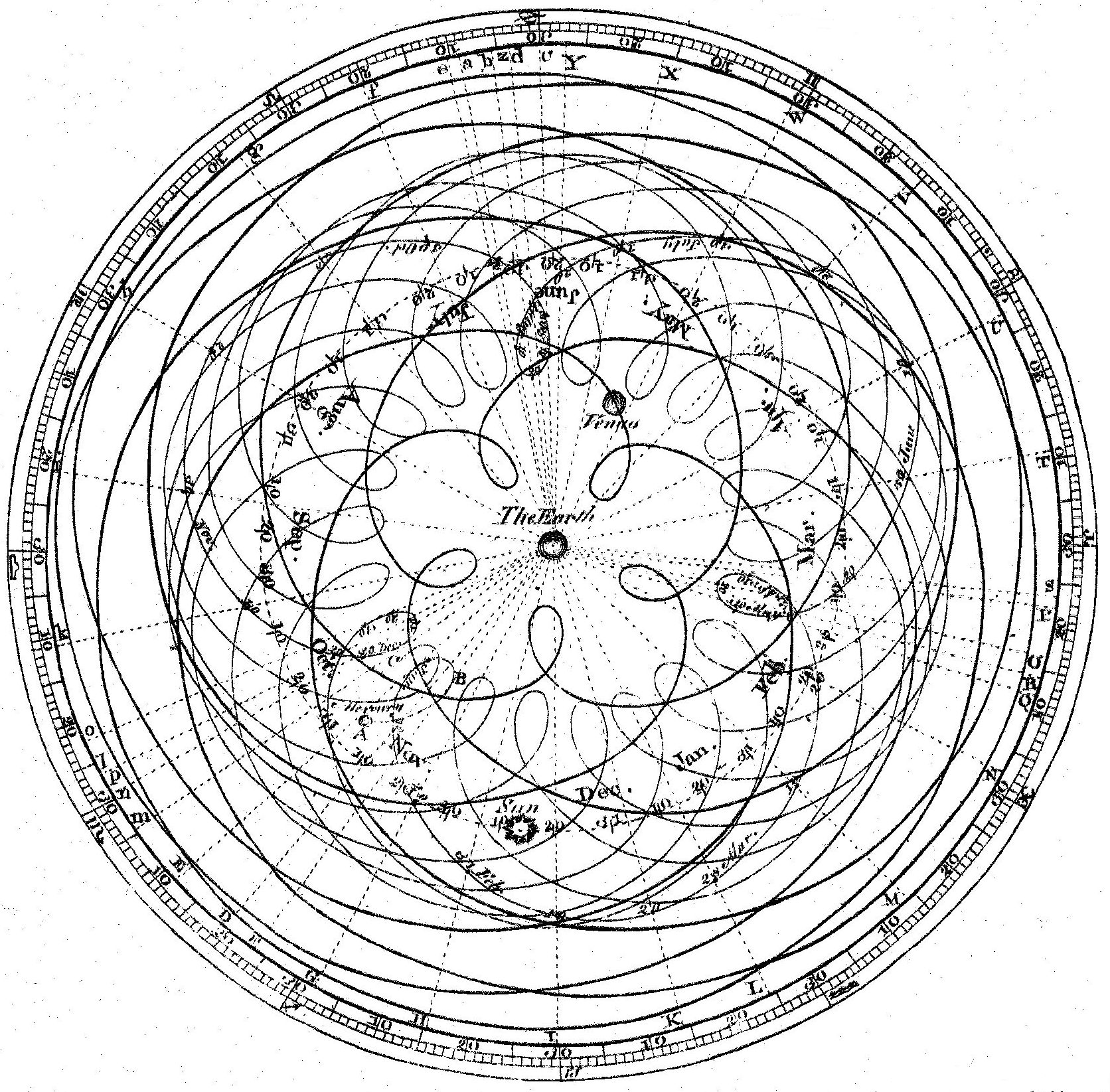
The apparent movement of sun and planets with Earth as center Giovanni Domenico Cassini, 1625–1712
Behind all other philosophies, there are two basic ways of looking at the universe, the materialistic and the transcendental views.
NOTE: Do not confuse transcendental as used here with the so-called Transcendentalism movement of the nineteenth century which was really a Naturalistic or agnostic philosophy.
NOTE: Materialism, in the philosophical sense, is not the love of things as the term is used today, having been corrupted by the popular culture. It is really the denial of the existence of anything beyond the material world.
The materialist view says the physical universe that we see and interact with is all that there is, and it is its own explanation for being. The transcendent view says there must be something more behind and above it all, an overarching force that is responsible for existence itself and the physical laws that give order to the universe. This blog reflects my transcendental beliefs that there must be something beyond the material that is beyond the reach of science. As a transcendentalist and a scientist, I have no reservations about science and religion being compatible.
“Try and penetrate with our limited means the secrets of nature and you will find that, behind all the discernible concatenations, there remains something subtle, intangible and inexplicable.”
Albert Einstein
Since materialists only believe in what they can see and touch, pure materialists are necessarily atheists and have a great deal of reservations about religion, especially as it relates to science. Even the agnostic, who is uncertain about a transcendent quality to the universe, is not comfortable with the notion that science and religion are compatible, since he believes that there is no way for us to know about anything outside the material world.
Joke: What do you get when you cross an insomniac agnostic and a dyslexic? Answer: A person who stays up all night wondering if there is a Dog.
Chico Marx (often attributed to Groucho Marx)
Science is the pursuit of truth about the predictable, repeatable and measurable aspects of the universe with which we can or could conceivably interact[1].
Anything beyond that is not science but philosophy, no matter how much mathematics or “supporting” data is attached. A one-time event that cannot be tested or repeated, such as the origin of the universe or the origin of life cannot be elucidated purely through science.
Materialists/atheists sometimes use the fact that we can only observe and test the physical world as proof that there is nothing else beyond that. Although science, in its truest sense, is an unbiased quest for the truth, that does not mean the people in the sciences are always unbiased or have no hidden agendas outside of science. Similarly, although religion seeks answers from a God centered perspective, man’s interpretations of God’s revealed truth may at times lead to error through misunderstandings or cultural bias.
As a Christian, I believe God’s revelations in the Bible are true, but I also believe that man’s interpretations can sometimes be wrong. An example of this from history is the supposed flat-Earth belief in the European Middle Ages, (which, by the way, is a nineteenth century myth[2]). Those few holding this belief had interpreted “… the four corners of the earth,” in Isaiah[3] and Revelation[4] to mean the Earth had four literal corners and was thus flat. What was obviously meant were the four directions.
Even at that time, the belief in a flat Earth was not widespread and a spherical Earth had been common knowledge[5] especially for sailors who clearly saw the curvature of the horizon and saw sails appear over it before the ships appeared. It was evident in earlier ages that the Earth cast a circular shadow on the moon, especially during lunar eclipses. The ancient Greeks and other cultures in antiquity knew the Earth was a sphere and actually calculated its circumference by triangulation.
“The discovery of truth is prevented more effectively, not by the false appearance things present and which mislead into error, not directly by weakness of the reasoning powers, but by preconceived opinion, by prejudice.”
Arthur Schopenhauer
Contrary to what you may have been taught, true science and Christianity are thoroughly compatible, and Christians have contributed greatly to the foundations of science. Anyone who believes in God must also believe that God invented science and gave us the ability to understand the laws of the universe. More than any other religion, Christianity taught that God had created an orderly, understandable universe that obeys natural laws. In this view, it is left to individuals to discover what that order and those laws are.
Science seeks the truth of WHAT, WHERE, WHEN and HOW things happen.
Religion seeks the truth of WHY things happen, WHO might have caused them and for “what” ultimate Purpose.
Therefore, we would not expect science to say anything at all about the why and who of religion, or for religion to necessarily seek spiritual answers in the what, where and how of science. The two are separate but complementary parts of the whole picture. They both seek to understand our “world” but approach it from different directions. Some agenda driven scientists who campaign against a belief in God have stepped beyond science into what amounts to a religion of evangelical atheism, which is also based on faith. Just because science can only study the material world does not mean there is nothing else outside it that is beyond the reach of science.
Because they choose not to believe in God or miracles, materialist atheists choose to define a miracle as breaking the physical laws of the universe. However, it is not necessary for God to break and act outside of his own physical laws to do things we don’t understand based on our limited knowledge and beliefs. Based on superior knowledge of a system he invented, God can use the natural laws in unique ways to do things seemingly impossible perhaps even including manipulating time and space. Similarly, magic acts appear to break the laws of logic but are really doing something else that is hidden from the audience.
A closed minded, dogmatic scientist is an oxymoron[6] and is not a true scientist at all regardless of her credentials. Science is a developing discipline where new knowledge sometimes radically changes accepted theories. The universe is filled with mysteries and unanswered or unanswerable questions. A true scientist must keep an open mind about all possibilities and admit that some things are not known or not even knowable. It is not necessary to make up clever stories to compensate for the missing knowledge, much less teach such speculative beliefs as settled science. It is OK to say “I don’t know” unless you are pushing an agenda other than truth. When scientists fill in gaps in knowledge with clever “just-so” stories, it is a Science of the Gaps[7] and is not science at all.
As a scientist, I use the tools of science to search for truth about our world. I think it is safe to say that there are prejudices and fiercely held beliefs on both sides. But beliefs are not facts no matter how many are convinced that they are true. It makes no sense to hold on to a view that has been shown to be in error, simply because it is “accepted and established.” Nor is it useful to stoop to name calling, slurs and other put-downs of those on the other side of an issue. Consensus is alien to science and is only properly used for opinions, not facts, in cultural and political settings. Consensus can lead into egregious errors. Remember, before Copernicus and Galileo the consensus was that the entire universe revolved around the Earth. Truth is never the result of a popular vote.
“To be a faultless member of the flock, first one must be a sheep.”
Albert Einstein
Nowhere is it more evident today than in the subjects of evolution and the origins of life and the universe. Both sides of these questions are often so steeped in their own emotional capital that their judgment and willingness to honestly debate may be clouded. For some, there are no grounds for discussion, much less any compromises. The other side is often viewed as either evil, ignorant or having sinister hidden motives. Science by definition is the quest for truth about our world; it has no business being closed minded and dogmatic to the point of preaching against religious belief or God based on materialist beliefs and prejudices.
The actions of a scientist are closer to a religion than true science when he insists that religion is bad and that everyone must believe as he does. Unfortunately, evangelical atheism has often used science to further its “religion.” This has also been true of the Progressive and Socialist political agendas that often go hand in hand with it. Both philosophies have effectively used the all too gullible press as a weapon in their war on both religion and truth. It is impossible to separate science, politics, popular culture, religion and the role of the press in the search for truth. They are all irreversibly entangled.
Because evolution is such an emotionally charged subject, when I started to write my book I was inclined to give it a minor role compared to other mysteries. However, when I studied it further from all sides, I realized that evolution was the beginning of and the role model for promoting most of the later dogma disguised as science, and belief disguised as truth. Its presentation in the popular press rather than peer reviewed scientific journals[8], the political style of rhetoric used to promote it, and the types of defensive arguments employed, taught later generations how to promote their points of view in other fields. In many areas, science has been hijacked by materialists who promote progressive and anti-God views through philosophical story-telling disguised as science.
Evolution is also a good example of entrenched dogma that the adherents insist must be accepted without question. As such, it is closer to myth than science. Science is never chiseled in stone. It is a changing discipline where nothing and no one are held sacred or inviolable. New knowledge is always to be encouraged and should never be seen as a threat. If any area of science does stifle dissenting views, it is not science anymore; it is a religion or at least a strongly held philosophy. Unfortunately, the fields of evolution, origin of life, cosmology and particle physics have become so dogmatic that dissent or differing views are attacked, defunded and blocked from publication in scientific journals.
“In view of such harmony in the cosmos which I, with my limited human mind, am able to recognize, there are yet people who say there is no God. But what makes me really angry is that they quote me for support of such views.”
Albert Einstein
[1]The Capricious Cosmos by Joe Rosen, 1991, Macmillan, New York.
[2] Popularized in A History of the Life and Voyages of Christopher Columbus, 1828, by Washington Irving.
[3] Bible: Isaiah 11:12 – “And he shall set up an ensign for the nations, and shall assemble the outcasts of Israel, and gather together the dispersed of Judah from the four corners of the earth.” (King James version)
[4] Bible: Revelation 7:1 – “And after these things I saw four angels standing on the four corners of the earth, holding the four winds of the earth that the wind should not blow on the earth, nor on the sea, nor on any tree.” (King James version)
[5] Bible: Isaiah 40:22 – “It is he that sitteth upon the circle of the earth, and the inhabitants therof are as grasshoppers; that streatcheth out the heavens as a curtain, and spreadeth them out as a tent to dwell in.” also Job 26: 7 – “He stretcheth out the north over the empty place, and hangeth the earth upon nothing.” (King James version)
[6] Oxymoron – a combination of contradictory or incongruous words such a “cruel kindness”
[7] A takeoff on the God of the Gaps claim of atheists to characterize any belief in a creator or design.
[8] Except for the original verbal presentation of a paper on the subject to the Linnean Society.
A progressive, anti-God mindset has come to dominate science and many other aspects of our world. Magical thinking, hidden agendas and protection of turf have replaced the need and the pursuit of truth.
The progressive monopoly relies on three things: academia, media and government funding. Academia, rather than being the open forum for discussing diverse ideas it should be, has become a closed priesthood where dissenting opinions are repressed, punished and blocked from funding and from academic publication by biased editors and peer reviewers. The popular press, whether print or electronic, is gullible and all too eager to parrot the standard line of SQR (Status Quo Regurgitators) without question. This includes the entertainment industry. Government funding grants aimed at supporting the standard line and controlled by SQR department heads, control what research can and cannot be done.
Solutions:
A public awareness of the problems is needed, leading to an open debate and holding accountable those blocking the free pursuit of truth. More, not less, research and discovery would result. Daylight is a good disinfectant.
It will be very difficult to break through the progressive monopoly and inform the people of the problem so it may take a generation. That is why books like this are important. It is one more way to chip away at the imposing edifice of the progressive monopoly.
The public must demand that academic departments allow and encourage questions, debates and alternative research.
Peer reviewed publications must be held accountable for bias and advocacy that blocks publication of valid research based on alternative views.
The popular press and the entertainment industries must be held accountable by an informed public for biased reporting and propaganda disguised as entertainment.
Government funding should be minimized and scrutinized to assure that meaningful research is done and that outcomes reflect the unbiased truth.
Educate yourself so you can use logic and facts, not emotional appeals in the debate. Arguing based on the Bible won’t help your case with those that don’t believe; it will only give your opponents ammunition to claim that you are anti-science and superstitious. Stick to facts and logic. Find and support those publications, websites and blogs that point out bias and give voice to alternative views as one way of educating yourself. Be discerning about internet information sources so you don’t get misled by illogical, unsupported wild speculation on either side. Learn to recognize the difference between opinion and facts. Start blogs of your own to give others an outlet for dissent. Read the books and visit the websites in the bibliography of this book.
Tactics – Direct Confrontation:
This new challenge for each of us to reveal the truth won’t be easy. As a matter of fact, because of the typically harsh and defensive responses of the progressives, it will sometimes be downright unpleasant. Most people will avoid confrontation on those grounds, preferring to avoid conflict and remain silent. Many are aware of the problem, or at least some part of it, but few are bold enough to stand up to the elitist bullies who call them names, disparage their character and engage in hate-filled diatribes. Remember, it’s not about you. It’s about them defending their fragile egos, their territories and their control of the situation.
They will try to make you defensive and emotional like they are by attacking your character and intelligence. The key to discussing anything with them, assuming they are at all willing, is to remain calm and logical, not emotional (offended, hurt, angry, etc.). Don’t let them put you on the defensive. Stand your ground and continue to ask your questions and make your logical points in a relatively nonthreatening manner. As long as they don’t actually hit you, their tantrums and accusations mean nothing. If they manage to get you to address the issue emotionally, you have lost at least half of your argument. Not only will you be mischaracterized, but in any argument (discussion) when emotion enters, logic goes out the window.
For those of you who are confident enough, I would encourage you to enter those very debates without fear or dread with business-like or diplomatic composure. It may be useful to start with quiet discussions on milder aspects of their beliefs in private so they do not feel obligated to defend themselves in public. By all means, don’t try to defend yourself or give them counter examples to illustrate that you are not guilty of whatever their accusations are. You would be wasting your breath, falling into their trap and giving them ammunition to shoot back at you. By putting you on the defensive they have achieved half of their goal of sidetracking the discussion and making you look foolish. Their favorite game is “Got Ya!”
Let the vitriol flow over you without obvious effect. Address the facts and the possibility that their thinking might have some logical flaws or blind spots. When they lose their composure or spew slanderous remarks, that is a sign that you are on the right track because they are attempting to use intimidation to shut you up. Remain calm and repeat your point in a gentle, composed manner. Point out the logic of both points of view without sinking to their emotional level. Whatever the outcome, thank them for being willing to discuss the issue.
If you are a student, you may have to repeat the status quo line and not be too outspoken until after you get your passing grade. Remember, the professor is protecting his image to the rest of the class. In those cases, it is probably best to wait until the class is over to raise your questions in private and in a relatively non-threatening way if at all. You will have to gradually judge their tolerance for dissenting voices to see how far you can go in educating them. Some have such fragile egos that you will not be able to engage them at all. They may be unwilling to discuss their beliefs, so some finesse may be required to keep the door to communication open. Some, however, will be at least somewhat open to discussion of their beliefs.
Department heads or deans need to hear from students about those professors who are abusing their positions to proselytize or indoctrinate instead of teach. If no one complains, these leaders really don’t know what is going on. One complaint may not have any effect, but complaints from numerous students may have some effect in reining in such abuse. Talk among other students and compare notes about the professor’s behavior. Encourage others to also complain, preferably after the course is completed.
Tactics – Indirect Campaigns:
Start contacting those who control the message and the money. Write letters, emails, comment on social media, websites or blogs and phone those who can affect change. Contact members of Congress, heads of government departments, academic deans and heads of academic departments, media producers and editors, as well as advertisers of biased media. Let them know that you do not accept the bias that is exhibited. Give logical arguments for free exchange of ideas and discussions of logical alternatives. One person contacting them may not have much effect, but numerous contacts cannot be ignored. Most of these leaders and politicians assume that one letter from a proactive person represents opinions of many others not willing or able to speak out.
The decline of the Holy Roman Empire in the 5th century was followed by a period of absolute power and control by monarchs and the Catholic Church known later as the Middle Ages or Dark Ages, so called by those in succeeding generations who wanted to believe theirs was a more “enlightened” age. Starting with the Italian Renaissance, in the 14th century and continuing through the Age of Reason and the Enlightenment of the 16th through the 19th centuries, the Western world was in a state of constant turmoil and social change.
The invention of the printing press by Johann Gutenberg in 1450 made mass printings and translations of the Bible and other books possible so that they became accessible outside of elite circles. This furthered the Protestant Reformation which had begun in the 14th century with John Wycliff in England and Czech priest Jan Hus who was burned at the stake in 1415. These departures from Catholic tradition were followed by other reformers including Martin Luther, a Catholic priest, who posted his Ninety-five Theses in Wittenberg in 1517 condemning church abuses.
The Medieval Catholic Church, with its domination by rich and powerful men, had become more of a political and military force than a representation of Christ’s love and compassion as reflected by the apostles and the early church. This is not to say that the Church did not do many good things as exemplified by church run universities, hospitals, orphanages, observatories, libraries and other repositories of ancient and new knowledge.
Forced conversions, persecution of “heretics,” i.e. any form of Christianity[1], science or philosophy not sanctioned by the Church, excommunications, torture and death by burning and other means were all practiced at times by the Church. The reader should note that excommunication to the devoted Catholic of the time meant he had no chance of salvation and was doomed to hellfire forever – as opposed to Protestant belief that only God could ever decide that. (What a freeing concept!) Imprisonment, torture and even death were preferable to excommunication. Similarly, monarchies had absolute power over the people and could, almost at will, have anyone stripped of his position, his property, his freedom or his life. Only the Church had any power over monarchies.
Assisted by the rise of Protestantism, the alienation of the people by abuses and domination of the Catholic Church and the Monarchy eventually led to limitations or overthrow of monarchies and the rise of various types of social philosophies and experimentation within and outside the various churches. In this vacuum, many experimental philosophies were espoused, some of which were irreligious or openly hostile to religion. Some went so far as to throw out Christianity altogether. The Directory, set up in France after the French Revolution, is probably the best, though later, example of such an extreme view. For a period of time under this regime in the 18th century, religion, particularly Christianity, was actually outlawed in France, which led to persecution of Christians and Jews.
The Italian Renaissance, beginning in the 14th century, marked a return to classical thinking of the Greek philosophers such as Plato and Aristotle. This influenced the formation of humanist and materialist philosophies, which became popular among intellectuals. Materialist philosophy states that there is nothing beyond the material world that we can see and touch. Humanists[2] believed that man was basically good and was only corrupted by society. Materialism[3] said “down with god,” and Humanism said “up with man.”
The goodness and eventual perfection of man and society was/is an important part of the basic philosophy of Progressivism and was/is practiced by communists, socialists and their ilk. It is, in my view, a misinterpretation of human nature and a false belief in our ability to change it. This is Magical Thinking because it is contrary to experience. The unchanging nature of man is the reason that both Shakespearian and Greek plays still have relevance today. The circumstances and society are different, but the human reactions are the same. The Christian viewpoint was/is that man himself is imperfect and cannot be perfected by human endeavor, no matter how noble. If society is faulty, it is because imperfect man is its author.
Note that the word “progressive” has been corrupted from its original meaning. The progressive philosophy originally meant that progress was possible through work, learning and inspiration, built on the works of others progressively. This is contrary to today’s interpretation of progressivism as an inevitable quality of the universe, moving naturally from simpler to more complex and from imperfection to perfection and utopia, which is again Magical Thinking.
In the 19th century, socialist thought was dominated by the “man good, society bad” humanist philosophy of Rousseau, and was guided by the “scarcity and struggle” philosophy of economist Thomas Malthus[4]. The dominant theme of the day was social progress of the “noble savage” toward ultimate social perfection, once he was freed from the tyranny of governments and religion. This utopian dream was a perfect philosophy for radicals who wanted to overthrow, rather than reform, what they perceived to be the corrupt and corrupting society of the time. Many social experiments were carried out in which utopian socialist communities were formed, lived and ultimately failed.
A very early forerunner of this was the Plymouth colony in the 17th century, led by William Bradford. From the beginning they tried a form of communal living wherein all production was shared equally by everyone. When it became obvious that people would not produce well unless they were rewarded in proportion to their labors, this philosophy was quickly rejected, and was replaced by private ownership and free enterprise that quickly produced more prosperity and created wealth. Nineteenth century examples of these utopian socialist experiments include New Harmony, Indiana, Brook Farm, Massachusetts and North American Phalanx, New Jersey.
[1] Example: Waldensians were a group professing poverty, preaching, and opposed to image worship, relics, pilgrimages, intercession of the saints, etc. that were persecuted by the Roman Catholic Church beginning in the 12th century.
[2] Originally from the Italian word umanista for a teacher of classical Greek and Latin beginning in the 14th century and promoted by Petrarch.
[3] Note that the word Materialism has been corrupted by the left to mean living for gain of material things, not a philosophy that denies any spiritual aspects. Reinterpretation of words is a common practice of the left that blurs real meanings.
[4]An Essay on the Principles of Population, 1798, predicted starvation because populations were increasing exponentially while food supplies were increasing arithmetically. This philosophy assumed no improvements above subsistence level farming, no development of more prolific and disease resistant crops or mechanical means to increase production, and no other factors that would limit population such as disease and war.
Quantum Mechanics or Quantum Theory, which is based on complex mathematics, tries to describe and explain the odd behavior of particles and forces in the atomic and subatomic realm. In this theory, things don’t happen in a smooth (analog) manner but in a punctuated (digital) manner Electrons move around the nucleus at high speeds so that their exact location at any one moment is not known precisely without measurement. The likelihood of finding a given electron at a particular place in its orbital is described by a probability, thus defining the electron “cloud” or “shell.” An electron jumps from one allowed orbital to another by absorbing energy (a photon) at a specific energy (wavelength).
The absorbed photon at a specific energy level is called a quantum, thus quantum theory. The electron will also fall from this “excited” state back to its more stable “ground” state orbital by emitting a quantum of energy. Electrons exist or move between one allowed energy state (orbital) and another based on discrete quanta of energy that they absorb, emit or carry. Each element has unique orbital energies so that light interacting with an atom shows absorption and emission lines at specific wavelengths that can be used to identify the element.
Wave-Particle Duality:
In Quantum Theory, subatomic particles are described as both particles and waves simultaneously. This is referred to as wave-particle duality. All types of energy, including subatomic binding forces, are also defined as both particles and waves, so that matter and energy are treated as if they are the same thing. Both subatomic particles and photons sometimes act like waves and sometimes like particles, depending on how they are tested or detected. Two experiments are noted as evidence: the double slit interference patterns and the photoelectric effect in which electrons are emitted when light is shined on a metal surface. Einstein assumed this proved that energy waves were really made of particles that he called photons.
The double slit experiment is said to demonstrate the wave nature of particles and photons. The photoelectric effect is said to demonstrate the particle nature of particles and photons. Wave-particle duality rests on the assumption that single photons or particles are being measured. Since all detectors have threshold sensitivities below which nothing is detected, it could mean that multiple, not single, photons or particles are really being tested[1]. This would explain the interference patterns seen when either photons or electrons are tested in the double slit experiment. Photoelectric experiments may also be misinterpreted. It is possible that absorbed energy, not photon particles, causes emission of loosely held electrons on the metal surface. Granted, this is speculation at this time, but calls for more study.
Copenhagen Interpretation:
In the widely accepted Copenhagen interpretation of quantum mechanics, a particle is said to not have a fixed state but exist in a smeared out multiplicity of states at once until a measurement is taken when it “collapses” into one state. The observer (or detector) becomes a part of the quantum system. This is the principle of superposition. Because an electron can be found in any of the probability-allowed “shell” locations, this interpretation assumes that the electron really is at all the locations or states at once and only assumes a fixed state when measured. This assumption extends to all of the characteristics of the electron such as position, spin or momentum. This assumption also extends to all other subatomic particles and photons (energy particles).
The Copenhagen interpretation of Quantum Theory also says the electron exists in one or the other allowed orbital level but does not exist anywhere between. When a quantum of energy is absorbed the electron is said to pop out of existence in the original shell and simultaneously pop into existence in the new shell. But, since the electron shell defines a probability, and most of the time the electron exists in one of these shells, the probability of finding it anywhere between is statistically infinitesimal. It is said not to exist there, and it is thus called “forbidden.” Is it only an extremely small probability or are we talking about its actual existence? The Copenhagen interpretation of Quantum Theory says it is the latter. Other interpretations of Quantum Theory differ as to what actually happens. See list below.
Uncertainty Principle: Ontology or Epistomology?
In trying to measure these discrete orbitals and their electron locations and momenta, it became apparent that measurement of any kind disturbed the system so that only one of two coupled parameters could be determined at any one time, e.g. position and momentum (or speed). This led to the Heisenberg Uncertainty Principle, which states that it is impossible to know both the position and the momentum of any one subatomic particle at the same time. The system is disturbed by measurement because measuring subatomic particle parameters is like administering eye drops with a fire hose. Because the subatomic particles are so small compared to any means of measuring their parameters, what is measured is in a disturbed condition.
The Heisenberg Uncertainty Principle was meant to be a statement of experimental limitations, not that location and momentum (or other coupled parameters) did not exist in a fixed state at the same time. However, Bohr and other Copenhagen interpretation proponents interpreted it that way, assuming that atoms or atomic particles were never in a fixed state until measured, and that uncertainty is a fundamental characteristic of subatomic particles, not just an experimental limitation. Thus they have substituted ontology (being) for epistemology (ability to know). Heisenberg never accepted the principle of superposition or non-locality claimed in the Copenhagen interpretation.
Superposition:
Edwin Schrodinger provided the mathematical equations for the behavior of electromagnetic waves that are used in quantum mechanics[2]. These probabilistic differential wave equations are linear (first order), that is, they can be plotted as straight lines on a graph. Superposition is a concept in mathematics stating that in linear equations all of the contributing factors must add up to the net effect of each factor individually. Since Schrodinger’s equations for waves are linear, it is assumed that their application to subatomic particles is also linear. From there it is a leap of faith to assume that particles don’t just have the capability of being in different states, but that they are simultaneously in all possible states at once. Instead of just being a mathematical concept, superposition now was applied directly to subatomic particles in a real physical sense.
However, Schrodinger did not agree with this Copenhagen interpretation of quantum mechanics. He came up with an example within everyone’s sphere of experience that illustrated the absurdity of their assumed superposition. This was the famous Schrodinger’s Cat thought experiment. He set up the experiment so that a cat in a closed box could be either alive or dead, depending on whether a radioactive particle spontaneously decayed setting off a mechanism that released a deadly poison gas. In this thought experiment, using the Copenhagen interpretation of superposition, since we don’t know what state the cat is in until the box is opened, the cat is both dead and alive until it is opened at which time the cat becomes either dead or alive. The act of observing somehow must cause the cat to assume either a dead or alive state. In all other realms, this would be called Magical Thinking. Meant to point out the weakness or absurdity of superposition, it has been used to illustrate the opposite through convoluted “reasoning” to make it fit the Copenhagen or similar interpretations.
Communication at a distance:
The idea of instantaneous communication and action at a distance is a consequence of this assumed superposition where particles did not assume a fixed state until observed. By Pauli’s Exclusion Principle, no two electrons in the same orbital can be in the same quantum state. Each must differ in some way, for example they must have opposite spins. The two particles are said to be entangled since each must be in the opposite state to the other. If one of the electrons is emitted and travels relatively far away, when one of the electrons is measured (observed), it collapses into a fixed state and simultaneously the other one collapses into the opposite state that can be confirmed when it is measured. This implies speed of communication faster than the speed of light, the assumed upper limit of speed[3].
Einstein thought that quantum action at a distance was an illusion based on the assumption of superposition, aka non-locality. If particles are assumed to have fixed states, although unknown to an observer, the action at a distance is no mystery. It only implies that entangled states, e.g. opposite spins, persist after separation. When one of the particles is measured, you automatically know the state of the other since they must be the opposite of each other, whether together of separated. Einstein spent the latter part of his career trying to prove this.
Other Interpretations:
There are more than a dozen other interpretations. The most popular, among a long list, (see table following), are the Copenhagen interpretation and its variants, the Many Worlds interpretation and the Ensemble interpretation. Variants of the Copenhagen interpretation involve either the observer or the cat (as observer and participant) as being parts of the quantum system. Another, the Many Worlds interpretation is even more speculative. In this scenario, each time a subatomic particle collapses and “chooses” a fixed state, reality splits in two and both possible realities still exist, but in different undetectable dimensions. Think of this as a time series of pictures or a strip of movie film. At the decision point, the one series becomes two, and at the next decision point, becomes four, etc. ad infinitum.
The Ensemble interpretation states that Quantum Mechanics can only be applied to statistically significant numbers of particles, not to individual particles. Since the wave equations describe probabilities, it would be meaningless to apply probabilities or statistics to single particles. This is the interpretation favored by Einstein but is discounted by leading QM physicists. Similar realistic interpretations such as those proposed by de Broglie-Bohm and science philosopher Karl Popper assume real particles with real positions and real wave functions that do not need to “collapse” upon measurement. I tend to prefer these theories because of their realism.
“The attempt to conceive the quantum-theoretical description as the complete description of the individual systems leads to unnatural theoretical interpretations, which become immediately unnecessary if one accepts the interpretation that the description refers to ensembles of systems and not to individual systems.”
—A. Einstein in Albert Einstein: Philosopher-Scientist
Is the universe really indeterminant?
As a consequence of the probabilistic view of the subatomic world, Quantum Theory leads to a conclusion that events are not deterministic, but rather are indeterminate; that they just happen without actual connections between cause and effect. If deterministic, then events in the past must predict future events as causal antecedents. In the macro or “real” world, everything has a cause or causes, whether known or not. Determinism is the accepted view or apparent state of the real universe because, knowing the mass, position and the momentum of a (larger) body, plus all of the influences on it and the mathematical equations governing its movement, one can (in theory) calculate its position and speed at any other time in the future or the past. This is the basis of celestial mechanics by which planets, etc. are tracked.
The question is: since we don’t know for sure what the outcome according to QM will be, is it really indeterminate or are there certain things we don’t or can’t know about the system that only makes it look indeterminate? If it were possible to know all of the parameters and influences without disturbing the system could we, with certainty, predict outcomes? According to the Copenhagen interpretation of quantum theory, the universe is really indeterminant at the atomic level and only LOOKS determinant at the macroscopic level. This eliminates the infinite series of cause and effect, and therefore the question of a first cause.
[2] Side note: These equations assume massless particles and waves. Since real particles have mass, particle physicists assume there is a particle that gives all other particles mass. The Higgs boson is the assumed particle that creates mass when a particle is in a Higgs field.
[3] It should be noted that many thought experiments and most actual experiments have been done using light, not subatomic particles. The results of these actual experiments depend on your interpretation of Quantum Theory. See other interpretations that follow.
After his trip around the world on The Beagle, Darwin waited 23 years to present his theory of Evolution. The myth is that he sat on the theory out of fear of repercussions. However, when Charles Darwin published On the Origen of Species in 1859 evolutionary theories had been around for a long time. There were at least a dozen evolutionary theories, including one by Erasmus Darwin, Charles’ grandfather, in the late eighteenth and early nineteenth century that were openly debated among scientists.
Alfred Russel Wallace 1862
It wasn’t until Alfred Russell Wallace, a naturalist and admirer, sent Darwin his observations and theory of Evolution while still away on a voyage to the Malay Archipelago and Borneo, that Darwin’s theory was (hurriedly?) presented, acknowledging Wallace as co-discoverer, and published, establishing primacy over Wallace. Was Wallace the true originator of a theory that Darwin had overlooked in his own observations? Did Wallace provide the link that brought all his speculations together? Darwin’s claims were backed by his friends Charles Lyle and Joseph Hooker, so we may never know the truth. It is sure that the scientific reputation of Wallace declined, while Darwin’s grew. It is interesting to note that Wallace later rejected the theory as lacking both mechanism and sufficient evidence.
Leaf Cutter Ants – Worker ants of various castes and two large queens
Darwin thought cells were simple bags of gel. He knew nothing of DNA or any other cellular structures. He believed that inheritance was through “Gemmules” that each cell shed and that traveled to the gametes (sperm and egg). Since each cell “voted” it was called pangenesis. He believed that the life experiences of the parents were passed on to their offspring in this way. He believed evolutionary incremental changes occurred by passing these life experiences on to subsequent generations.
Darwin’s Dilemma
Colony insects were a problem for Darwin. If life experiences were passed on, how does a queen ant, who has never experienced foraging for food, pass on the behavior of the worker ants who hunt for food and bring it back to the colony?
His theory of evolution taught that use and disuse along with adaptation to environmental changes experienced by parents were passed on and were responsible for the changes seen between species by gradual changes over time, coupled with natural selection aka survival of the fittest. How is this any different from J-B Lamarck’s theory of acquired characteristics, which was discredited as having no foundation? Did acceptance for Darwin’s theory and not Lamarck’s have more to do with politics and marketing than science?
Modern Evolutionary Biologists’ Dilemma
Obviously, modern evolutionary biologists found pangenesis and inheritance of acquired traits embarrassing, so, in the early 20th century they changed the theory to include genetics with an emphasis on natural selection and called it Neo-Darwinism or the Modern Synthesis. Later, they included DNA. Although Darwin is still revered as if he had everything right, this form of Evolutionary theory is grossly different from the original Darwinian theory except for the assumption of natural selection and unlimited gradual changes producing new species over time.
“Geese are but Geese tho’ we may think ’em Swans; and Truth will be Truth tho’ it sometimes prove mortifying and distasteful.” — Benjamin Franklin
Diogenes looking for an honest man
Science is the pursuit of truth about the predictable, repeatable and measurable aspects of the universe with which we can or could conceivably interact. It must also be verifiable, falsifiable and testable.
Much of what we think we know about the universe and life is really belief, based on faith. Much of what we think we know about science is actually not science at all but philosophy. While technology is certainly real, and observation and experimental data are real, inferences, conclusions, projections, deduction from pure reason of what (we believe) must be, models and other “facts,” especially about events in the past, are really beliefs disguised as facts. Many of the “facts” that fall into this category are either irrelevant or detrimental to true science, and are only relevant to supporting certain social and cultural paradigms.
Through all of this philosophy disguised as science is a common thread of progressivism and atheism. The universe, the earth, life, everything are assumed (on faith) to be naturally progressing from simpler through more organized and complex toward perfection. Progressivism is teleological because progress is assumed to have a purpose – to move toward perfection. As such, it requires faith. It takes as much faith to believe in a universe and life that invented themselves, as it takes to believe in a creator, whether it is one that set up the initial conditions and walked away, or one that continues to orchestrate its functions or cares about mankind on a personal basis.
“It ain’t so much the things we don’t know that get us into trouble. It’s the things we know that ain’t so.”
— Artemus Ward aka Charles Farrar Browne
Most of the people who “preach” this dogma don’t even know that it is not science because they have been taught it all their lives and assume the theories have been proven absolutely in the past. They have never gone back to historical or original sources to learn the truth.
So how do we combat this progressive philosophy disguised as science? It is not sufficient to use religion (another philosophy) against it; facts are needed to defeat this magical thinking. The facts are there but have been suppressed by true believers and media that support the standard line, and have been hidden by rewriting history. Keep watching this site and the facts will be presented. Then it is up to all of us to use facts to hold accountable those spreading this false paradigm of how the universe works.
“The discovery of truth is prevented more effectively, not by the false appearance things present and which mislead into error, not directly by weakness of the reasoning powers, but by preconceived opinion, by prejudice.”





 Science is distorted by progressive philosophy