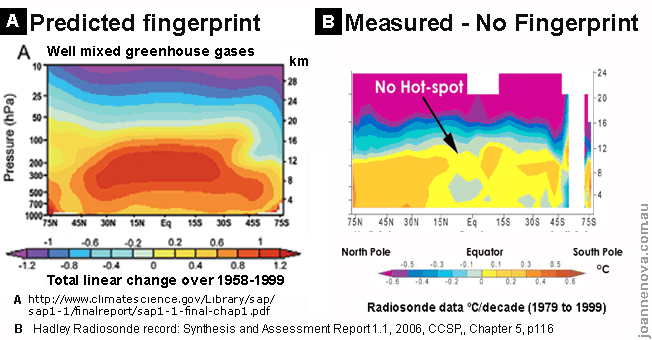
Predicted hot spot from water vapor forcing is missing
Claim 3. Carbon dioxide is important because it has a forcing effect on other factors such as water vapor which magnify warming effects.
Truth: Since the atmospheric absorption of CO2 is already near saturation, (see previous post), very little additional heating can take place due to increased CO2. Contrary to AGW advocates, increased water vapor from warming doesn’t stay as vapor to trap heat near the surface. It forms low altitude clouds that strongly reflect solar heat back out into space, overwhelming any trapped re-radiation from the Earth and having an overall cooling effect. The models, which assume water vapor remains as vapor, predict an atmospheric “hot spot” at middle altitudes. Weather balloons and satellites have failed to find this assumed hot spot, which is the signature of atmospheric forcing of global warming in computer models. Due to low altitude clouds reflecting sunlight back into space, any feedback is negative (cooling), not positive (warming) as assumed in computer models. For earlier posts, go to http:realscienceblog.com
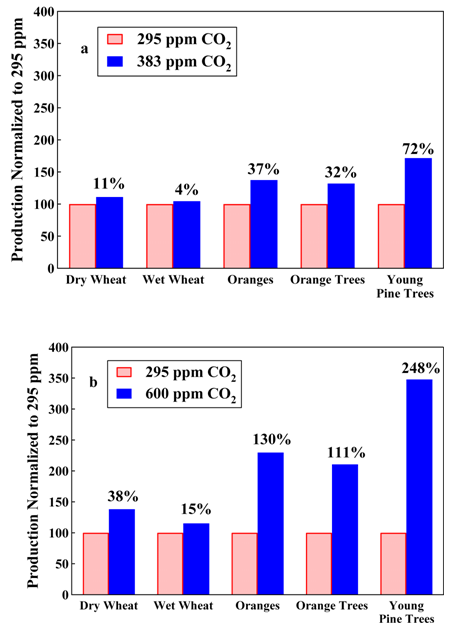
CO2 Enhanced Plant Growth Rates – Chart Source: Review Article “Environmental effects of increased atmospheric carbon dioxide,” Willie Soon (1), Sallie L. Baliunas(1), Arthur B. Robinson (2), Zachary W. Robinson (2) Climate Research. 13, 149-164, (1999)
a.) Animals exhale CO2 and breathe in O2, while plants use CO2 for photosynthesis and “exhale” O2. Professional greenhouses often add extra CO2 to increase growth rates. Increased plant growth removes much of the CO2 released into the atmosphere. Between pre-industrial and present times, studies show an average of 15 percent increase in plant growth rates, with some species increased many times that, e.g, young pine trees. Increased plant growth rates and wider distribution of arable (farmable) land due to warming as well as improved farming practices can solve the so-called overpopulation problem.
b.) Critics created the “progressive nitrogen limitation hypothesis,” which assumes that increased growth rates of trees would deplete poor soils of nitrogen, thus mediating the positive effects of increased CO2. This is a scenario based on an unproven hypothesis, not reality, which stubbornly refuses to support the hypothesis. Many studies[1] show that, contrary to the hypothesis, although roots grow deeper and produce more fine hairs, soil and forest floor are enriched in nitrogen from biological sources, ie, increased root mass and leaf litter supporting beneficial microbes in the soil. Deeper roots with more fine hairs also make plants mean enhanced tolerance to dryer conditions. (also see next item)
c.) One benefit of increased CO2 is that the stomata (openings) of leaves, which take in CO2 and emit water vapor and oxygen, are reduced, leading to less water loss, enhanced water use and improved tolerance to dryer conditions. At elevated CO2 levels, stomata do not need to be open as far to allow sufficient CO2 in for photosynthesis and, as a result, less water is lost through transpiration[2]. In controlled studies, an additional benefit of reduced stomata openings is a reduction in ozone damage.
d.) The increased rate of growth of plants, from forests to sea algae, results in more of certain cooling aerosols being produced. These include Carbonyl Sulfide (COS) from soil and seas that become highly reflective sulfate in the stratosphere to reflect more solar radiation back into space; iodo-compounds[3] from sea algae that nucleate clouds to reflect more solar radiation back into space; and dimethyl sulfide (DMS), from seas that nucleates clouds as well as other aerosols such as isoprene from trees with similar effects.
The increase in carbon dioxide is greening many arid regions because of more efficient use of water and the increased growth rate. Sub-Saharan Africa is blooming, the Amazonian jungle is flourishing and global vegetative cover is increasing. The effect on ocean phytoplankton is equally as dramatic. Significant reduction of carbon dioxide levels as proposed by the various climate agreements would have a detrimental effect on plant growth and consequently food supplies. A concentration of 150 ppm is too low for photosynthesis to occur and plants die.
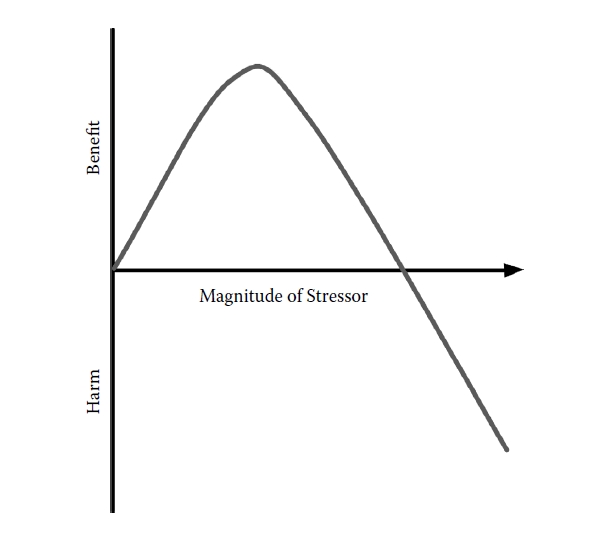
Hormesis Diagram with CO2 concentration on the horizontal axis vs plant growth rate
Hormesis is a phenomenon, commonly seen in medicine and nutrition, where a low or moderate concentration or dose results in a positive effect, but a larger dose results in damage. For instance, some salt and water are necessary to good health, but beyond a certain point, ingesting more can be harmful or fatal. The effect of CO2 on plant life appears to be one such system. Increased CO2 obviously benefits plant life, but it is uncertain at what level CO2 might have a detrimental effect on growth. In professional greenhouses and experiments, even ten times the current level is still beneficial.
[1] Example: Phillips, R.P., Finzi, A.C. and Bernhardt, E.S. 2011. “Enhanced root exudation induces microbial feedbacks to N cycling in a pine forest under long-term CO2 fumigation”. Ecology Letters14: 187-194.
[2] See review article of research papers: “Responses of agricultural crops to free-air CO2 enrichment” Kimball, B.A., Kobayashi, K. and Bindi, M., Advances in Agronomy77: 293-368 2002.
[3] Iodo-compounds contain iodine derived from seaweed
AGW Claim 2. Manmade carbon dioxide (CO2) is the main cause of global warming
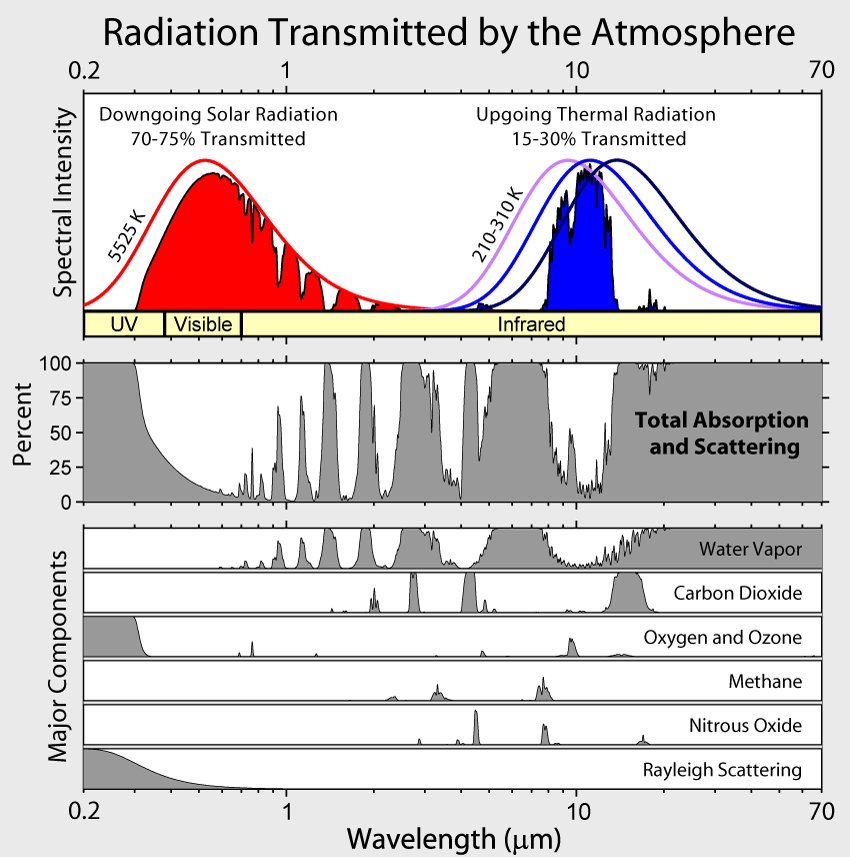
Truth: a.) Carbon dioxide is a minor player in any further warming. It is uniformly distributed in the atmosphere but only absorbs infrared (heat) in a very narrow wavelength range. The CO2 wavelength range is outside the range of most of the solar radiance that penetrates our atmosphere. It falls roughly inside the wavelength range of temperatures re-radiated when solar radiation heats the Earth’s surface.
The atmospheric CO2 already absorbs almost all of the radiation that it can in that wavelength range. Most of the warming effect of CO2 has already occurred in the past and is one of the reasons our planet is not a frozen wasteland. Any increase in CO2 will have a very minor effect. With CO2 absorption near saturation, almost all of the re-radiated heat in that wavelength range is already being trapped, so it can have little or no effect on future increases in temperature or supposed forcing of water vapor. (will be explained in claim 3 analysis in future posts.) With CO2 essentially eliminated as a source, any increase in temperature must be from other sources.
This figure above requires a bit of explaining. The top spectrum shows the wavelengths at which the atmosphere transmits light and heat as well as the blackbody idealized curves for no absorption. It is a little misleading because the data is not based on actual solar and earth data. It is based on two experimental heat sources, one centered at 5525 K (5252o C or 9485o F), the approximate temperature of solar radiation, and one centered in the range of 210 to 310 K (-63o C to 36.8o C or -82oF to 98o F), the approximate temperature range of re-radiated heat from the earth. In reality, solar radiation power, (Watts/m2/micron), is six million times as strong as the power of re-radiated heat from the Earth.
The other spectra are absorption[1] spectra. The first one shows the relative percent absorption by total atmospheric gases at various wavelengths, (note that this spectrum is practically the inverse of the transmission spectrum above it), and the spectra below that show the absorption wavelength ranges of individual atmospheric gases, (but not the relative strength of that absorption in reality). As experimental, not real atmospheric, data they can only tell us the wavelength ranges of the absorption, not their relative strengths in the atmosphere.
Note that CO2 absorbs in the 15 micron range[2], which is within both the range of re-radiated heat and the strong absorption by water vapor, of which the CO2 peak forms a mere shoulder. CO2, in the atmosphere is evenly distributed and is near-saturation level at this wavelength. That means that little if any re-radiated heat can escape through the blanket of CO2, which is why our earth is not a frozen wasteland. This also mean that adding more CO2 will have little effect on future temperatures. Lesser CO2 peaks in the 2.7 and 4.3 micron ranges only contribute in a minor way. The first is completely covered by a water vapor absorption peak and the second forms a shoulder in another water vapor peak. These minor peaks occur in a region where both solar radiation and re-radiation are minimized. Methane and nitrous oxide are also shown to be minor players, having narrow absorption ranges and are at low concentrations in the atmosphere. Note too that ozone blocks most of the ultraviolet light from the sun.
b.) Water is by far the most important greenhouse gas/liquid in the form of vapor, high and low altitude clouds, rain and snow, which both absorb and reflect in-coming sunlight and re-radiated heat from the surface. Water vapor is not uniformly distributed in the atmosphere, being concentrated near the earth, it strongly absorbs heat in a wide range of wavelengths. More heat means more water vapor evaporating from the oceans. Sounds pretty scary, doesn’t it? Contrary to what is assumed by climate modelers, who use this to claim forcing by CO2, the extra vapor doesn’t remain as vapor. It quickly forms low altitude clouds that strongly reflect in-coming sunlight and heat into space. Any re-radiated heat from the surface that may be trapped by clouds is a small fraction compared to the in-coming solar radiation, so blocking solar radiation has a net cooling effect that overwhelms any increases in trapped re-radiation. High altitude clouds tend to trap heat from being re-radiated into space, but have little effect because the increases in cloud cover due to warming are mostly in low altitude clouds.
c.) Methane, like CO2, only absorbs heat in narrow wavelength ranges far from most of solar heat radiance, so that water, with its broad absorbance spectrum, trumps all other greenhouse gases. Like CO2, methane is at or near its absorbance saturation point in the atmosphere so that increases would have little effect. While it is true that continued warming could result in release of methane from melting permafrost, it would have a relatively minor effect on global temperatures. Methane is derived mostly from decaying organic material and from natural seeps on the land and under the sea, as well as termites and ruminant flatulence. Methane absorbs 29 times as much heat per volume as carbon dioxide but at 1.8 ppbv[3], (.00000018 percent), compared to CO2 at 380 ppmv[4], (0.038 percent), it is recognized as a minor player in greenhouse warming along with Ozone (O3) and Nitrous Oxide (N2O).
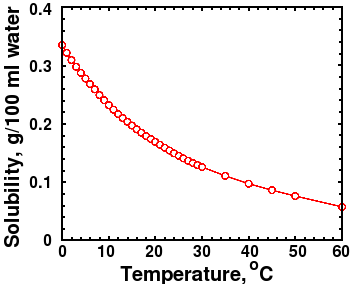
CO2 Solubility in Water vs Temperature
d.) Manmade carbon dioxide is estimated to be about 5 percent (1/20th) of the total CO2 emitted. Animals and man are relatively minor contributors. Decaying organic matter is the major source, followed by volcanic activity and release from warmer oceans. Warmer water releases more CO2 than cooler water due to decreased solubility of CO2 with rising temperature. Many studies show that atmospheric CO2 concentration rises AFTER warming, not before. So which is the cause and which is the effect?
See next post for the beneficial effects of CO2 on plant life.
[1] Transmission and Absorption are inversely related by the formula A = 1/log T.
[2] The horizontal axis is a log scale in microns so that the 1 to 10 range is in units of 1 and the 10 to 70 range is in tens.
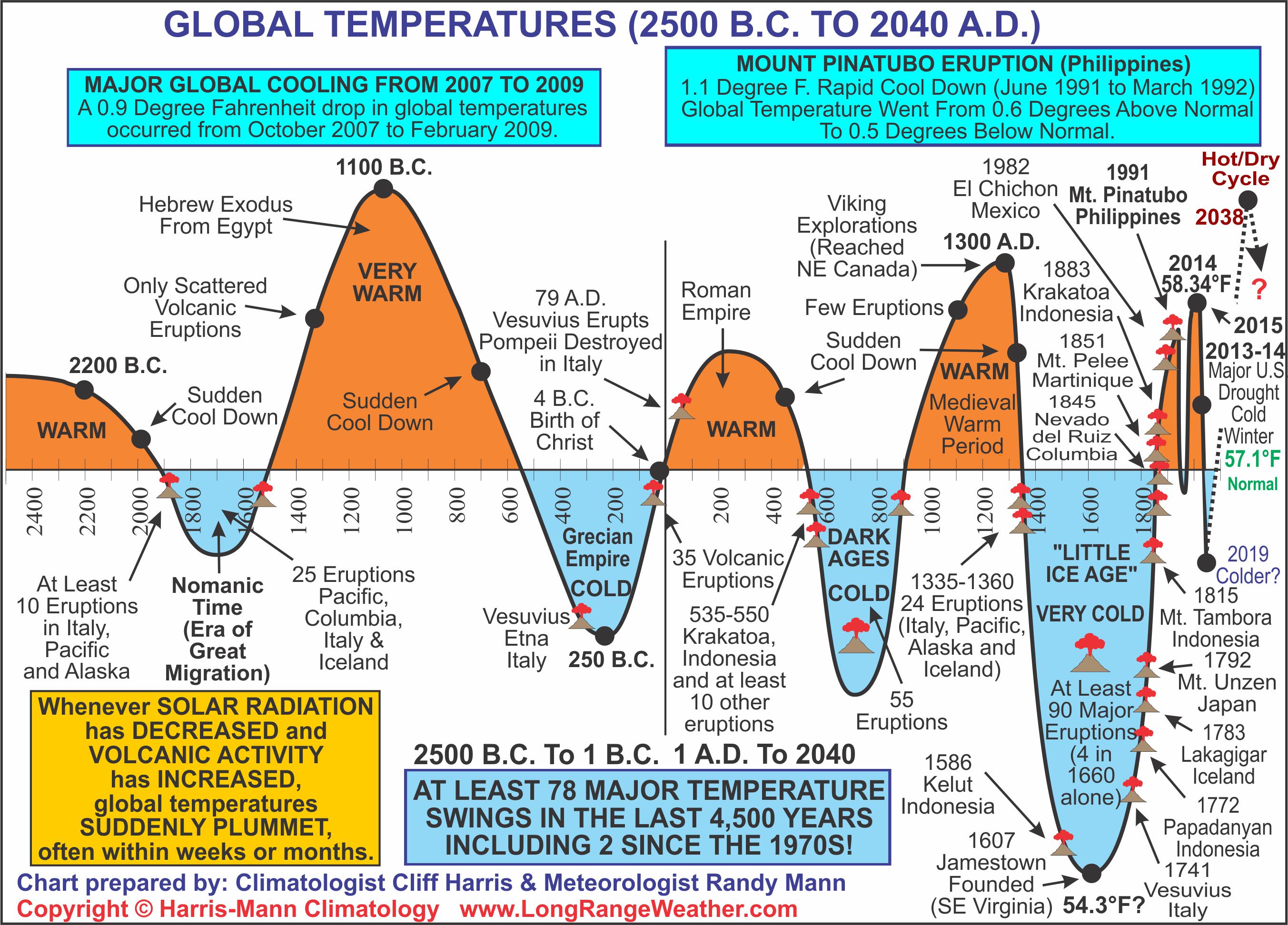
Global Temperatures 2500 BC to 2040 AD (projected) Note: Temperature range is less than plus or minus 2.5oF (1.4oC) from present.
Part 2 of answers to AGW Claim 1. “Global warming and/or climate change are established facts.” See “Anthropogenic Global Warming vs. Truth – Part 1” blog post for Part 1.
Quote: “Since 1895, the media has alternated between global cooling and warming scares during four separate and sometimes overlapping time periods. From 1895 until the 1930’s the media peddled a coming ice age. From the late 1920’s until the 1960’s they warned of global warming. From the 1950’s until the 1970’s they warned us again of a coming ice age. This makes modern global warming the fourth estate’s fourth attempt to promote opposing climate change fears during the last 100 years.”
— Senator James Inhofe, Monday, September 25, 2006
1872 John Tyndall measured the heat absorption of various atmospheric gases over the entire wavelength range of his heat source. He found that water vapor and CO2 absorbed more strongly than other atmospheric gases such as oxygen and nitrogen. Oxygen and nitrogen, major components of the atmosphere, had little or no absorption of heat in the range tested. It is important to note that his experiments did not separate the heat into specific wavelengths. See Claim 2 and its chart in the next blog post.
Quote: “…if, as the above experiments indicated, the chief influence be exercised by the aqueous vapour, every variation of this constituent must produce a change of climate. Similar remarks would apply to the carbonic acid [CO2] diffused through the air… they constitute true causes, the extent alone of the operation remaining doubtful.”
— John Tyndall, Contributions to Molecular Physics in the Domain of Radiant Heat, 1872
1895, February, The New York Times: “Geologists Think the World May Be Frozen Up Again”
1899, Nils Eckholm claims that burning coal will double CO2 and cause climate change. Eckholm and Svante Arrhenius claim that it will prevent a predicted coming Ice Age. From Historical Perspectives on Climate Change by James Rodger Fleming, 1998, Oxford University Press.
1902, Los Angeles Times: “Disappearing Glaciers … persistency that means their final annihilation …”
1912, October, The New York Times: “Prof. Schmidt Warns Us of an Encroaching Ice Age”
1923, Chicago Sun-Times: “Scientist says Arctic ice will wipe out Canada”
1923, The Washington Post: “The discoveries of changes in the sun’s heat and southward advance of glaciers … possible advent of a new ice age.”
1924, September, The New York Times: “MacMillan Reports Signs of New Ice Age”
1929, Los Angeles Times: “Is another ice age coming?” “Most geologists think the world is growing warmer, and that it will continue to get warmer.”
1932, The Atlantic magazine, “This Cold, Cold World”
1933, March, The New York Times, “America in Longest Warm Spell Since 1776; Temperature Line Records a 25-Year Rise.”
1933, National Weather Bureau Monthly Weather Review: “…wide-spread and persistent tendency toward warmer weather … Is our climate changing?”
1938, Royal Meteorological Society Quarterly Journal: (Global warming, caused by man heating the planet with carbon dioxide) “is likely to prove beneficial to mankind …”
1938, Chicago Tribune, “Experts puzzle over 20 year mercury rise … mysterious trend toward warmer climate in the last two decades.”
1939, The Washington Post: “… weather men have no doubt that the world at least for the time being is growing warmer.”
1952, August, The New York Times: “… the world has been getting warmer in the last half century.”
1954, U.S. News and World Report: “… winters are getting milder, summers drier. Glaciers are receding, deserts growing.”
1954. Fortune magazine: “Climate – the Heat May Be Off”
1955, Gilbert Plass predicts 3.6o C (6.8o F) warming if CO2 is doubled.
Quote: “ … average surface temperature of the earth increases 3.6o C if the CO2 concentration in the atmosphere is doubled …” (this is the false assumption on which many computer models rest)
Quote: “The extra CO2, released into the atmosphere by industrial processes and other human activities may have caused the temperature rise during the present century. In contrast with other theories of climate, the CO2 theory predicts that this warming trend will continue, at least for several centuries.”
—Gilbert Plass, 1956, “The Carbon Dioxide Theory of Climatic Change.” [1]
1956, October 28, The New York Times: “Warmer Climate on Earth May Be Due To More Carbon Dioxide in the Air,” by Waldemar Kaempffert in The New York Times “Science in Review”
1959, The New York Times: “Arctic Findings in Particular Support Theory of Rising Global Temperatures”
1969, February, The New York Times: “… the Arctic pack ice is thinning and that the ocean at the North Pole may become open sea within a decade or two.”
1970, The Washington Post: “… get a good grip on your long johns, cold weather haters – the worst may be yet to come … there’s no relief in sight.”
1974, Time magazine: “Global cooling for the past forty years”
1974, The Washington Post: “… weather aberrations they are studying may be the harbinger of another ice age.”
1974, Fortune magazine: “As for the present cooling trend a number of leading climatologists have concluded that it is very bad news indeed.”
1974, The New York Times: “… the facts of the present climate change are such that the most optimistic experts would assign near certainty to major crop failure … mass deaths by starvation, and probably anarchy and violence.” (emphasis added)
1975, The New York Times: “Scientists Ponder Why World’s Climate is Changing; A Major Cooling Widely Considered to Be Inevitable”
1975, Nigel Calder, editor of New Scientist in International Wildlife Magazine: “The threat of a new ice age must now stand alongside nuclear war as a likely source of wholesale death and misery for mankind” (emphasis added)
1976, U.S. News and World Report: “Even US farms may be hit by cooling trend”
1981, The New York Times: (Global Warming) “… of an almost unprecedented magnitude”
1988, James Hansen, Goddard Institute for Space Studies, testifies before Congress that global warming is a fact and that consequences of doing nothing will be dire.
IPCC, Intergovernmental Panel on Climate Change, was established by the United Nations in that year with the mission to find a connection between human activity and climate change. (emphasis added)
After that, the media blitz of articles supporting the belief in global warming or climate change are too numerous to list in detail here.
Quote: “The 1995 IPCC draft report said, ‘Any claims of positive detection of significant climate change are likely to remain controversial until uncertainties in the total natural variability of the climate system are reduced.’ It also said, ‘No study to date has positively attributed all or part of observed climate changes to anthropogenic causes.’ Those statements were removed, and in their place appeared: ‘The balance of evidence suggests a discernable human influence on climate.'” (emphasis added)
— “Aliens Cause Global Warming,” Caltech Michelin Lecture, Michael Crichton, 1/17/2003
Quote:“I readily confess a lingering frustration: uncertainties so infuse the issue of climate change that it is still impossible to rule out either mild or catastrophic outcomes, let alone provide confident probabilities for all the claims and counterclaims made about environmental problems. Even the most credible international assessment body, the Intergovernmental Panel on Climate Change (IPCC), has refused to attempt subjective probabilistic estimates of future temperatures. This has forced politicians to make their own guesses about the likelihood of various degrees of global warming.” (emphasis added)
— Stephen Schneider, (warmist camp), former Professor of Environmental Biology and Global Change at Stanford University, in “Global Warming: Neglecting the Complexities,” Scientific American, January 2002, an article requested by the publisher to critique Bjorn Borg’s book The Skeptical Environmentalist
Quote: “On the one hand, as scientists we are ethically bound to the scientific method, in effect promising to tell the truth, the whole truth, and nothing but — which means that we must include all the doubts, the caveats, the ifs, ands, and buts. On the other hand, we are not just scientists but human beings as well. And like most people we’d like to see the world a better place, which in this context translates into our working to reduce the risk of potentially disastrous climatic change.
To do that we need to get some broadbased support, to capture the public’s imagination. That, of course, entails getting loads of media coverage. So we have to offer up scary scenarios, make simplified, dramatic statements, and make little mention of any doubts we might have. This ‘double ethical bind’ we frequently find ourselves in cannot be solved by any formula. Each of us has to decide what the right balance is between being effective and being honest. I hope that means being both.” (emphasis added. Note that the excuse for dishonesty is based on an unsubstantiated assumption that doing so will result in a better world.)
— Stephen Schneider, (warmist camp), former Professor of Environmental Biology and Global Change at Stanford University, in Discover, 1989
[1] Plass, G. N. (1956), “The Carbon Dioxide Theory of Climatic Change.” Johns Hopkins University Press, Tellus, 8: 140–154. doi: 10.1111/j.2153-3490.1956.tb01206.x
Logical Fallacy Definition: A statement that appears to be logical but does not meet the requirements of valid logical arguments or induction.
SOME Logical Fallacies
Appeal to Authority – (Argument from Authority) If an authority, leader or expert says it is true, it must be true. That all depends on the authority, his knowledge of the subject, his agenda and his belief system. This argument goes: if Einstein or (fill in the blank) said it, then it must be true. Another form of this is the consensus of experts. Yes, a whole cadre of experts can be wrong if the framework (or paradigm) in which they believe is false or incomplete. Also, remember that being an expert in one field of science or being accomplished in any field does not qualify for expert status in another, sometimes related, field. We are all ignorant in more areas than those in which we are well versed. I wouldn’t want a physicist or engineer performing surgery on me, even if he is world renowned. Likewise, I wouldn’t want a surgeon to build a bridge. What makes a celebrity (or scientist or politician) more qualified than others to comment on issues of the day unless they are also experts in that field? Nothing.
Even experts can be wrong and their theories should never be sacrosanct against criticism or question. Could Einstein be wrong? Of course. Experts are not infallible, and treating them that way leads us back to protecting the status quo and COWDUNG[1]. One example from my past is a professor of zoology who insisted that holes found in pastures surrounding the college were due to pocket gophers. He had spent years studying them in the southwestern United States, so he could be considered an expert on pocket gophers. The college was in Virginia, well outside their range. The holes were due to ground hogs (wood chucks) which are common in the area. If you are a hammer, everything looks like a nail.
Appeal to Ignorance – (or argument from ignorance) This argument says that if a theory has not been proven wrong, it must be true. On the other hand, it can be argued that if the theory has not been proven true, it must be false. Or yet, if there is a lack of evidence for one theory, then another theory is assumed to be true. This is also called an Argument by Lack of Imagination. It can be applied to the arguments for macro-evolution[2]. In the sense that, because no one has come up with a different theory, which excludes God as a cause, then Darwin’s theory must be true. While there could be some validity in it, this is a specious[3] argument. Absence of another explanation does not make the current one true. The theory must rest on the evidence, not on an absence of an alternative theory or evidence to the contrary.
Argument from Silence – (argumentum ex silentio) Similar to Appeal to Ignorance; absence of evidence to the contrary or a different theory is deemed to validate the argument. Absence of evidence is not evidence of absence.
Argument from Personal Incredulity – A theory is thought to be proven untrue because someone finds it personally offensive, unlikely or unbelievable, and consequently a preferred alternative is thought to be proven true. Also known as Argument from Personal Belief or Argument from Personal Conviction.
Appeal to the Majority – Consensus as proof. A commonly held belief must be true. Consensus is an alien concept to science because it is based on opinion, assumption or belief not fact. Those advocating man-made global warming use this one profusely. They say the argument is over; it is a proven fact based on a supposed majority of scientists. Never mind that many of those included in the “consensus” know next to nothing about that field of study and many competent scientists in the field disagree or have doubts. Truth is never determined by committee vote or marketing or propaganda.
“In questions of science the authority of a thousand is not worth the humble reasoning of a single individual.” —- Galileo
Appeal to Emotion – Replacing rational arguments with emotional appeals. Propaganda is often laced with emotionally charged statements. Hitler was a master of this one.
False cause or non sequitur[4] – Incorrectly assumes that one thing is the cause or explanation of another; an argument where the conclusion does not connect well with the premise. Big trucks do not beget little trucks, although big (adult) animals beget little (infant) animals. City buses do not necessarily cause a reduction in the number of cars, especially when many buses are nearly empty or are scheduled poorly.
Irrelevant Conclusion – An argument for one conclusion really proves a different one. For example, arguments against Intelligent Design as not being science, but this argument can also be applied to Evolution itself.
Amphiboly – A sentence that can be interpreted in more than one way. Example: The statement, “He only said that.” could mean “only he” or “only said” or “only that.” Was he the only one saying it? Does it mean that he only said he would do it and that he didn’t actually do it? Does it mean he said only that and not the other statements attributed to him? As you can see, what is being modified by “only” makes a lot of difference.
Equivocation – Using the same term to mean two or more different things. Changing what is meant in mid-argument. This is commonly used in evolution’s defense where micro and macro-evolution are used interchangeably to defend the theory. Well documented variability within species is used in a confusing way to imply the ability of species to change into other species.
Changing the subject – Arguing for one thing to prove another. This is another favorite tool in evolution’s defense. Example: Using changes within a species as “proof” of evolution into an entirely different creature. See equivocation above.
Red Herring – inserting another unrelated factor intended to throw off the opposition rather than address the issue. Example: Citing the belief in seven literal days of Biblical creation to change the subject and/or discredit valid scientific objections to evolution.
Straw Man – arguing against a weaker proposition to imply winning a stronger one. Darwin set up his case for Evolution by arguing for repeated special creations from nothing. (God points and Poof! a new animal appears.) The prevailing view was really that changes had obviously happened through the ages, but that there was no evidence for a particular mechanism, divine or otherwise. Darwin didn’t provide a fact-based mechanism either, just opinions; but in light of this straw man argument, many found it plausible.
Ad Hominem Attack – attacking the opponent on personal grounds not related to the subject, including name calling or mischaracterizing the opponent’s beliefs. Example: Grouping people together to imply guilt by association to invalidate their arguments. Again, evolutionists group everyone who argues against Darwinian Evolution with young earth or seven-day creationists. This is also called guilt by association. Another form of this is maligning the opponent’s motives or character.
Begging the Question – The premise automatically assumes the truth of the conclusion in the statements to support it. Example: saying “Everyone knows—.” “There is a consensus among scientists that—-.” or “It has been proven—.”
Complex Question – The statement contains the conclusion within it.
Wrong Direction – An argument in which the cause and effect are reversed.
Post Hoc – because one thing follows another it is assumed to cause it. Example: According to statistics, people who smoke, drink alcohol and engage in sex at younger ages die younger, therefore early smoking, drinking and sex cause premature death. It does not take into account that this may imply a philosophy of risk taking and that the stated activity may have nothing to do with the causes of premature death, such as by accident, suicide or diabetes associated with extreme obesity and sedentary lifestyle.
Insignificant or Complex Cause – one thing is assumed to cause another but it is only one, perhaps minor, part of a group of causes. Example: The assumption that man is the cause of global warming, when other factors such as changes in solar radiance, water vapor and clouds, methane from animals and decomposing vegetation, changes in surface reflectivity and the fact that we have been recovering from the Little Ice Age since the mid-1700s could be equally or more important.
Appeal to Motives: Prejudicial Language – value or moral goodness is attached to agreeing with the argument; conversely, assigning immoral or sinister motives to the opponent. Those opposed to the theory of man-made global warming are judged to have sinister motives that will harm mankind and the planet.
[1] COWDUNG – the COnventional Wisdom of the DomiNant Group, Michael Disney, The Hidden Universe, 1984
[2] Macro-evolution – that which gives rise to whole new species, as opposed to micro-evolution that describes variations within a single species. Micro-evolution is well known and has been applied successfully by breeders of everything from petunias to dogs.
[3] Specious – having a false appearance of truth or genuineness.
[4] Non sequitur – (Latin: it does not follow) an inference that does not follow from the premise.
What do we really know about our world? What is fact and what is opinion? What is knowledge and what is belief, and can we know the difference? Isn’t science about facts and religion about faith? Well, not entirely. Science, with all of its trappings of mathematics, still is subject to interpretation, ie, belief, based on assumptions. There is as much faith in science as in anything else we do. Consensus and computer models do not change a belief into a fact.
DO WE KNOW:
that there was a Big Bang that started the universe?
that black holes, parallel universes, exotic dark matter or dark energy exist ?
how all of the elements and physical laws originated?
how the galaxies, stars, the solar system, planets, the Earth or the moon were formed?
the true distances to other galaxies?
the age of the universe, our galaxy or the Earth?
that the universe, including space itself, is expanding?
that the fourth dimension or multiple dimensions exist?
that a dimension known as space-time exists?
what gravity is?
what time is?
what life is?
that life spontaneously arose from a soup of chemicals?
that all species evolved gradually from a common ancestor?
that the mind is just a program created by the brain?
what consciousness, thought or memory are?
what sleep is?
what instinct is?
why we have free will and are not just robotic slaves to our genes?
why we have abilities and skills that are not necessary or are detrimental to survival?
The answer to most of these and many other questions about science and our understanding of our world is MAYBE, NO, or PROBABLY NOT.
The bad news is that we don’t know as much as we thought we knew.
The good news is that we don’t know as much as we thought we knew.
Bringing some accepted scientific “facts” or the evidence supporting them into question will not tear down our knowledge base. On the contrary, it will open doors to more exciting discoveries, unconstrained by fixed paradigms[1]or established systems into which they must be fitted. By questioning everything, we can look at all things with fresh eyes and with minds open to all possibilities, regardless of established beliefs. This should lead to more scientific study and discoveries, not less. Robust scientific theories and real facts will be strengthened by such questioning.
Only the theories without proper basis or support will suffer. Even those will benefit from fresh approaches that may come closer to solving some of the remaining mysteries than is currently possible. It is to our benefit that true understanding can develop unconstrained by dogma[2]. Fixed dogma tends to constrain and inhibit new knowledge, especially if the new knowledge does not fit neatly into the established picture.
“Michael Faraday warned against the tendency of the mind ‘to rest on an assumption’ and when it appears to fit in with other knowledge to forget that it has not been proved.”
W. I. B. Beveridge, The Art of Scientific Investigation
[1] Paradigm – A picture or view of reality into which all facts and beliefs must fit.
[2] Dogma –established opinion put forth as authoritative, especially without adequate grounds.
By Paul Homewood h/t AC Osborn Hot on the heels of the RSS pause busting adjustments, themselves repeating NOAA’s own ones, Melanie Phillips has a thoughtful piece in the Times…
Why aren’t the environmentalists screaming about the birds killed and the harm to the environment? It’s because their goal isn’t really protecting the environment, its political control of US. Hmmm. I smell collusion.
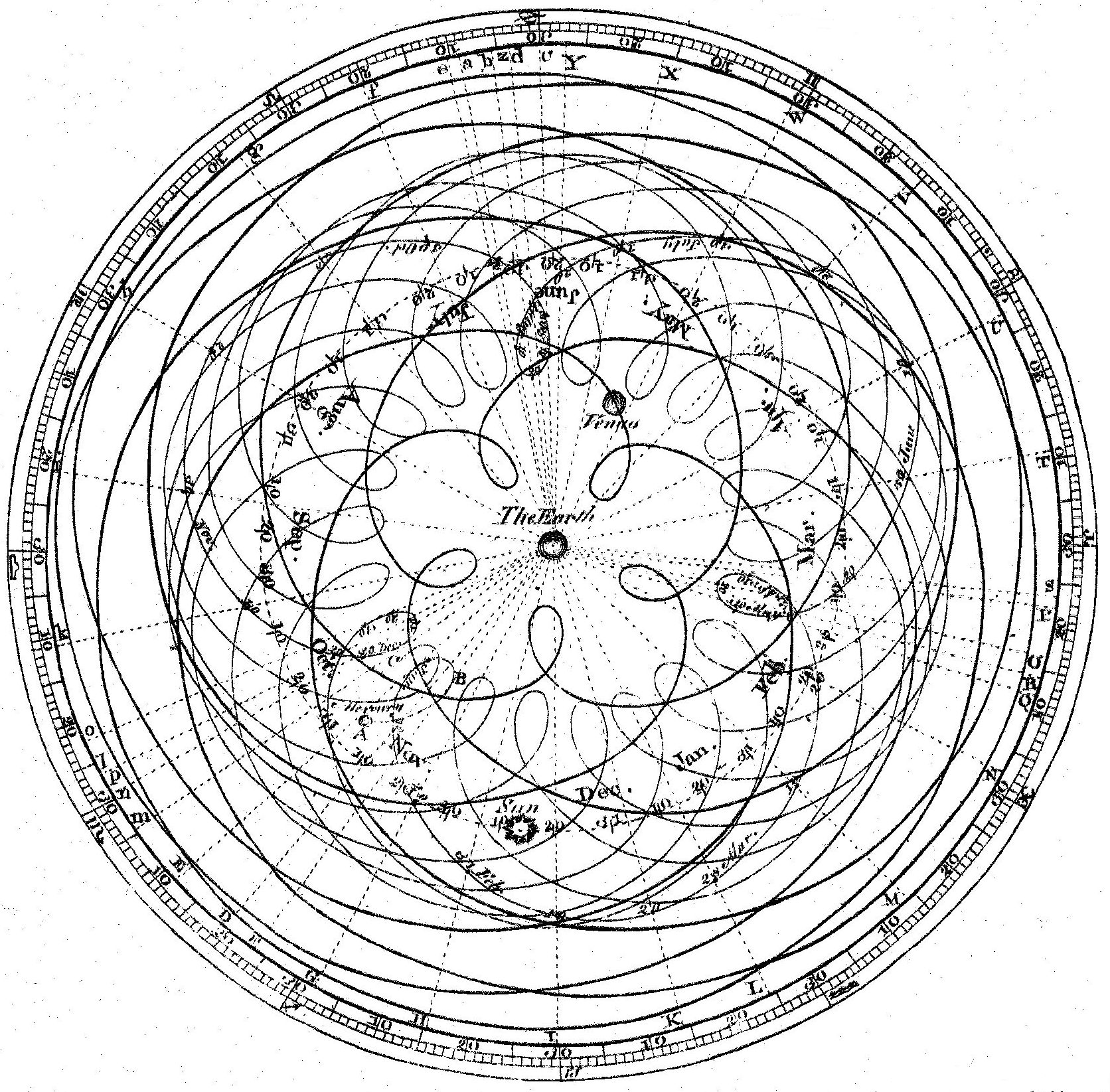
The apparent movement of sun and planets with Earth as center Giovanni Domenico Cassini, 1625–1712
Behind all other philosophies, there are two basic ways of looking at the universe, the materialistic and the transcendental views.
NOTE: Do not confuse transcendental as used here with the so-called Transcendentalism movement of the nineteenth century which was really a Naturalistic or agnostic philosophy.
NOTE: Materialism, in the philosophical sense, is not the love of things as the term is used today, having been corrupted by the popular culture. It is really the denial of the existence of anything beyond the material world.
The materialist view says the physical universe that we see and interact with is all that there is, and it is its own explanation for being. The transcendent view says there must be something more behind and above it all, an overarching force that is responsible for existence itself and the physical laws that give order to the universe. This blog reflects my transcendental beliefs that there must be something beyond the material that is beyond the reach of science. As a transcendentalist and a scientist, I have no reservations about science and religion being compatible.
“Try and penetrate with our limited means the secrets of nature and you will find that, behind all the discernible concatenations, there remains something subtle, intangible and inexplicable.”
Albert Einstein
Since materialists only believe in what they can see and touch, pure materialists are necessarily atheists and have a great deal of reservations about religion, especially as it relates to science. Even the agnostic, who is uncertain about a transcendent quality to the universe, is not comfortable with the notion that science and religion are compatible, since he believes that there is no way for us to know about anything outside the material world.
Joke: What do you get when you cross an insomniac agnostic and a dyslexic? Answer: A person who stays up all night wondering if there is a Dog.
Chico Marx (often attributed to Groucho Marx)
Science is the pursuit of truth about the predictable, repeatable and measurable aspects of the universe with which we can or could conceivably interact[1].
Anything beyond that is not science but philosophy, no matter how much mathematics or “supporting” data is attached. A one-time event that cannot be tested or repeated, such as the origin of the universe or the origin of life cannot be elucidated purely through science.
Materialists/atheists sometimes use the fact that we can only observe and test the physical world as proof that there is nothing else beyond that. Although science, in its truest sense, is an unbiased quest for the truth, that does not mean the people in the sciences are always unbiased or have no hidden agendas outside of science. Similarly, although religion seeks answers from a God centered perspective, man’s interpretations of God’s revealed truth may at times lead to error through misunderstandings or cultural bias.
As a Christian, I believe God’s revelations in the Bible are true, but I also believe that man’s interpretations can sometimes be wrong. An example of this from history is the supposed flat-Earth belief in the European Middle Ages, (which, by the way, is a nineteenth century myth[2]). Those few holding this belief had interpreted “… the four corners of the earth,” in Isaiah[3] and Revelation[4] to mean the Earth had four literal corners and was thus flat. What was obviously meant were the four directions.
Even at that time, the belief in a flat Earth was not widespread and a spherical Earth had been common knowledge[5] especially for sailors who clearly saw the curvature of the horizon and saw sails appear over it before the ships appeared. It was evident in earlier ages that the Earth cast a circular shadow on the moon, especially during lunar eclipses. The ancient Greeks and other cultures in antiquity knew the Earth was a sphere and actually calculated its circumference by triangulation.
“The discovery of truth is prevented more effectively, not by the false appearance things present and which mislead into error, not directly by weakness of the reasoning powers, but by preconceived opinion, by prejudice.”
Arthur Schopenhauer
Contrary to what you may have been taught, true science and Christianity are thoroughly compatible, and Christians have contributed greatly to the foundations of science. Anyone who believes in God must also believe that God invented science and gave us the ability to understand the laws of the universe. More than any other religion, Christianity taught that God had created an orderly, understandable universe that obeys natural laws. In this view, it is left to individuals to discover what that order and those laws are.
Science seeks the truth of WHAT, WHERE, WHEN and HOW things happen.
Religion seeks the truth of WHY things happen, WHO might have caused them and for “what” ultimate Purpose.
Therefore, we would not expect science to say anything at all about the why and who of religion, or for religion to necessarily seek spiritual answers in the what, where and how of science. The two are separate but complementary parts of the whole picture. They both seek to understand our “world” but approach it from different directions. Some agenda driven scientists who campaign against a belief in God have stepped beyond science into what amounts to a religion of evangelical atheism, which is also based on faith. Just because science can only study the material world does not mean there is nothing else outside it that is beyond the reach of science.
Because they choose not to believe in God or miracles, materialist atheists choose to define a miracle as breaking the physical laws of the universe. However, it is not necessary for God to break and act outside of his own physical laws to do things we don’t understand based on our limited knowledge and beliefs. Based on superior knowledge of a system he invented, God can use the natural laws in unique ways to do things seemingly impossible perhaps even including manipulating time and space. Similarly, magic acts appear to break the laws of logic but are really doing something else that is hidden from the audience.
A closed minded, dogmatic scientist is an oxymoron[6] and is not a true scientist at all regardless of her credentials. Science is a developing discipline where new knowledge sometimes radically changes accepted theories. The universe is filled with mysteries and unanswered or unanswerable questions. A true scientist must keep an open mind about all possibilities and admit that some things are not known or not even knowable. It is not necessary to make up clever stories to compensate for the missing knowledge, much less teach such speculative beliefs as settled science. It is OK to say “I don’t know” unless you are pushing an agenda other than truth. When scientists fill in gaps in knowledge with clever “just-so” stories, it is a Science of the Gaps[7] and is not science at all.
As a scientist, I use the tools of science to search for truth about our world. I think it is safe to say that there are prejudices and fiercely held beliefs on both sides. But beliefs are not facts no matter how many are convinced that they are true. It makes no sense to hold on to a view that has been shown to be in error, simply because it is “accepted and established.” Nor is it useful to stoop to name calling, slurs and other put-downs of those on the other side of an issue. Consensus is alien to science and is only properly used for opinions, not facts, in cultural and political settings. Consensus can lead into egregious errors. Remember, before Copernicus and Galileo the consensus was that the entire universe revolved around the Earth. Truth is never the result of a popular vote.
“To be a faultless member of the flock, first one must be a sheep.”
Albert Einstein
Nowhere is it more evident today than in the subjects of evolution and the origins of life and the universe. Both sides of these questions are often so steeped in their own emotional capital that their judgment and willingness to honestly debate may be clouded. For some, there are no grounds for discussion, much less any compromises. The other side is often viewed as either evil, ignorant or having sinister hidden motives. Science by definition is the quest for truth about our world; it has no business being closed minded and dogmatic to the point of preaching against religious belief or God based on materialist beliefs and prejudices.
The actions of a scientist are closer to a religion than true science when he insists that religion is bad and that everyone must believe as he does. Unfortunately, evangelical atheism has often used science to further its “religion.” This has also been true of the Progressive and Socialist political agendas that often go hand in hand with it. Both philosophies have effectively used the all too gullible press as a weapon in their war on both religion and truth. It is impossible to separate science, politics, popular culture, religion and the role of the press in the search for truth. They are all irreversibly entangled.
Because evolution is such an emotionally charged subject, when I started to write my book I was inclined to give it a minor role compared to other mysteries. However, when I studied it further from all sides, I realized that evolution was the beginning of and the role model for promoting most of the later dogma disguised as science, and belief disguised as truth. Its presentation in the popular press rather than peer reviewed scientific journals[8], the political style of rhetoric used to promote it, and the types of defensive arguments employed, taught later generations how to promote their points of view in other fields. In many areas, science has been hijacked by materialists who promote progressive and anti-God views through philosophical story-telling disguised as science.
Evolution is also a good example of entrenched dogma that the adherents insist must be accepted without question. As such, it is closer to myth than science. Science is never chiseled in stone. It is a changing discipline where nothing and no one are held sacred or inviolable. New knowledge is always to be encouraged and should never be seen as a threat. If any area of science does stifle dissenting views, it is not science anymore; it is a religion or at least a strongly held philosophy. Unfortunately, the fields of evolution, origin of life, cosmology and particle physics have become so dogmatic that dissent or differing views are attacked, defunded and blocked from publication in scientific journals.
“In view of such harmony in the cosmos which I, with my limited human mind, am able to recognize, there are yet people who say there is no God. But what makes me really angry is that they quote me for support of such views.”
Albert Einstein
[1]The Capricious Cosmos by Joe Rosen, 1991, Macmillan, New York.
[2] Popularized in A History of the Life and Voyages of Christopher Columbus, 1828, by Washington Irving.
[3] Bible: Isaiah 11:12 – “And he shall set up an ensign for the nations, and shall assemble the outcasts of Israel, and gather together the dispersed of Judah from the four corners of the earth.” (King James version)
[4] Bible: Revelation 7:1 – “And after these things I saw four angels standing on the four corners of the earth, holding the four winds of the earth that the wind should not blow on the earth, nor on the sea, nor on any tree.” (King James version)
[5] Bible: Isaiah 40:22 – “It is he that sitteth upon the circle of the earth, and the inhabitants therof are as grasshoppers; that streatcheth out the heavens as a curtain, and spreadeth them out as a tent to dwell in.” also Job 26: 7 – “He stretcheth out the north over the empty place, and hangeth the earth upon nothing.” (King James version)
[6] Oxymoron – a combination of contradictory or incongruous words such a “cruel kindness”
[7] A takeoff on the God of the Gaps claim of atheists to characterize any belief in a creator or design.
[8] Except for the original verbal presentation of a paper on the subject to the Linnean Society.