Evolution: Setting the Stage Part 4

Charnia Pre-Cambrian fossil

Evolution from the Beginning

When Charles Darwin published On the Origen of Species in 1859 evolutionary theories had been around for a long time. The third century BC Greek philosopher Epicurus derived a form of evolutionary theory from Democretus’ atomic theory. Lucretius, first century BC Roman poet, proposed it as a logical necessity of naturalism in order to explain life arising from nature alone without divine intervention. It was resurrected in the Renaissance through the Age of Enlightenment in a number of forms. See the table.

Charles Darwin had been introduced to evolutionary theories through his grandfather, Erasmus Darwin, a physician, inventor and poet. See an evolutionary verse in the box below. Erasmus Darwin was a friend of William Wordsworth and Samuel Coleridge and their contemporaries who admired his poetry. Mary Shelly wrote Frankenstein after reading of his galvanic experiments on animals. He was an advocate of evolution by acquired characteristics, a theory later popularized by Jean-Baptiste Lamarck and which was still later discredited as having no viable mechanism. Charles’ family was wealthy, being associated with the Wedgwood fortune. Both sides of the family were Unitarian free thinkers, but the Wedgwood side leaned toward Anglican, at least socially. In this environment and later through his brother Erasmus’ circle of friends, Charles was exposed to the intellectual elite of the day.


Organic life beneath the shoreless waves

Was born and nurs’d in ocean’s pearly caves;

First forms minute, unseen by spheric glass,

Move on the mud, or pierce the watery mass;

These, as successive generations bloom,

New powers acquire and larger limbs assume;

Whence countless groups of vegetation spring,

And breathing realms of fin and feet and wing.

— Erasmus Darwin, The Temple of Nature, 1803


 Evolution theories before Darwin (click to follow link)

Charles’ father Robert was a physician and wished for Charles and his older brother Erasmus Alvey Darwin to follow suite. The brothers attended medical training together at the University of Edinburgh. Erasmus graduated as a physician, but was retired on a pension at age 26 by his father because of his frail health. He spent the rest of his life entertaining the intellectual elite. Charles did badly in medicine, probably because his interests lay elsewhere. While there, he studied with naturalist Robert Edmund Grant who was a proponent of Lamarck’s acquired traits evolutionary theory and homology, a belief that similar form meant common ancestry. He learned stratigraphic geology from Robert Jameson and also studied plant classification and taxidermy.

Later, his father sent him to Christ’s College where he received a BA in theology. His father had procured a position for him as an Anglican pastor, but Charles never was ordained and did not practice. More interested in natural history, he studied botany and geology and aspired to travel for study in the tropics, a popular avocation of young men of independent means. One of his professors, John S. Henslow, got him an unpaid position on the HMS Beagle as gentleman’s companion to Captain Robert FitzRoy on a voyage to map the coastline of South America. Darwin spent his time collecting fossils, plants and animals from South America to the Galapagos Islands to Polynesia. Because Professor Henslow popularized the collections he sent back before his return, Darwin was a celebrity when he arrived home.

When Charles returned from his five year around the world trip in 1836, he published detailed journals of the trip, as well as other scientific books, and delivered papers to the Geological, Geographical and Zoological Societies. He spent another twenty years studying barnacles, pigeon breeding and similar subjects. He never addressed Evolution in any of these publications. He did not publish On The Origin of Species for 23 years! Supposedly he did not publish earlier because he feared reprisals, but being of independent means, being recognized as an authority in his field, and actively dialoging with leaders of the day about other theories of transmutation of species, this seems to be a thin excuse invented by later authors. This excuse was never alluded to in his book. Instead, he described working on it steadily over all those years and that he chose to publish his “abstract” (On the Origin of Species) due to failing health, although he said it would take three or four more years to complete his work.

It wasn’t until Alfred Russell Wallace, a naturalist and admirer, sent Darwin his observations and theory of Evolution while still away on a voyage to the Malay Archipelago and Borneo, that Darwin’s theory was (hurriedly?) presented and published, establishing primacy over Wallace. To his credit, when his friend Charles Lyell presented the joint papers[1] to the Linnaean Society, Darwin acknowledged Wallace as co-founder of the theory. Claiming to have sat on his theory for over twenty years, he rushed to publish On the Origin of Species which he described as an unfinished manuscript without supporting facts, acknowledgements or references[2]. This state was little improved even in the Sixth (and last) Edition, which was only minimally changed from the first edition except for historical recognition of others before him and attempts to address some of the most important scientific criticisms.

I have always wondered whether Wallace was the true originator of a theory that Darwin had overlooked in his own observations, although he had written letters to Joseph Hooker and Asa Gray earlier hinting at an evolutionary theory. Did Wallace provide the link that brought all his speculations together? Because he was backed up by his friends Joseph Hooker and Charles Lyell in his claim of primacy, we may never know. It is sure that the scientific reputation of Wallace declined, while Darwin’s grew. It is interesting to note that Wallace later rejected the theory as lacking both mechanism and sufficient evidence. Others have also speculated about Wallace being the true originator of the theory.

[1] Presented as On the Tendency of Species to form Varieties; and On the Perpetuation of Varieties and Species by Natural Means of Selection. It was composed of two papers, Wallace’s On the Tendencies of Varieties to Depart Indefinitely from the Original Type and Darwin’s Abstract Extract from an Unpublished Work on Species along with Abstract of a Letter to Asa Gray (to establish primacy).

[2] On the Origin of Species, first edition, Introduction, paragraph 3 & 4.

The Evidence that CO2 is Not the Problem

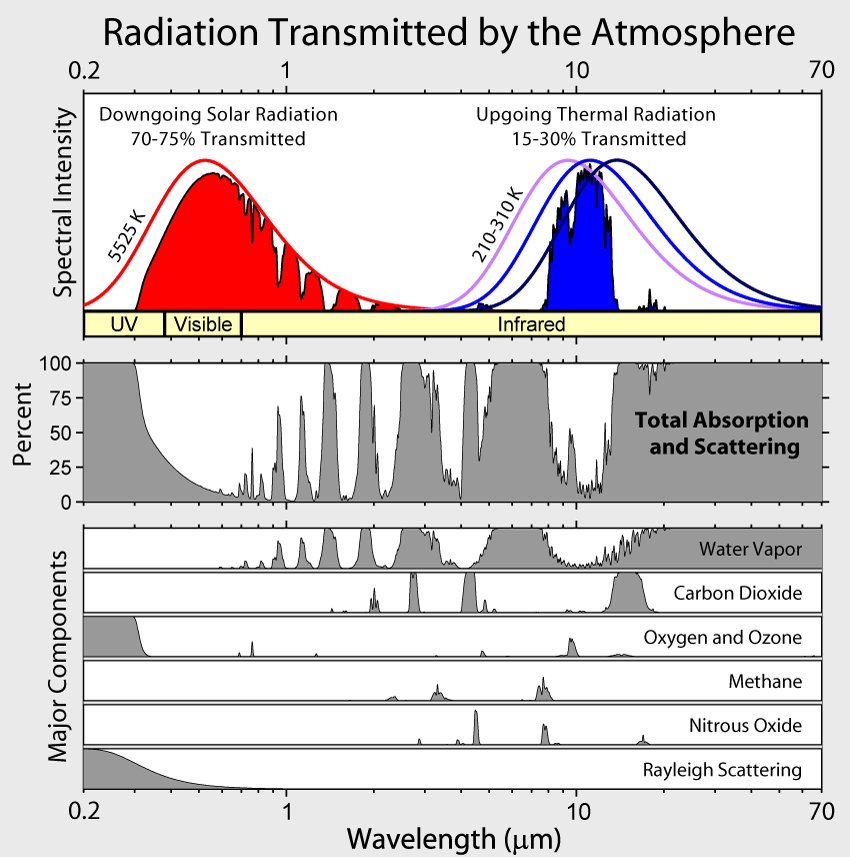
Atmospheric Transmission of Different Gases

http://www.globalwarmingart.com/wiki/File:Atmospheric_Transmission_png

Source: Robert A. Rohde (Dragons flight at English Wikipedia) – This figure was created by Robert A. Rohde from published data and is part of the Global Warming Art project. http://www.atmo.arizona.edu/stud

This figure requires a bit of explaining. The top spectrum shows the wavelengths at which the atmosphere transmits light and heat as well as the “black body” idealized curves for no absorption. It is a little misleading because the data is not based on actual solar and earth data. It is based on two experimental heat sources, one centered at 5525 K (5252o C or 9485o F), the approximate temperature of solar radiation, and one centered in the range of 210 to 310 K (-63o C to 36.8o C or -82oF to 98o F), the approximate temperature range of re-radiated heat from the earth. In reality solar radiation power, (Watts/m2/micron), shown in red, is six million times as strong as the power of re-radiated heat from the earth, shown in blue.

The other spectra are absorption[1] spectra. The top one shows the relative percent absorption by total atmospheric gases at various wavelengths, (note that this spectrum is practically the inverse of the transmission spectrum above it), and the spectra below that show the absorption wavelength ranges of individual atmospheric gases, but not the relative strength of that absorption in reality. As experimental, not real atmospheric, data they can only tell us the wavelength ranges of the absorption, not their relative strengths.

Note that CO2 absorbs in the 15 micron range[2], which is within both the range of re-radiated heat and the strong absorption by water vapor, of which the CO2 peak forms a mere shoulder. This is used to claim forcing of water vapor by CO2, without regard to the real near-saturation level of CO2 absorption.  Lesser CO2 peaks in the 2.7 and 4.3 micron ranges also only contribute in a minor way, the first is completely covered by a water vapor absorption peak and the second forms a shoulder in another water vapor peak. These minor peaks occur in a region where both solar radiation and re-radiation are minimized. Methane and nitrous oxide are also shown to be minor players, having narrow absorption ranges and low concentrations. Note too that ozone blocks most of the ultraviolet light from the sun.

The CO2 hypothesis is based on bad science; first that of John Tyndall, 1862, and then of Gilbert Plass, 1955.

  1.  In 1872 John Tyndall measured the heat absorption of various atmospheric gases over the entire wavelength range of his heat source. He found that water vapor and CO2 absorbed more strongly than other atmospheric gases such as oxygen and nitrogen. Oxygen and nitrogen, major components of the atmosphere, had little or no absorption of heat in the range tested. It is important to note that his experiments did not separate the heat into specific wavelengths.

Quote: “…if, as the above experiments indicated, the chief influence be exercised by the aqueous vapour, every variation of this constituent must produce a change of climate. Similar remarks would apply to the carbonic acid [CO2] diffused through the air… they constitute true causes, the extent alone of the operation remaining doubtful.”

Contributions to Molecular Physics in the Domain of Radiant Heat, John Tyndall, 1872, Cambridge University Press


2.  In 1955 Gilbert Plass claimed that a doubling of CO2 would result in a 3.6 degree temperature increase.


Quotes:  “ … average surface temperature of the earth increases 3.6o C if the CO2 concentration in the atmosphere is doubled …”

 “The extra CO2, released into the atmosphere by industrial processes and other human activities may have caused the temperature rise during the present century. In contrast with other theories of climate, the CO2 theory predicts that this warming trend will continue, at least for several centuries.”

The Carbon Dioxide Theory of Climatic Change by Gilbert Plass, 1956, Johns Hopkins University


This was followed by mathematical climate models, originally in climate alarmism testimony before Congress, 1988, by James Hansen at NASAs Goddard Institute for Space Studies that was based on calculations that worked for Venusian atmospheric gases, Sulfuric Acid clouds and a thick, heavy CO2 atmosphere.  The models exclude clouds as a factor and claim a forcing of water vapor heat retention.  The premise  only works if evaporated vapor remains as low level vapor rather that forming clouds.

NOTE: Figure:  “Radiation Transmission by the Atmosphere” was reinserted 8/22/2020 because of a broken link in the original.


Evolution: Setting the Stage, Part 2

Marx_and_Engels

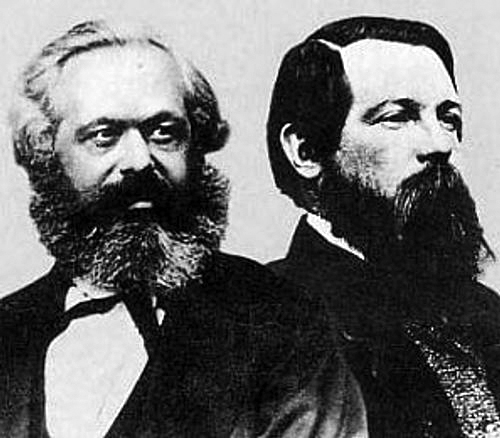
Karl Marx and Fredrick Engels    Source:  Wikipedia, Public Domain

Socialism / Communism

Socialist thought began to be accepted in the 17th century (or even earlier) and flourished in the 19th and early 20th centuries. Socialism is actually a kind of social Darwinism or social engineering. It is based on a misunderstanding of human nature and a belief that man’s very nature could be molded and improved. This was based on the belief that the world is naturally progressive and everything, including human nature, is being continually improved throughout time.

The socialist dream sounds wonderful: everyone working for the common good and no one going without. Unfortunately, this belief has proven again and again to be wrong. Human nature is basically Self-centered, and in general man is generous and altruistic only after personal needs and desires are met. Humans are motivated by a focus on Me first, then spouse and children, then extended family, then friends, then local tribe and only then extending to local and state authority, to country and to the greater global society last.

Man naturally is very compassionate and generous toward those in need of charity, but only after his basic needs are met. Socialism requires that man’s focus be on the state (or society as a whole), while putting himself and his own interests last. This is the exact opposite of man’s true, unchanging nature. Habits and attitudes can be taught to a certain degree, but it has been demonstrated many times that man’s basic selfish and imperfect nature cannot be changed.

As the Plymouth colony learned, (see Part 1), without personal rewards for his achievements, a person’s motivation to produce is reduced or eliminated along with most of his creativity and efficiency. At the same time, his selfishness, envy, resentment and deceit grow as a result of perceived inequities. In such a society, the lazy person who hardly contributes at all gets as much as the hard working person who produces most of what is shared.

In labor unions where all members are rewarded equally whether they are cracker-jack contributors or space filling dead wood, resentment is rampant and efficiency and productivity suffer. Such unions discourage excellence and encourage minimal or status quo contributions. In the absence of an overarching internally motivated altruism, socialist societies must be tightly and thoroughly controlled by the state, ultimately resulting in totalitarian dictatorships or at best dictatorial bodies of an elite class in order to force people to behave as is required to maintain the society.

Unfortunately, socialism/communism also leads to moral degradation wherein cheating, lying and other forms of deceit are used to gain perceived or actual basic needs or an advantage over others. A prime example is the old Soviet Union, where morals and ethics have suffered greatly from real or perceived deprivations. As a general rule, needy is greedy. Everyone may be equal, but everyone, except the elite, is poorer for it.

Essentially we are back to monarchies and privileged gentry oppressing serfs or slaves “for their own good.” So much for equality as espoused by socialism, communism and their ilk. It is a very old, very bad idea that results in a return to old oppressions and a loss of basic freedoms and inalienable human rights “endowed by our Creator.”

But wait, what about the utopian dream? Marx presented his philosophy as a series of steps where, through the principles of dialectical materialism[1], society progresses from original oppression by the bourgeois[2] under capitalism[3] through struggle to a “dictatorship of the proletariat[4]” to a utopian state where governments are unnecessary and fade away on their own. Unfortunately, it never goes beyond the dictatorship stage because the utopian dream is totally unrealistic, unworkable and unsustainable in the real world due to the inherent and unchangeable nature of man and to reality in general. Marx never explained how the society would take that final step from dictatorship to utopia. People in power want to stay in power. It is totally unrealistic to expect them to voluntarily give that up.

Even if utopia were attained, how would the utopian society be organized and maintained without essentially robotic altruism to the society[5] by every individual and (again) strict control from the top to keep it all going? Like monarchies and dictatorships it is still all about control by an elite group. In recent fiction, Star Trek is a model of a utopian society. Poverty has been eliminated and altruism is the norm. No one is envious or resentful of others’ successes, and everyone gladly obeys orders from a wise and benign leader toward a common goal. However, the real world is more like Babylon 5 with all of its intrigues, envy, resentment, prejudices, hatreds and inequities. Man’s nature cannot be denied, and control through coercion and rewards is necessary for even a “utopian” society to function. Heaven on earth is impossible as long as imperfect people are involved.

Unfortunately, even today there are those who would throw away their freedom, in the form of excessive regulation and government control, to gain a (false) sense of security under the control of a supposedly wiser elite. It seems there are some who are uncomfortable with freedom, with all its risks and opportunities, and who desire a nice safe cage. (Some intellectuals and elitists who espouse the socialist philosophy assume that they will be among the elite and are only uncomfortable that others are not controlled. However, most of these people will end up being the controlled, not the controllers.)


They, who can give up essential liberty to obtain a little temporary safety,  deserve neither liberty nor safety.                    —Benjamin Franklin


Christianity is built on the value and importance of the individual whereby everyone benefits freely as a result of freely practiced moral values such as duty, honor, charity, respect and equality of opportunity (not outcome, which is unrealistic)[6]. Socialism in its many forms, does not value the individual but rather sees people as groups that should (be compelled to) work for the greater good of the whole, regardless of whether it is good for any one individual. These two philosophies are diametrically opposed. Socialism can only succeed if Christianity is either eliminated or tightly controlled as a purely social ritual. That is why socialism and atheism are such good partners, and behind socialism is the ever-present progressivism.

The belief in a naturally progressive universe says that everything from the universe to molecules is evolving toward perfection, with no room for absolutes, not even moral ones.   If the entire universe is believed to be naturally progressive, then there is no need for a God to have caused or influenced it. It is its own reason for being. To those who espouse atheism or socialism in its various forms, progressivism is what gives meaning to life and their cause, essentially replacing God. It gives them a purpose and a satisfaction in furthering that assumed natural progress. That is why it has such a strong hold on its believers, especially those who wish to engineer a socialist utopia or stop evolution in its tracks to “save the planet.”

The progressive universe itself becomes their de facto god, and social change toward a dreamed-of perfect utopian paradise becomes the goal and their purpose in life. Since no cultural or social system has ever achieved the perfection envisioned, to the progressive the present system, whatever it may be, must be changed to further that perceived progress. This makes it a perfect philosophy for young radicals who wish things were better but lack the life experiences to see the broader picture or the unintended consequences of rampant social change.

However, remember the maxim: all progress is change, but all change is not progress. That is, unless you believe that progress is inevitable as do the progressives. But progress requires work while regress is the natural state of things. A boulder perched on the edge of a cliff, given enough time and erosion, will naturally roll down (regress) by necessity, but pushing it back up to the top (progress) requires work. Progress is not a natural thing; it must force its way against the regressive nature of the universe. The Second Law of Thermodynamics states that entropy always increases – that chaos or disorder always increases and usable energy always decreases. This is the opposite of the progressive philosophy. Dust, death and decay are natural results of the real world.

If the universe is naturally progressive, then everything must be interpreted as progressing or “evolving” toward perfection, whether it is molecules, life, earth, stars, galaxies or the universe.   The fixed laws and values of basic physics, such as the force of gravity or the mass of the proton, are a great mystery to those who reject all absolutes in favor of universal progress. These values are under constant attack by theorists using deductive reasoning, i.e. “pure” reason, rather than inductive reasoning based on reality, experiments and observation.

This is the case of cosmology and particle physics today. They start with an a priori[7] hypothesis, based on assumptions about how the universe must behave, and produce complex mathematical equations to model an imagined perfectly symmetrical, homogeneous and beautifully progressive universe. In areas where reality conflicts with the theory that is based on pure mathematics, the facts are either ignored as anomalies, reinterpreted to make them fit or new layers of complexity are added to their calculations. Never is the theory questioned.

Why all the expounding on progressivism and its partner socialism with its unrealistic view of human nature, and ultimately its tragic results? First of all, it is a perspective on the pseudoscientific theories discussed in this blog that are all about control of thought by an elite class of “experts” who are not to be questioned. Progressivism and Socialism have influenced or control the foundations of most of modern science and academia today.

That does not mean that real scientific achievement is not valid or does not advance our knowledge of our world; it means that real results are often interpreted to fit the prevailing progressive paradigm. For instance, if DNA of similar organisms is less different than dissimilar ones, which is expected if DNA determines form and function, it is not acceptable to just state the known facts and note the similarities and differences. The very real data must be fitted into the evolution paradigm by concluding that similar DNA means that they must have evolved from a common ancestor. While this may or may not be true, it is far from proven. It is a leap of faith and a philosophy based on existing paradigms.

Secondly, Darwinism and Eugenics[8]specifically have been used as tools and extensions of socialist philosophy throughout its history. Pre-Marx progressive socialist thought itself nurtured Darwinism. Darwin’s theory of Evolution by survival of the fittest (class struggle in socialist parlance) through natural selection arose amidst this nineteenth century pre-Marxist socialist-progressive era. In the context of the prevailing philosophies, this meant to the materialists and humanists that once and for all religion could be eliminated. It seemed to confirm their social ideas that the world was naturally progressive and did not need any outside forces to bring it about. Using the theory of Evolution, religion could be replaced by materialism, humanism and socialism as the new “religion” of the people.

[1] Dialectical materialism supposedly progresses from thesis (original idea) through antithesis (opposition) to synthesis (final form).

[2] Bourgeois (originally a resident of a town or burgh) is defined in Marxism as the (supposed oppressor) upper and middle classes as opposed to the Proletariat defined as the (supposedly oppressed) lower classes. (Proletariat is originally from the Latin proletarius, for citizens lacking property that were exempted from taxes and military service and could only contribute to the state by having children.) This assumes that there is a strict class order rather than a fluid classless society whereby individuals assume ever changing positions based on effort and ability.

[3] Capitalism was coined by early socialists from capital, which originally meant head and later meant property or money.

[4] Dictatorship of the proletariat is really a dictatorship by elites with special privileges over the masses which are tightly controlled.

[5] Only colony animals such as ants, bees and a few rare vertebrates behave like that without coercion.

[6] To be a Christian is to believe in Jesus Christ, repent of sins and rely on Him. Unlike all other religions, it is a religion of Faith, not works. The Christian does good works not to ensure his salvation, but to emulate Jesus, follow His teachings and please God, all done out of gratitude for salvation already gained through simple Faith.

[7] A priori means presumed from the beginning; self-evident; intuitively obvious.

[8] Eugenics is a “science” that deals with the improvement (as by control of human mating) of hereditary qualities of a race or breed. Systematized by Francis Galton, Charles Darwin’s half-cousin in the late 19th century in which he advocated controlled breeding to prevent mankind from falling into mediocrity by regression towards the mean. This system was later used by the Nazis (National Socialist Party) in their pursuit of the master race, and was used to justify the elimination of Jews and other “undesirables”.

Does the observer determine outcomes in quantum physics ?

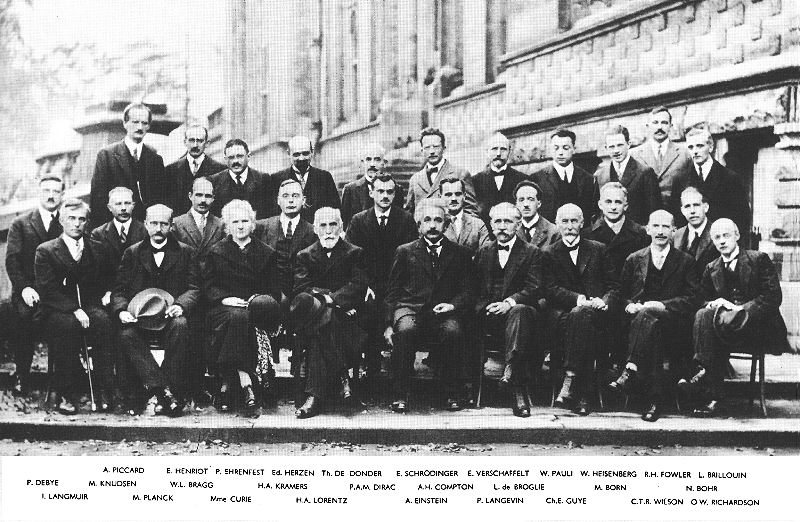
Solvay Conference on Quantum Mechanics 1927

Quantum Mechanics or Quantum Theory, which is based on complex mathematics, tries to describe and explain the odd behavior of particles and forces in the atomic and subatomic realm. In this theory, things don’t happen in a smooth (analog) manner but in a punctuated (digital) manner Electrons move around the nucleus at high speeds so that their exact location at any one moment is not known precisely without measurement. The likelihood of finding a given electron at a particular place in its orbital is described by a probability, thus defining the electron “cloud” or “shell.” An electron jumps from one allowed orbital to another by absorbing energy (a photon) at a specific energy (wavelength).

The absorbed photon at a specific energy level is called a quantum, thus quantum theory. The electron will also fall from this “excited” state back to its more stable “ground” state orbital by emitting a quantum of energy. Electrons exist or move between one allowed energy state (orbital) and another based on discrete quanta of energy that they absorb, emit or carry. Each element has unique orbital energies so that light interacting with an atom shows absorption and emission lines at specific wavelengths that can be used to identify the element.

Wave-Particle Duality:

In Quantum Theory, subatomic particles are described as both particles and waves simultaneously. This is referred to as wave-particle duality. All types of energy, including subatomic binding forces, are also defined as both particles and waves, so that matter and energy are treated as if they are the same thing. Both subatomic particles and photons sometimes act like waves and sometimes like particles, depending on how they are tested or detected. Two experiments are noted as evidence: the double slit interference patterns and the photoelectric effect in which electrons are emitted when light is shined on a metal surface. Einstein assumed this proved that energy waves were really made of particles that he called photons.

The double slit experiment is said to demonstrate the wave nature of particles and photons. The photoelectric effect is said to demonstrate the particle nature of particles and photons. Wave-particle duality rests on the assumption that single photons or particles are being measured. Since all detectors have threshold sensitivities below which nothing is detected, it could mean that multiple, not single, photons or particles are really being tested[1]. This would explain the interference patterns seen when either photons or electrons are tested in the double slit experiment. Photoelectric experiments may also be misinterpreted. It is possible that absorbed energy, not photon particles, causes emission of loosely held electrons on the metal surface. Granted, this is speculation at this time, but calls for more study.

Copenhagen Interpretation:

In the widely accepted Copenhagen interpretation of quantum mechanics, a particle is said to not have a fixed state but exist in a smeared out multiplicity of states at once until a measurement is taken when it “collapses” into one state. The observer (or detector) becomes a part of the quantum system. This is the principle of superposition. Because an electron can be found in any of the probability-allowed “shell” locations, this interpretation assumes that the electron really is at all the locations or states at once and only assumes a fixed state when measured. This assumption extends to all of the characteristics of the electron such as position, spin or momentum. This assumption also extends to all other subatomic particles and photons (energy particles).

The Copenhagen interpretation of Quantum Theory also says the electron exists in one or the other allowed orbital level but does not exist anywhere between.   When a quantum of energy is absorbed the electron is said to pop out of existence in the original shell and simultaneously pop into existence in the new shell. But, since the electron shell defines a probability, and most of the time the electron exists in one of these shells, the probability of finding it anywhere between is statistically infinitesimal.   It is said not to exist there, and it is thus called “forbidden.” Is it only an extremely small probability or are we talking about its actual existence? The Copenhagen interpretation of Quantum Theory says it is the latter. Other interpretations of Quantum Theory differ as to what actually happens. See list below.

Uncertainty Principle: Ontology or Epistomology?

 In trying to measure these discrete orbitals and their electron locations and momenta, it became apparent that measurement of any kind disturbed the system so that only one of two coupled parameters could be determined at any one time, e.g. position and momentum (or speed). This led to the Heisenberg Uncertainty Principle, which states that it is impossible to know both the position and the momentum of any one subatomic particle at the same time. The system is disturbed by measurement because measuring subatomic particle parameters is like administering eye drops with a fire hose. Because the subatomic particles are so small compared to any means of measuring their parameters, what is measured is in a disturbed condition.

The Heisenberg Uncertainty Principle was meant to be a statement of experimental limitations, not that location and momentum (or other coupled parameters) did not exist in a fixed state at the same time. However, Bohr and other Copenhagen interpretation proponents interpreted it that way, assuming that atoms or atomic particles were never in a fixed state until measured, and that uncertainty is a fundamental characteristic of subatomic particles, not just an experimental limitation. Thus they have substituted ontology (being) for epistemology (ability to know). Heisenberg never accepted the principle of superposition or non-locality claimed in the Copenhagen interpretation.

Superposition:

 Edwin Schrodinger provided the mathematical equations for the behavior of electromagnetic waves that are used in quantum mechanics[2]. These probabilistic differential wave equations are linear (first order), that is, they can be plotted as straight lines on a graph. Superposition is a concept in mathematics stating that in linear equations all of the contributing factors must add up to the net effect of each factor individually. Since Schrodinger’s equations for waves are linear, it is assumed that their application to subatomic particles is also linear. From there it is a leap of faith to assume that particles don’t just have the capability of being in different states, but that they are simultaneously in all possible states at once. Instead of just being a mathematical concept, superposition now was applied directly to subatomic particles in a real physical sense.

However, Schrodinger did not agree with this Copenhagen interpretation of quantum mechanics. He came up with an example within everyone’s sphere of experience that illustrated the absurdity of their assumed superposition. This was the famous Schrodinger’s Cat thought experiment. He set up the experiment so that a cat in a closed box could be either alive or dead, depending on whether a radioactive particle spontaneously decayed setting off a mechanism that released a deadly poison gas. In this thought experiment, using the Copenhagen interpretation of superposition, since we don’t know what state the cat is in until the box is opened, the cat is both dead and alive until it is opened at which time the cat becomes either dead or alive. The act of observing somehow must cause the cat to assume either a dead or alive state. In all other realms, this would be called Magical Thinking. Meant to point out the weakness or absurdity of superposition, it has been used to illustrate the opposite through convoluted “reasoning” to make it fit the Copenhagen or similar interpretations.

 Communication at a distance:

 The idea of instantaneous communication and action at a distance is a consequence of this assumed superposition where particles did not assume a fixed state until observed. By Pauli’s Exclusion Principle, no two electrons in the same orbital can be in the same quantum state. Each must differ in some way, for example they must have opposite spins. The two particles are said to be entangled since each must be in the opposite state to the other.   If one of the electrons is emitted and travels relatively far away, when one of the electrons is measured (observed), it collapses into a fixed state and simultaneously the other one collapses into the opposite state that can be confirmed when it is measured. This implies speed of communication faster than the speed of light, the assumed upper limit of speed[3].

Einstein thought that quantum action at a distance was an illusion based on the assumption of superposition, aka non-locality. If particles are assumed to have fixed states, although unknown to an observer, the action at a distance is no mystery. It only implies that entangled states, e.g. opposite spins, persist after separation. When one of the particles is measured, you automatically know the state of the other since they must be the opposite of each other, whether together of separated. Einstein spent the latter part of his career trying to prove this.

Other Interpretations:

There are more than a dozen other interpretations. The most popular, among a long list, (see table following), are the Copenhagen interpretation and its variants, the Many Worlds interpretation and the Ensemble interpretation. Variants of the Copenhagen interpretation involve either the observer or the cat (as observer and participant) as being parts of the quantum system. Another, the Many Worlds interpretation is even more speculative. In this scenario, each time a subatomic particle collapses and “chooses” a fixed state, reality splits in two and both possible realities still exist, but in different undetectable dimensions. Think of this as a time series of pictures or a strip of movie film. At the decision point, the one series becomes two, and at the next decision point, becomes four, etc. ad infinitum.

The Ensemble interpretation states that Quantum Mechanics can only be applied to statistically significant numbers of particles, not to individual particles. Since the wave equations describe probabilities, it would be meaningless to apply probabilities or statistics to single particles. This is the interpretation favored by Einstein but is discounted by leading QM physicists. Similar realistic interpretations such as those proposed by de Broglie-Bohm and science philosopher Karl Popper assume real particles with real positions and real wave functions that do not need to “collapse” upon measurement. I tend to prefer these theories because of their realism.

“The attempt to conceive the quantum-theoretical description as the complete      description of the individual systems leads to unnatural theoretical interpretations, which become immediately unnecessary if one accepts the interpretation that the description refers to ensembles of systems and not to individual systems.”

—A. Einstein in Albert Einstein: Philosopher-Scientist

Is the universe really indeterminant?

As a consequence of the probabilistic view of the subatomic world, Quantum Theory leads to a conclusion that events are not deterministic, but rather are indeterminate; that they just happen without actual connections between cause and effect. If deterministic, then events in the past must predict future events as causal antecedents. In the macro or “real” world, everything has a cause or causes, whether known or not. Determinism is the accepted view or apparent state of the real universe because, knowing the mass, position and the momentum of a (larger) body, plus all of the influences on it and the mathematical equations governing its movement, one can (in theory) calculate its position and speed at any other time in the future or the past. This is the basis of celestial mechanics by which planets, etc. are tracked.

The question is: since we don’t know for sure what the outcome according to QM will be, is it really indeterminate or are there certain things we don’t or can’t know about the system that only makes it look indeterminate? If it were possible to know all of the parameters and influences without disturbing the system could we, with certainty, predict outcomes? According to the Copenhagen interpretation of quantum theory, the universe is really indeterminant at the atomic level and only LOOKS determinant at the macroscopic level. This eliminates the infinite series of cause and effect, and therefore the question of a first cause.


[1] See also Andrew Ancel Gray at http://modelofreality.org/cgi-bin/iet.cgi

[2] Side note: These equations assume massless particles and waves. Since real particles have mass, particle physicists assume there is a particle that gives all other particles mass. The Higgs boson is the assumed particle that creates mass when a particle is in a Higgs field.

[3] It should be noted that many thought experiments and most actual experiments have been done using light, not subatomic particles. The results of these actual experiments depend on your interpretation of Quantum Theory. See other interpretations that follow.

Major QM Interpretations  (click to follow link)

What about Climate Change?

CLIMATE CHANGE: PHILOSOPHY DISGUISED AS SCIENCE

For a current example of philosophy and/or politics disguised as science, we need look no further than the climate change debate. Regardless of the merits of the case for the Anthropogenic Global Warming or AGW theory that manmade carbon dioxide is the cause of climate change, the way it has been advocated is more akin to a political campaign than to a dispassionate search for truth. Political action is advocated that would drastically change our world, crippling industry and technological progress while leaving developing nations to flounder in their poverty. The two pronged approach of this philosophy is to curtail both technology and population.

Developed countries are said to hog all the resources at the expense of developing countries. People are said to be the problem, and advanced societies must be brought down to near subsistence levels while primitive societies are not raised from their squalor. But is any of this true? Is it science or is it politics? Unfortunately, it is more about politics, philosophy and belief than about science. Are there too many people, and are subsistent societies cleaner and less ecologically harmful? Are developed nations really hogging all of the resources at the expense of developing ones? The answer to each of these questions is NO.

Typical political tactics employed include:

  1. Appeal to authority, (a logical fallacy): the “consensus of scientists” with only a very small, elite group deemed qualified to understand or comment on it.

2.  Appeal to ignorance(a logical fallacy): It must be increasing CO2 (Carbon Dioxide) because we can’t find any other cause – but we aren’t looking very hard at things like wind and water cycles or solar activity.

3.  Depend on statistics and computer models instead of real historical facts and experimental data. Remember GIGO – Garbage In, Garbage Out. A model is only as good as the data used or left out, the type of mathematical calculations based on that data and assumptions and conclusions made.

4.  Use fear to sell the agenda: Use warnings of catastrophic consequences if action is not taken immediately by governments, industry and individuals based on models of a poorly understood atmospheric and planetary system. (The Con: “special today just for you but you must call within the next 30 minutes or you’ll miss out.” or “You can save the planet, so call your congressman today before it’s too late.”)

5.  Use guilt and shame to get people, governments and industries to “go green” and curtail the activities that use fossil fuels or otherwise emit CO2.

    1. Do you use incandescent light bulbs? Then you’re killing the planet because you’re consuming power from fossil fuel driven power plants. The government must phase out incandescent light bulbs in favor of LED or compact fluorescents, (which contain mercury, a primary pollutant); we must regulate power plants to insure maximum efficiency regardless of increased cost to the consumer, which hurts the poor most.
    2. Do you eat beef? You’re killing the planet because of methane from cows. The government must regulate the methane from cows.
    3. Do you Fly, drive or use a ferry or train?  You’re killing the planet because of fossil fuel consumption. The government must demand more efficient transportation – even if CAFE[1] standards demand lighter and less safe vehicles that are killing people.
    4. Do you use manmade fibers or plastics in any form? You’re killing the planet because it takes fossil fuels to produce them – never mind that most of these things get put in a landfill, which is a form of sequestering carbon. The government must regulate the industries that produce them – and the landfills, too.
    5. Do you use paper products? You’re killing the planet because trees that could consume CO2 are cut down to produce paper. Never mind that trees are farmed and harvested and new trees are planted to more than replace those used. Younger trees consume CO2 at a faster rate per ton than older trees.

6.  Use the press to promote their views and disparage the opposition in the form of propaganda. (TV, radio, internet, movies, books, magazine and journal articles, newspapers)

    1. Present a parade of “experts” and dire predictions as absolute settled facts, not as projections of a computer model.
    2. Sensationalize and exaggerate any “fact” that supports the global warming theme and downplay or fail to report on things that don’t.
    3. Declare that the polar bears are drowning because the sea ice is melting. Never mind that polar bears can swim up to 60 miles between feeding areas, that there is no net loss of sea ice over time and that polar bear numbers are increasing.
    4. Have a storm, flood or drought? Blame it on Climate Change. Make it sound biblical in proportions and the worst in history.
    5. Have a problem with mosquitos because of a particularly wet spring? It must be Global Warming.
    6. Are the seas rising at the same rate they have been rising for centuries[2]? Oh, my God, our cities will soon be underwater and we’re all going to drown!

7.  Demonize anyone who disagrees as “deniers” with the unspoken implication that they are on a moral level with holocaust deniers. Climate experts that aren’t on board with the whole global warming scenario and who have DATA to back it up are called “just weathermen” who are unqualified to comment, even though many of them have better credentials than many of the AGW proponents.

8.  Exclude from publication or grants, any research that doesn’t agree with their conclusions, and then declare that there are few peer reviewed papers on the other side. Never mind that government funding is overwhelmingly on one side. Journals such as Science and Nature have become advocates instead of unbiased scientific publications.

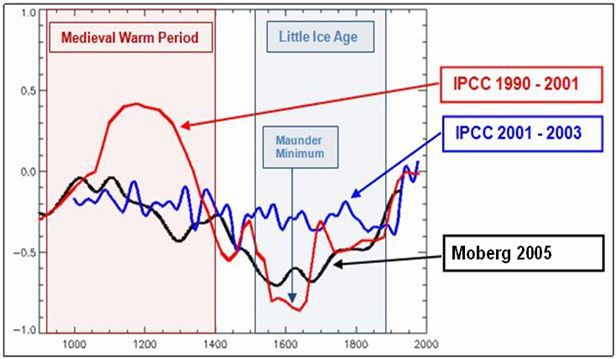
9.  Hide raw and analyzed data and analysis methods from other researchers who wish to verify the work. Real science always shares data and methods with other researchers so their results can be verified. This one includes the “massaging” of the data to say something it doesn’t. The Climate-gate scandal was all about hiding the data and massaging it to eliminate the Medieval Warm Period and the Little Ice Age and to create a “hockey stick” that was used to alarm governments into drastic control measures.   When other researchers finally got hold of the (massaged) data[3] and analysis methods, it was discovered that any random set of numbers, when plugged into the formula, produced a similar “hockey stick.” This showed that the analysis algorithm on which the computer models were based was worse than worthless.

Recorded temperature throughout history (red) vs. IPCC model (blue)

Comparison of graphs published by earlier and later versions of the IPCC Assessment on Climate Change. Note that the later graph eliminated both the Medieval Warm Period and the Little Ice Age.  Source: http://wattsupwiththat.com/2010/03/10/when-the-ipcc-disappeared-the-medieval-warm-period/  Note also that the vertical temperature scale is less than a degree above and below today’s temperature, which is set near zero on the graph.

  • The data for the line marked Moberg is available through NOAA website and is from “Highly variable Northern Hemisphere temperatures reconstructed from low- and high-resolution proxy data” Nature, Vol. 433, No. 7026, pp. 613 – 617, 10 February 2005. Anders Moberg1, Dmitry M. Sonechkin2, Karin Holmgren3, Nina M. Datsenko2 & Wibjörn Karlén3 1 Department of Meteorology, Stockholm University, SE-106 91 Stockholm, Sweden 2 Dynamical-Stochastical Laboratory, Hydrometeorological Research Centre of Russia, Bolshoy Predtechensky Lane 11/13, Moscow 123 242, Russia 3 Department of Physical Geography and Quaternary Geology, Stockholm University, SE-106 91 Stockholm, Sweden

10.  Ignore other factors that may contribute to or mediate the supposed effects of manmade carbon dioxide (such as water vapor, high and low altitude clouds, methane, increased plant growth, ocean sequestering or release, solar activity cycles, precession of earth’s tilt, Pacific Decadal Oscillation, etc.)

Manmade global warming or climate change as it has come to be called[4] is said to be an established fact, and the consequences are dire unless global governments act now to mitigate its effects. The polar ice caps and glaciers will melt away; the oceans will rise and drown coastal and island regions; droughts, floods, storms and temperatures will all increase and millions, dare I say billions, will die. But is any of it true, and is it science? The answer is NO. While there has been general warming since the “Little Ice Age” of the 17th and 18th centuries overlain with periods of lesser heating and cooling, is the change good or bad? Is it unusually rapid now and will these alleged trends continue into the future? Is it extreme enough to cause the dire effects predicted and should global governments act now to prevent the predicted disastrous consequences? It is important to know if these modeled projections are reliable predictions and if real, is real science involved in any meaningful way. What do we really know about it?

NOTE: IPCC temperature chart was reinserted 8/22/2020 due to broken original link.

[1] CAFE Standards are Corporate Average Fuel Economy Standards first mandated by Congress in 1975 during the energy crisis. These standards have been continually tightened for even greater fuel efficiency. The result is lighter, smaller, less protective and less safe cars that are contributing to highway crash deaths.

[2] Seas have been rising since the Little Ice Age in the 17th and 18th centuries at about 7 inches per century.

[3] Raw data was actually destroyed to prevent others from getting it through a Freedom on Information request.

[4] Recently there have been efforts to define it as climate disruption or climate catastrophe, implying that a tipping point is near

Did Darwin steal his theory of Evolution?

After his trip around the world on The Beagle, Darwin waited 23 years to present his theory of Evolution.  The myth is that he sat on the theory out of fear of repercussions. However, when Charles Darwin published On the Origen of Species in 1859 evolutionary theories had been around for a long time.  There were at least a dozen evolutionary theories, including one by Erasmus Darwin, Charles’ grandfather, in the late eighteenth and early nineteenth century that were openly debated among scientists.

Alfred Russel Wallace 1862 - Project Gutenberg eText 15997
Alfred Russel Wallace 1862

It wasn’t until Alfred Russell Wallace, a naturalist and admirer, sent Darwin his observations and theory of Evolution while still away on a voyage to the Malay Archipelago and Borneo, that Darwin’s theory was (hurriedly?) presented, acknowledging Wallace as co-discoverer, and published, establishing primacy over Wallace.  Was Wallace the true originator of a theory that Darwin had overlooked in his own observations?  Did Wallace provide the link that brought all his speculations together?  Darwin’s claims were backed by his friends Charles Lyle and Joseph Hooker, so we may never know the truth.  It is sure that the scientific reputation of Wallace declined, while Darwin’s grew.  It is interesting to note that Wallace later rejected the theory as lacking both mechanism and sufficient evidence.