TOP 10 Climate Change Alarmist Myths Unearthed : #3 OCEAN ACIDIFICATION

Jamie Spry's avatarClimatism

CLIMATE CHANGE Alarmist Myths Unearthed OCEAN ACIDIFICATION


“CLIMATE alarmism is a gigantic fraud: it only survives by suppressing dissent and by spending tens of billions of dollars of public money every year on pseudo-scientific propaganda.” – Leo Goldstein

*

CLIMATISM TOP 10 ALARMIST MYTHS – Intro

EXCESSIVE or exaggerated alarm about a real or imagined threat is fundamental in driving the human CO2-induced global warming climate change narrative.

THE most popular climatic and weather-related events, as marketed by the Climate Crisis Industry, fall well within the bounds of natural variability. So, in order for such events to make the headlines, attract taxpayer funding for ‘research’, and advance the misanthropic, man-made climate change agenda, they must be accompanied by inflated language, an urgent tone, imagery of doom, and in many cases, fraudulent data.

IN this series we take an objective/sceptical look at ten of the more popular metrics used by warming alarmists to push…

View original post 2,998 more words

TOP 10 Climate Change Alarmist Myths Unearthed : #2 SEA LEVEL RISE

Reblogged from Climatism.blog Here:

TOP 10 Climate Change Alarmist Myths Unearthed : #2 SEA LEVEL RISE

TOP 10 Climate Change Alarmist Myths Unearthed : #2 SEA LEVEL RISE


#2. SEA LEVEL RISE

“THE Seas Are Rising”! You’ve read it, seen it and heard about it just about everywhere in conjunction with the climate change debate. However, the very statement “rising sea levels” is deceptive from the start.

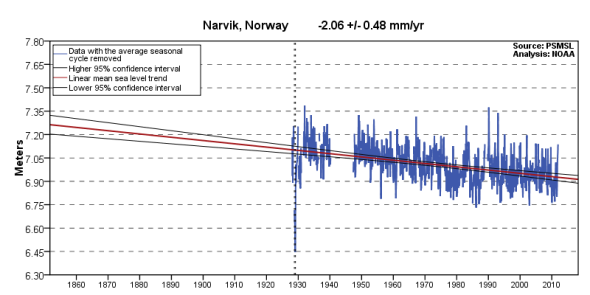
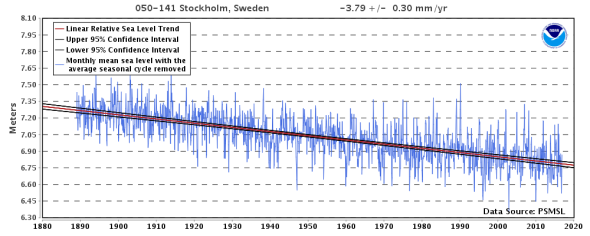
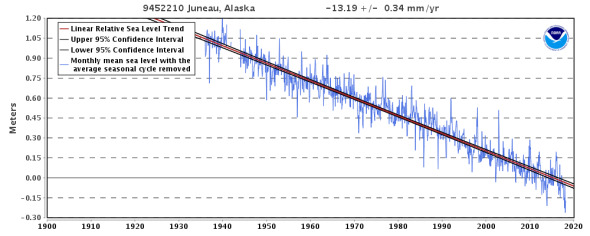
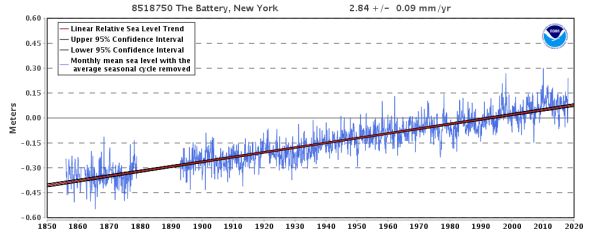
SEA-levels both rise and fall depending on where you are on the planet. Absolute sea-level varies from negative to positive to stable depending on a range of regional factors including: local vertical land motion, land use, salinity, regional ocean circulations, ocean heat content and tidal variations…

NEGATIVE CHANGE

Mean Sea Level Trend
040-081 Narvik, Norway

Mean Sea Level Trend
050-141 Stockholm, Sweden

Mean Sea Level Trend
Juneau, Alaska

*

POSITIVE CHANGE

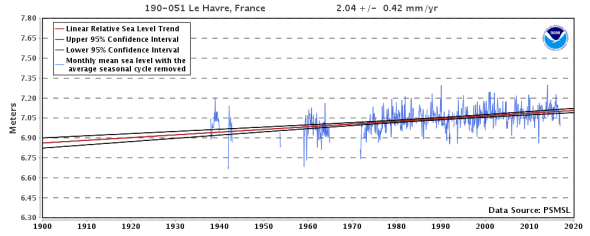
Relative Sea Level Trend
The Battery, New York

Relative Sea Level Trend
Le Havre, France

*

STABLE

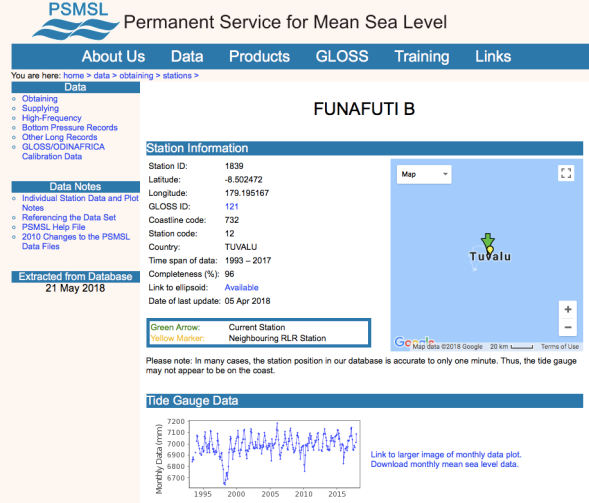
REMEMBER the “sinking” Pacific Island nations…

THE climate-theory-obsessed mainstream media has gleefully pawned the emotional link between climate change and ‘sinking’ tropical islands to push their man-made global warming agenda…

“The tiny pacific island nation of Tuvalu looks set to become a victim of global warming, with the entire country predicted to be washed away in 50 years.” (BBC 2002)

TUVALU’s plight even formed part of the basis for arguably the most hysterical fake news claim in the history of climate alarmism: the UN’s prediction that by the end of 2010, climate change would have created50 million environmental refugees”!

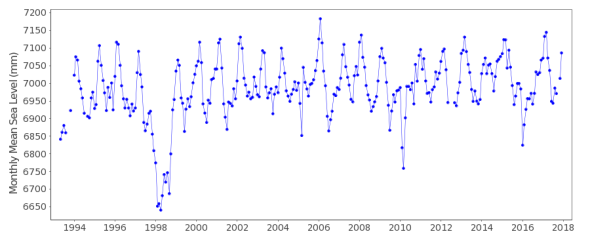
CLIMATISM, along with the climate sceptic “denier” community have been citing actual scientific data and empirical observations that have consistently contradicted the hysterical claims made by the mainstream media of “drowning island nations” for years…

Relative Sea Level Trend
Funafati B, Tuvalu

Wind Power: World’s Greatest Joke – UK Left Powerless During the ‘Big Calm’

stopthesethings's avatarSTOP THESE THINGS

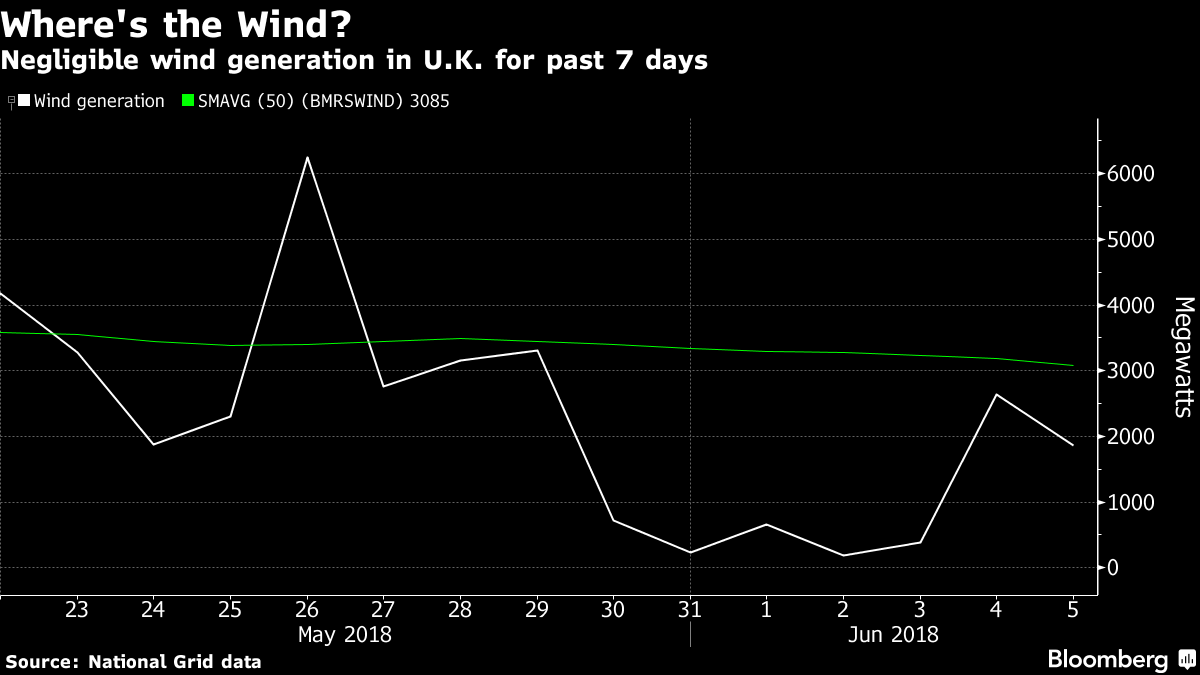
The greatest joke ever played on the world is the idea that the wind can – and will soon completely – power modern economies.

When the wind disappears for days and even weeks on end, those that promote it tend to get twitchy and change the subject.

Sometimes it’s mutterings about mega-batteries (that don’t exist) or pumping water uphill using electricity from (don’t tell them this part) coal-fired power plants to later deliver hydropower to plug those ever-yawning wind power gaps.

If either giant batteries or pumped hydro were economic, they wouldn’t need buckets of taxpayer’s money. The same is, of course, true of intermittent and unreliable wind power.

As sailors and kite-flyers well-know, planning your progress and/or amusement around the weather leads to mixed results.

Just how intermittent and unreliable the wind can be has been revealed (again) across the UK over the last month or so.

UK Wind…

View original post 797 more words

Thirty Years Of Failed Climate Predictions – the video — Watts Up With That?

On June 23 1988, NASA’s James Hansen testified before Congress and made very specific predictions about global warming. In this video I show how he got them exactly backwards, and how scientists and journalists continue to spread baseless misinformation.

via Thirty Years Of Failed Climate Predictions – the video — Watts Up With That?

HISTORY OF THE GLOBAL WARMING SCARE 1980-2010

via HISTORY OF THE GLOBAL WARMING SCARE 1980-2010

Renewables Disaster Killing Australian Industry: Big Users Forced to Shut Down In Calm & Cloudy Weather

stopthesethings's avatarSTOP THESE THINGS

Endangered species: thousands of well-paid jobs threatened by eco-zealots.

Australia’s enviable prosperity isn’t due to sunshine and breezes, it’s down to iron ore, coal and a bevy of other minerals including copper and uranium.

Australia also has an abundance of bauxite which, when a reliable and affordable power sources is added, turns ‘NT road-gravel’ into aluminium – a high-value metal used in all manner of applications, from mobile phones, window frames and hipster bicycles.

Australia’s remaining aluminium smelters and thousands of jobs are now under mortal threat. Thanks to an obsession with heavily subsidised, intermittent and unreliable wind and solar.

The same goes for a range of energy hungry businesses and the jobs and wealth they currently create.

The fastest way to destroy any businesses’ bottom line is to keep cranking up energy costs. Which is exactly what’s happening in Australia.

Already suffering the highest power prices in the world…

View original post 1,052 more words

Anti-humanism, Environmentalism and the Overpopulation Myth

Control: Communism, Environmentalism and the Overpopulation Myth.    


The roots of environmentalism go back to the eighteenth century in the form of the overpopulation myth of Malthusianism, which was all about limiting the human population to prevent a predicted Malthusian Catastrophe, i.e. mass starvation, and for genetic purity, especially among supposedly genetically inferior groups e.g. certain races, cultures and the chronically poor. This is based on the progressive beliefs in materialism, (i.e. there is no spiritual side, only the material we can see and touch), and humanism, (i e. man is the measure of everything and determines morals to suit his circumstances).  From these progressive philosophies grew socialism, communism, fascism, the eugenics[1] movement and environmentalism, all of which are about control of the masses by an elite few, and all are basically anti-human, anti-development and anti-freedom.

In 1798 Thomas Malthus published An Essay on the Principles of Population[2]  in which he predicted future starvation based on the assumption that the rate of population growth would far surpass the growth rate of food supplies. Using this, he proposed draconian measures to “fix” an assumed overpopulation problem at a time when world population was below one billion.  Malthus made two major erroneous assumptions:

  1. Genetic inferiority and enhanced fertility of less accomplished peoples
  2. No improvement in crop yields per acre.

He assumed that the only way to grow more food was to increase the number of acres under cultivation, which limited the total “carrying capacity” of any region and indeed the world. We now know that yields have improved by orders of magnitude through things such as introduction of more prolific, disease resistant plant varieties and high yield hybrids, nitrogen and mineral fertilization, mechanization and control of insect and rodent pests. Nor did he foresee the natural reduction of family size that usually occurs when people are raised beyond near-starvation subsistence, and when diseases are controlled so that high childhood mortality is reduced.

Using these false assumptions as a “reason,” he advocated government measures to reduce population growth rates among the poor such as regulating marriage, educating for moral abstinence, as well as birth control and sterilization. However, he opposed nutritional relief and improved hospital access that would have reduced infant mortality and extended life spans among the poor.  In his opinion, helping the poor only made the supposed overpopulation problem worse.  He extended this same philosophy to Africa where he observed that the Tsetse fly and Malaria helped to keep human population numbers and lifespans low, which he saw as a good thing.

This same upside down philosophy persists today among progressives who only typically want to manage the poor while keeping them poor.  Malthus was pushing evolution and eugenics long before Charles Darwin[3] and Frances Galton[4].   In The Descent of Man, Charles Darwin assumed that the superior races (white Europeans) would eventually cause the extinction of the inferior races (black and brown). Francis Galton coined the term eugenics for a theory about improving the human race through selective breeding and exclusion from reproduction of supposedly genetically inferior groups.


“At some future period, not very distant as measured in centuries, the civilized races of man will almost certainly exterminate and replace the savage races throughout the world.

—Charles Darwin, Descent of Man


Because genetic inferiority of certain races, cultures and the poor has largely been rejected by more enlightened geneticists and the public in general, (but apparently not for powerful population control supporters), along with vastly improved food production rates, environmentalism is the latest cause celebre to cover brutal inhumanity to man in the form of forced or coerced population control in places like China, lndia and Africa.  The shift from eugenics or racial purity to environmentalism is based on the false assumption that the world is overpopulated, resulting in harm to the environment.  This makes environmentalism and population control a perfect match and a good fit for the progressive elite seeking control.

Is it true that the world overpopulated? Only if agriculture had remained as it was in the eighteenth century.  However, the advances in crop yields are more than enough to feed the world.  There is more than enough food for all.  The reason for starvation and poor nutrition is usually political mismanagement or worse, such as well-meaning environmental and population control philanthropic societies, NGOs, UN and local governments intentionally keeping the poorest in their disease ridden squalor without adequate infrastructure to provide for basic needs in order to control the people.  A healthy and educated population is much harder for a dictator to control and thereby remain in power.

The best way to stabilize population, if that is the goal, is to raise the standard of living by providing employment, transportation, electricity, medical care, education, clean water and adequate food. It is a well known fact that family size is naturally reduced when living standards are improved beyond the point where excess children are needed to insure replacement of those lost in early childhood to disease and malnutrition.  It can be argued that the population is too low in many areas to provide the cooperation and man power to provide better facilities without outside aid. Only cities are overpopulated, and that is usually by choice. As population numbers have grown, the world has seen an increase in the standard of living, as reflected in the global GDP per capita, due to division of labor and shared responsibility for both agriculture and developing infrastructure.  We should be doing all we can to raise the world’s poor out of poverty. Caring for the environment is the last thing on the minds of people who are having difficulty feeding their children.  Raising their standard of living is the best thing we could do to stabilize the population and protect the environment. Unfortunately, the progressives would rather do the opposite for ideological reasons.

I have seen the benefits of higher population and the negative side of low population myself. I grew up in an area of the Appalachian Mountains where population is low. Services that are available in the cities and towns a couple of hours away are not or only marginally available in these mountainous rural areas.  Even finding a plumber or electrician is difficult.  Although the situation is better now because of improvements in highways, many in the area still must travel to the cities for proper medical care.  Lower population means lower tax basis, fewer businesses, less opportunity. It has been difficult getting businesses, whether they are medical facilities, manufacturing, commercial or food and entertainment,  interested in locating in an area where the customer and workforce base are low.  It has been particularly difficult getting doctors to come and stay.  It hasn’t been that long since the first fast food restaurant came into the area.  I bring this up to illustrate the logic of raising the population to improve living standards.  Granted, this is a far cry from poor villages in other countries, but it still illustrates the point that higher population brings higher living standards.

[1] Eugenics is the “science” of improving the human race by selective breeding of genetically superior people and preventing supposedly genetically inferior people from reproducing.

[2] Thomas Robert Malthus, An Essay on the Principles of Population, 1798, London

[3] Charles Darwin, On the Origin of Species , 1858, London, The Descent of Man, 1871

[4] Francis Galton, 1865 article “Hereditary Talent and Character”, Hereditary Genius., 1869, Inquiries into Human Faculty and Its Development, 1883.

 

The Truth about AGW aka Climate Change

The truth about Anthropogenic Global Warming aka Climate Change

The climate is changing as it always has.

The real question is

    • whether manmade Carbon Dioxide (CO2) is causing it,
    • whether it will have the dire consequences predicted and
    • whether we can or should do anything about it.
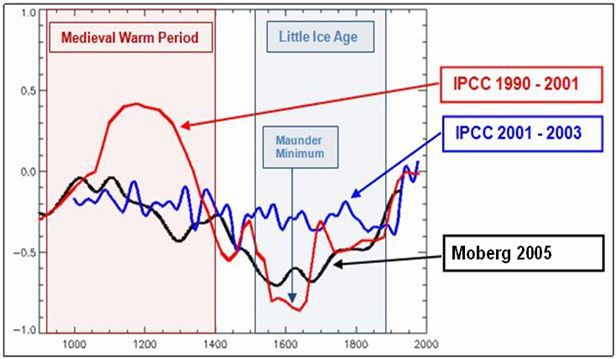
  • The earth has been warming since the Little Ice Age in the 18th century and has not reached the warmth of the Medieval Warm Period.
Recorded temperature throughout history (red) vs. IPCC model (blue)
  • Since the Little Ice Age, oceans have been rising steadily at 7 inches per century (<0.2 cm/yr.) and glaciers have been steadily receding with no recent acceleration.
  • Water, as vapor and clouds, is the major climate influence in the atmosphere. Water vapor can hold heat but also produces clouds that reflect heat back out into space. Precipitation from cooler high altitudes also helps in cooling.  More clouds, more cooling.
  • In the narrow band where CO2 absorbs heat reflected from the earth, it has already blocked the escape of most of the heat that it can. Increases in CO2 will have little or no effect on warming.
  • Warmer oceans hold less CO2 than cooler oceans, so warming causes off gassing. CO2 may be a trailing rather than a leading indicator of warming oceans and climate.
  • Plants use carbon dioxide for photosynthesis and give off oxygen. Animals use oxygen and exhale carbon dioxide.
  • Increasing from an assumed 280 ppm to 400 ppm (ppm = parts per million) is still a miniscule amount, but has increased plant growth rates so that forests and oceans have a greening effect that is visible from space.      (400ppm = 0.04%)
    • Greenhouses add CO2 by as much as 10 times normal to increase growth rates
  • During the Little Ice Age, the sun was quiet with no sunspots aka storms. This happened again around 1850 with a more modest cooling period. (Maunder Minimum and Dalton Minimum)
  • We appear to be entering a quiet period of the sun. That means a weaker solar wind so that more cosmic rays reach earth. Cosmic rays nucleate clouds. That means more clouds to cool the earth.
  • Other possible influences on climate include deviation of ocean currents, eg. Pacific Decadal Oscillation, which may be associated with more clouds, the wobbling (precession) of the earth’s axis and/or orbital eccentricity.
  • In Conclusion: CO2 is not the cause of recent warming.  None of the scary predicted consequences have materialized, and judging from history, are not likely to occur.  The climate is a very complex, poorly understood chaotic system.  Increased CO2 has been a boon to crops, forests and ocean plankton, and reducing CO2 would be harmful to plant life.
  • It is probably not possible to do anything about the current warming trend.

Want to know more about this and other Modern Myths including climate change, evolution, origin of life, Big Bang cosmology or quantum physics? See related posts on this website or buy the book Perverted Truth Exposed: How Progressive Philosophy Has Corrupted Science in print or as e-book/Kindle on line at WND Superstore (the publisher) or at Amazon, Books-a-Million or Barnes & Noble .

Solar and Wind are not reliable answers to clean energy

Are solar and wind power the answers to future clean energy needs? If not, why not.

  • Solar and wind power are NOT the answers to clean energy for the future.
  • If environmentalists were serious about clean power, they would support hydroelectric, geothermal and nuclear power. All of which are clean, reliable and use well developed technologies.
  • If CO2 is not causing warming, (see previous post Why CO2 is not the cause of climate change ) hydrocarbons can provide clean energy with proper scrubbers to eliminate pollutants from smoke.
  • Solar and wind power, by their very nature, are intermittent and unpredictable. The sun is not always visible and the wind is not always blowing at ideal speeds.
    • You can’t run a hospital or a manufacturing plant on unpredictable intermittent and fluctuating power.
    • Fluctuating power can damage computers and electric motors in appliances like refrigerators, heat pumps, etc.
  • As primary power sources, solar and wind power require back up power from other more consistent sources. Their unpredictable nature makes it difficult to supply consistent power as needed through back up sources like fossil fuel and hydroelectric power plants, which cannot change their output quickly, and must run at less than peak efficiency to be ready when needed.
  • More realistically, wind and solar can only provide a small amount of supplementary power to other more reliable sources like fossil fuel or hydroelectric plants.
  • Solar and wind require covering large areas with turbines or solar arrays to supply power, which necessarily disrupts ecosystems.
  • Solar panels and wind generators require exotic “rare earth” minerals, whose extraction is very polluting due to the naturally dispersed nature of rare earths (thus the name).
  • Solar panels are very inefficient and short lived, e.g. typically less than 30% efficiency for 15 to 20 years with declining efficiency over time. Efficiency varies with the time of day/angle of the sun, latitude, prevalence of clouds and dust accumulation. Disposal of wastes are also problematic.
  • Solar plants using mirrors aimed at a steam generator are low tech but their high heat kills birds.
  • Wind turbines kill birds and bats and produce infra-sound that may be harmful to animals and humans.
Raptors sucked into wind turbine blades

10. Why do environmentalists hate hydroelectric power, which is the cleanest and most reliable power source

  • Environmentalists oppose hydroelectric power for two reasons.
    • The first and real reason is that their socialistic goal is to cripple economies and reduce populations that these sources would support.
      • (“Giving society cheap abundant energy would be the equivalent of giving an idiot child a machine gun.” – Paul Ehrlich or paraphrased: “Like giving a loaded gun to a child”)
      • They dream of a return to idealized more primitive times, which were, in reality, brutal and polluting.
      • In reality, the best way to protect the environment and stabilize family sizes is to raise poor people in developing countries out of their disease ridden squalor. They’re not lazy, just sick. Poverty, not population size, is the cause of environmental damage.
      • Africa, for example, has largely untapped hydroelectric capacity beyond their energy needs for the foreseeable future, but that would support a larger population, which the environmentalists fight against.
    • The second “reason,” aka excuse, is disruption of the environment.
      • They don’t seem to mind the environmental disruption by wind and solar farms.
    • Hydroelectric power using large to small waterfalls provides reliable power with minimal impact.
    • Hydroelectric dams require reservoirs that fill slowly to cover formerly dry land, (so the downstream river is not starved in the process), which temporarily disrupts ecosystems that historically have quickly adapted.
      • They prevent periodic downstream flooding that causes misery and death.
      • They provide water for homes, industry and agriculture, and jobs from fishing and tourism.
        • If there is a shortage of fresh water in the world, as claimed by environmentalists, it is because reservoirs are needed.
        • Environmental groups have prevented the construction of over 200 hydroelectric dams in Africa alone.