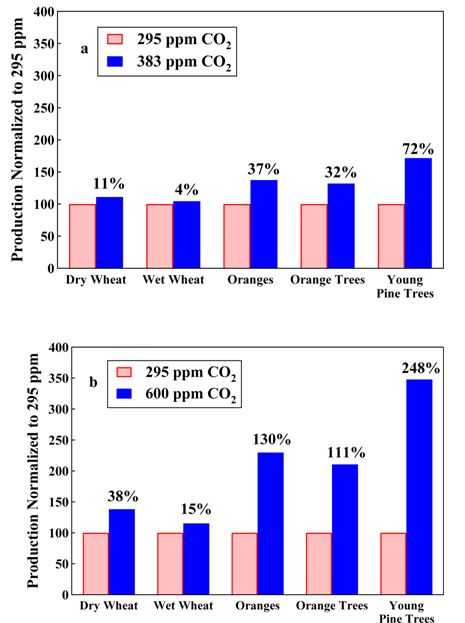
Animals exhale Carbon Dioxide (CO2) and breathe Oxygen (O2), while plants use CO2 and exhale O2. Professional greenhouses often add extra CO2 to increase growth rates. Increased plant growth removes much of the CO2 released into the atmosphere. Between pre-industrial and present times, studies show an average of 15% increase in plant growth rates, with some species increased many times that, e.g. young pine trees. Increased plant growth rates and wider distribution of arable (farmable) land due to warming as well as improved farming practices can solve the so-called overpopulation problem. If much of the data used in the climate models are based on proxy data from tree rings, and growth has been increased by CO2, does that mean that the data is artificially skewed toward “warmer” results? Hmmm.
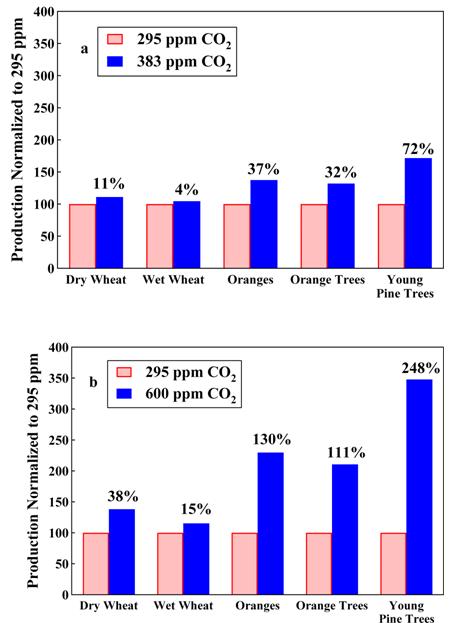
Figure 1. Comparison of Plant Growth at Pre-industrial CO2 levels (295 ppm in pink), at 383 ppm and 600 ppm (in blue) in Dry Wheat, Wet Wheat, Oranges, Orange Trees and Young Pine Trees. Note Percent increases.
Source: Review Article: “Environmental effects of increased atmospheric carbon dioxide,” Willie Soon (1), Sallie L. Baliunas(1), Arthur B. Robinson (2), Zachary W.Robinson (2) Climate Research. 13, 149-164, (1999) Affiliations: (1) Harvard-Smithsonian Center for Astrophysics, 60 Garden Street, Cambridge, Massachusetts 02138; (2) Oregon Institute of Science and Medicine, 2251 Dick George Road, Cave Junction, Oregon 97523
A. Critics created the “progressive nitrogen limitation hypothesis,” which assumes that increased growth rates of trees would deplete poor soils of nitrogen, thus mediating the positive effects of increased CO2. This is a scenario based on theory, not reality, which stubbornly refuses to support the hypothesis. Many studies[1] show that, contrary to the hypothesis, although roots grow deeper and produce more fine hairs, soil and forest floor are enriched in nitrogen from biological sources, i.e. increased root mass and leaf litter supporting beneficial microbes in the soil.
B. One benefit of increased CO2 is that the stomata (openings) of leaves, which take in CO2 and emit water vapor and oxygen, are reduced, leading to less water loss, enhanced water use and improved tolerance to dryer conditions. At elevated CO2 levels, stomata do not need to be open as far to allow sufficient CO2 in for photosynthesis and, as a result, less water is lost through transpiration[2]. In controlled studies, an additional benefit of reduced stomata openings is a reduction of ozone damage.
C. The increased rate of growth of plants, from forests to sea algae, results in more of certain cooling aerosols being produced. These include Carbonyl Sulfide (COS) from soil and seas that become highly reflective sulfate in the stratosphere to reflect more solar radiation back into space, Iodo-compounds from sea algae that nucleate clouds to reflect more solar radiation back into space, dimethyl sulfide (DMS), from seas that nucleates clouds and other aerosols such as isoprene from trees with similar effects.
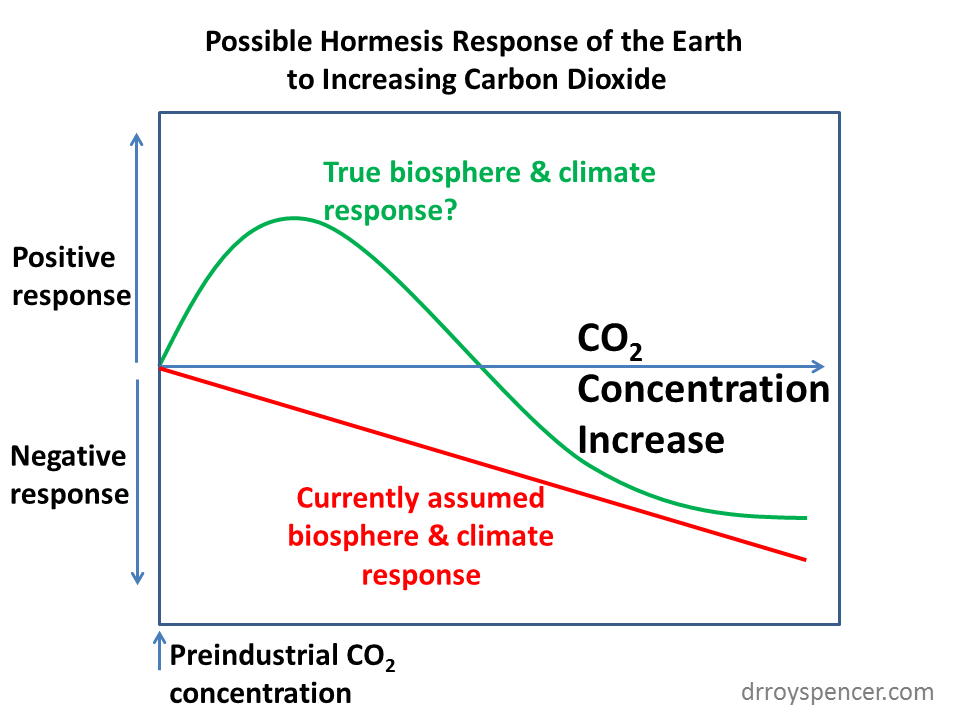
D. Hormesis is a phenomenon, commonly seen in medicine and nutrition, where a low concentration or dose results in a positive effect, but a larger dose results in damage. For instance, some salt and water are necessary to good health, but beyond a certain point, ingesting more can be harmful or fatal. The effect of CO2 on plant life appears to be one such system. Increased CO2 obviously benefits plant life, but it is uncertain at what level CO2 might have a detrimental effect on growth. In professional greenhouses and experiments, even ten times the current level is still beneficial.
Figure 2. Illustration of how Carbon Dioxide is beneficial to plants through Hormesis. Horizontal Axis is Increasing CO2 level.
[1] Example: Phillips, R.P., Finzi, A.C. and Bernhardt, E.S. 2011. “Enhanced root exudation induces microbial feedbacks to N cycling in a pine forest under long-term CO2 fumigation”. Ecology Letters14: 187-194.
[2] See review article of research papers: “Responses of agricultural crops to free-air CO2 enrichment” Kimball, B.A., Kobayashi, K. and Bindi, M., Advances in Agronomy77: 293-368 2002.
This article was first published in August, 2015. Some revisions/links have been added. Information is from my book Perverted Truth Exposed: How Progressive Philosophy has Corrupted Science, published June 2016, available online from Amazon.com
The truth about Anthropogenic Global Warming aka Climate Change
The climate is changing as it always has.
The real question is
whether manmade Carbon Dioxide (CO2) is causing it,
whether it will have the dire consequences predicted and
whether we can or should do anything about it.
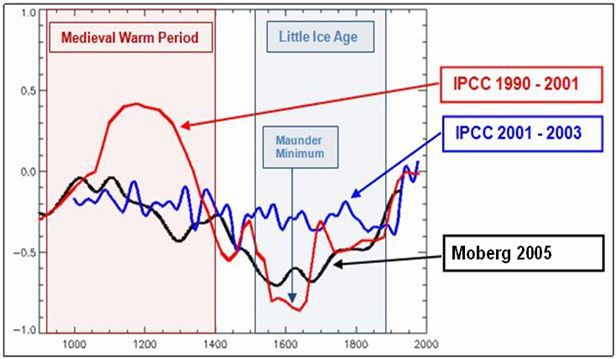
The earth has been warming since the Little Ice Age in the 18th century and has not reached the warmth of the Medieval Warm Period.
Recorded temperature throughout history (red) vs. IPCC model (blue)
Since the Little Ice Age, oceans have been rising steadily at 7 inches per century (<0.2 cm/yr.) and glaciers have been steadily receding with no recent acceleration.
Water, as vapor and clouds, is the major climate influence in the atmosphere. Water vapor can hold heat but also produces clouds that reflect heat back out into space. Precipitation from cooler high altitudes also helps in cooling. More clouds, more cooling.
In the narrow band where CO2 absorbs heat reflected from the earth, it has already blocked the escape of most of the heat that it can. Increases in CO2 will have little or no effect on warming.
Warmer oceans hold less CO2 than cooler oceans, so warming causes off gassing. CO2 may be a trailing rather than a leading indicator of warming oceans and climate.
Plants use carbon dioxide for photosynthesis and give off oxygen. Animals use oxygen and exhale carbon dioxide.
Increasing from an assumed 280 ppm to 400 ppm (ppm = parts per million) is still a miniscule amount, but has increased plant growth rates so that forests and oceans have a greening effect that is visible from space. (400ppm = 0.04%)
Greenhouses add CO2 by as much as 10 times normal to increase growth rates
During the Little Ice Age, the sun was quiet with no sunspots aka storms. This happened again around 1850 with a more modest cooling period. (Maunder Minimum and Dalton Minimum)
We appear to be entering a quiet period of the sun. That means a weaker solar wind so that more cosmic rays reach earth. Cosmic rays nucleate clouds. That means more clouds to cool the earth.
Other possible influences on climate include deviation of ocean currents, eg. Pacific Decadal Oscillation, which may be associated with more clouds, the wobbling (precession) of the earth’s axis and/or orbital eccentricity.
In Conclusion: CO2 is not the cause of recent warming. None of the scary predicted consequences have materialized, and judging from history, are not likely to occur. The climate is a very complex, poorly understood chaotic system. Increased CO2 has been a boon to crops, forests and ocean plankton, and reducing CO2 would be harmful to plant life.
It is probably not possible to do anything about the current warming trend.
Want to know more about this and other Modern Myths including climate change, evolution, origin of life, Big Bang cosmology or quantum physics? See related posts on this website or buy the book Perverted Truth Exposed: How Progressive Philosophy Has Corrupted Science in print or as e-book/Kindle on line at WND Superstore (the publisher) or at Amazon, Books-a-Million or Barnes & Noble .
In Perverted Truth Exposed, Kay Kiser exposes areas of science that have been corrupted by progressive and atheist philosophies disguised as science, including the theories of evolution, origin of life, cosmology, and quantum physics.
The climate change debate presents a modern example of how the perversion of science is politically imposed to support an anti-God, anti-human progress agenda of Marxist control and power while silencing opposition through intimidation. Kiser also answers:
Did Darwin really steal his theory of evolution from Alfred Wallace?
Why did Wallace later abandon the theory as not having sufficient evidence?
If Hubble discovered the expanding universe leading to the Big Bang Theory, why did he continually try to convince others that their conclusion was wrong?
Is man-made carbon dioxide causing global warming or is it a trailing indicator of climate change in a system dominated by solar cycles, cloud cover, and ocean currents?
Claim 10: World governments must take drastic action now to prevent further warming and catastrophic consequences.
Truth: The jury is still out as to whether warming is a good thing or a bad thing. More people die from cold weather-related events than from heat. Warming periods in the past such as the Medieval Warm Period were times of increased prosperity and peace. There is no indication that any sort of a tipping point is approaching that would cause the predicted catastrophic consequences. There has been no warming since 1998 and a possible cooling since 2005.
It is not even certain that government action could have any effect on warming. If carbon dioxide is not the main cause of warming, then regulating it might be a fool’s errand. (See Claim 2.) Developed nations might curtail use of fossil fuels, but treaties proposed like Kyoto and Rio exempt developing countries. This includes China, India, and Mexico, among the largest and most industrialized developing countries in the world. Their output of carbon dioxide and pollutants from power plants and industry more than overpowers any gains from developed countries’ gains in efficiency or a change to “renewable” and “sustainable” solar and wind energy.
Additionally, the money collected by the UN through these treaties is designated only for such unreliable energy development, not for improving the lives of impoverished peoples. Improving the lives of these people would go much farther to protect the environment than any of these things. (Meanwhile, the development of over 200 hydroelectric dams in Africa have been prevented by activists within and outside the UN.) People who have to worry about eating and feeding their families have no incentive to care for the environment. Higher standards of living lead to more caring for the environment.
Claim 8: The world is in danger of catastrophic consequences of global warming such as sea level rise, polar ice and glaciers melting, growing deserts, worse storms, droughts and floods.
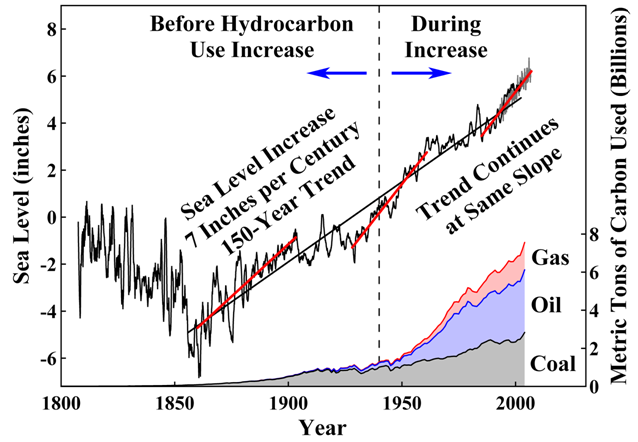
Truth: a.) Sea levels have been rising along with warming since the Little Ice Age at an average rate of 7 inches per century due to glacier melting and expansion of seawater with warming. This rate has not changed significantly in recent times. To claim that sea levels have risen, the IPCC used a tide gauge in Hong Kong that showed tide levels rising, not because of sea level rising, but because the land is sinking (subsiding). Those islands that were supposedly in danger of being swamped have had almost no net sea level rise in all the years since the early predictions. Globally, some land has been lost due to sea level rise and subsidence, but more land has been gained by other forces.
Sea Level Rise since the Little Ice Age
Source: “Environmental Effects of Increased Atmospheric Carbon Dioxide”[1] Note that it is not correlated to fossil fuel consumption
b.) Polar ice caps have shrunk and grown in recent years but overall they have remained relatively unchanged since preindustrial times. The media hype is about a theory that the Larsen Ice Shelf (in the more northerly Western Antarctica peninsula) might break away from Antarctica, causing rapid sea level rise of 5 meters (16.4 ft.). Although a part broke away in 1995, most experts say rapid collapse will not happen and any collapse and sea level rise would occur over centuries[2]. Both sea ice and ice cover have grown even more in other, more southerly locations on the continent. This year northern polar sea ice was thicker than usual so that there was some concern that the polar bears might have a harder time finding seals to eat. By the way, polar bear populations have been increasing in recent years.
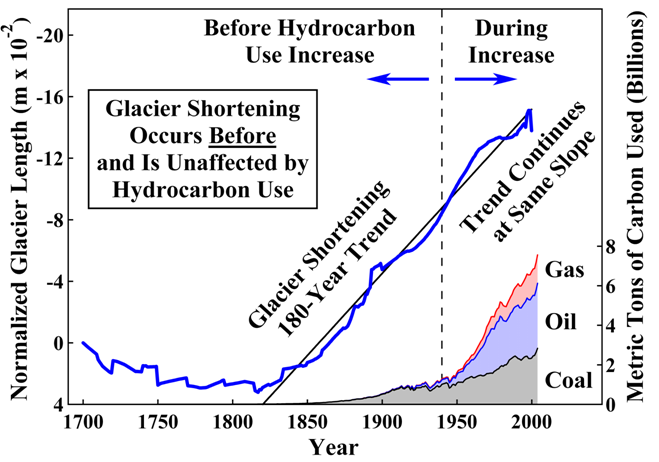
c.) Glaciers have been receding since the Little Ice Age at a relatively steady pace that, along with water expansion with warming, accounts for much of the sea level rise. Melting of floating sea ice doesn’t cause a rising sea level. It is already displacing its weight in saltwater. Ice expands as it freezes, so that melt water shrinks as it melts, resulting in the release of the same weight of water as was originally displaced. Only land-based glaciers will have any effect on sea level. While most glaciers are receding, there are some that are actually growing.
CO2 Increase since 1950 does not track Glacier Shortening
Source: “Environmental Effects of Increased Atmospheric Carbon Dioxide”[3]
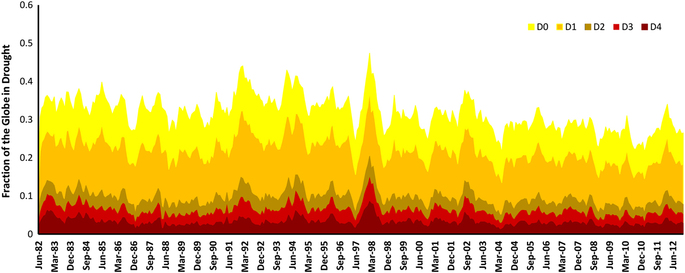
d.) Droughts have not increased in recent times. Some years are worse than others, but the overall picture has not changed.
Global drought monitoring
Global Drought: Fraction of the global land in D0 (abnormally dry), D1 (moderate), D2 (severe), D3 (extreme), and D4 (exceptional) drought condition (Data: Standardized Precipitation Index data derived from MERRA-Land)[4]
e.) Deserts are generally a result of geographic barriers and over grazing. Most of the Sahara Desert was once a grassy plain where livestock were grazed. It is a naturally dry area due to mountains to the west that block much of the moisture from the Atlantic Ocean. Overgrazing and loss of denuded top soil by winds had contributed to its expansion long before the industrial age. In most areas of the world, there has been no marked increase in the rate of desertification in recent times. Instead, deserts are greening as a result of higher CO2 levels that increase growth rates and make plants more tolerant of dry conditions by reducing the leaf pores. See previous post AGW Claims 2b The Benefits of Carbon Dioxide, answer c.
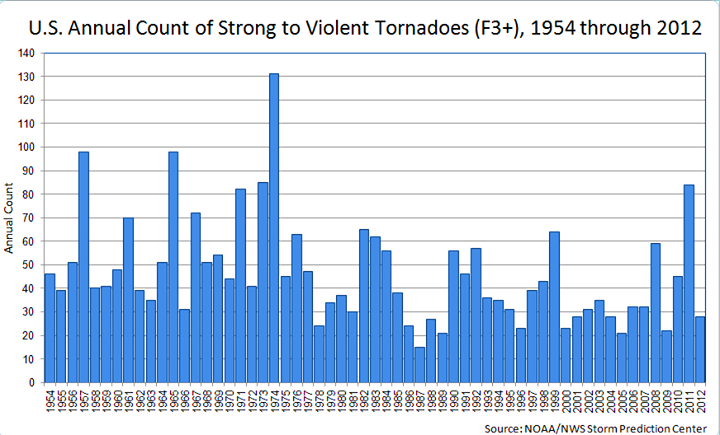
f.) Storms have not gotten worse. The dollar damages in some areas have increased due to increased urbanization, but not the severity of the storms themselves. The number of tornados has actually declined in the United States and their severity has not increased. The same is true of hurricanes and in recent years few have made landfall in the United States.
[1] Review Article: “Environmental effects of increased atmospheric carbon dioxide,” Willie Soon, Sallie L. Baliunas, Arthur B. Robinson, Zachary W. Robinson, Climate Res. 13, 149-164, (1999)
[2] Quote: “More realistically, ice-shelf deterioration is likely to be a rather slow process, and even for a major and sustained warming trend ice-sheet collapse would take several hundred years, with most of the associated rise in sea level occurring during the final century.” From Nature 277, 355 – 358 (01 February 1979); doi:10.1038/277355a0 “Effect of climatic warming on the West Antarctic ice sheet Robert H. Thomas1.), Timothy J. O. Sanderson2.) & Keith E. Rose3.) from 1.) Institute for Quaternary Studies, University of Maine at Orono, Orono, Maine 04469, 2.) British Antarctic Survey, Cambridge, UK, 3.)Scott Polar Research Institute, Cambridge, UK Present address: Department of Geophysics, Royal School of Mines, Imperial College, London SW7, UK http://www.nature.com/nature/journal/v277/n5695/abs/277355a0.html
[3] Reference: ”Extracting a Climate Signal from 169 Glacier Records,” J. Oerlemans, Institute for Marine and Atmospheric Research, Utrecht University, Princetonplein 5, 3584 CC Utrecht, Netherlands. Science 29 April 2005: Vol. 308, 675-677, doi: 10.1126/science.1107046.
[4] “Global integrated drought monitoring and prediction system,” Aengchao Hao, Amir AghaKouchak, Navid Nakhjiri, Alireza Farahmand, Nature, Scientific Data 1, Article number 140001 (2914), doi:10,1038/sdata.2014.1
Claim 6. Temperatures are hotter now than they have been in the last 100,000 years
Truth: This is clearly an unsubstantiated myth meant to scare people into compliance with drastic environmental regulations. The climate modelers have eliminated the Medieval Warm Period, which was hotter than it is today, and it was a time of prosperity. It was hotter in the 1930s than it is today. However, the American “Dust Bowl” of the 1930s was not due to warming. It was caused by opening up vast areas to farming that were poorly suited to it and a years-long severe drought. Based on historical accounts, ice cores and tree rings, modelers have dismissed the Medieval Warm Period and the Little Ice Age by claiming that they were not global phenomena but were limited to Europe and North America. More recent and more detailed ice core studies, etc. have shown that both of these periods were indeed global. Over the last 100,000 years, temperatures have been far hotter and far colder than the present. Who can say what “normal” global temperature is when it is always changing? Should we attempt to freeze the present day conditions as the ideal, or should we take a more reasonable approach to an ever changing climate?
Increase in hydrocarbon use since 1950 does not change Glacier shortening rate since Little Ice Age (indicator of warming climate)
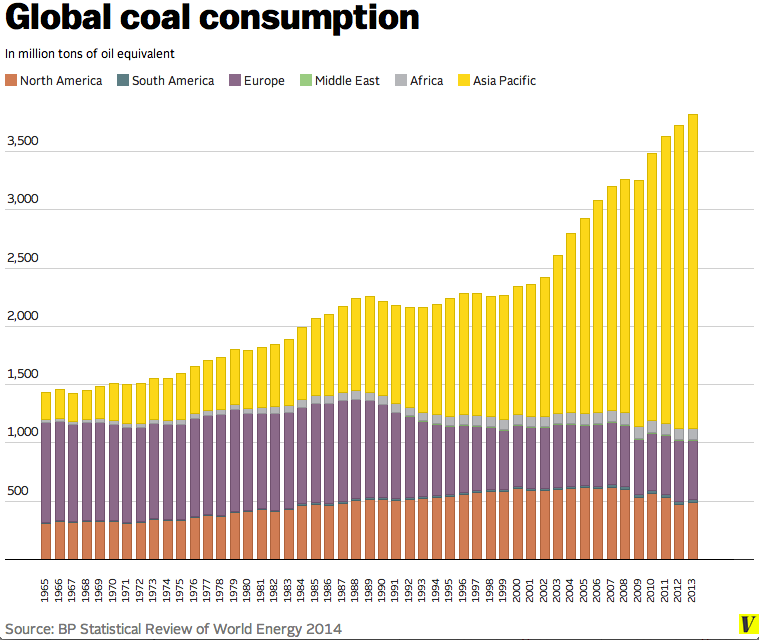
Claim 4. Manmade CO2 levels have been rising rapidly due to increased industrialization and populations since the 1950s.
Truth: CO2 levels have been steadily rising along with warming since the Little Ice Age. Recent increases in industrialization and population appear to have contributed to the increase in atmospheric CO2 since the 1950s when fossil fuel consumption began increasing. Rising temperatures have also contributed to increased CO2 because it is less soluble in warmer ocean water and is thus released. it is unclear how much is from manmade sources and how much is from natural processes, but some estimate put it at 5%. However, if CO2 is not responsible for global warming, (see previous posts) increased levels shouldn’t alarm anyone and in fact increased CO2 should be celebrated as a plant growth promoter.
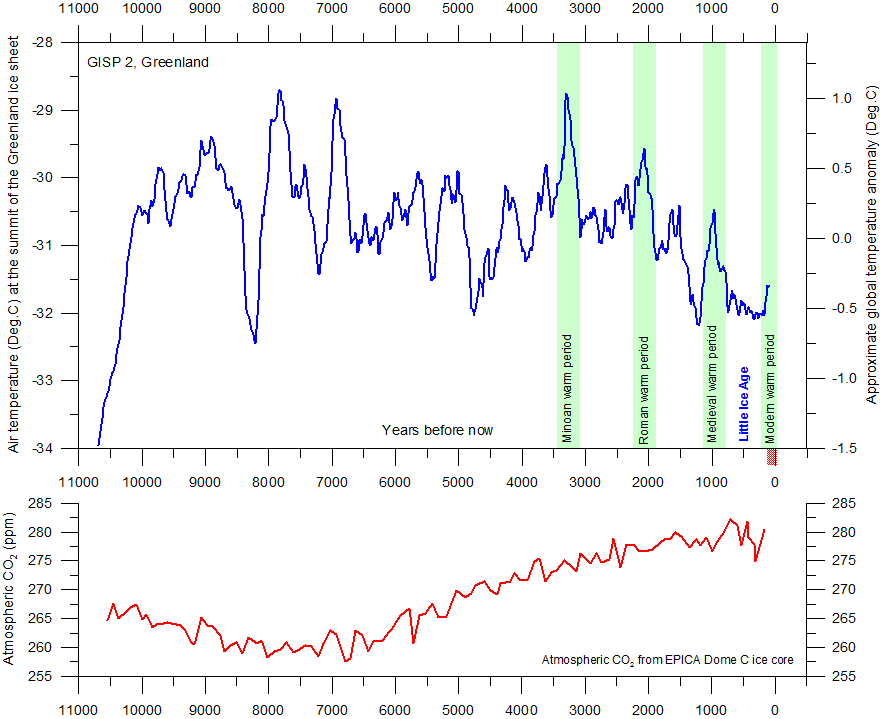
Eleven thousand year temperature and CO2 level record from ice cores
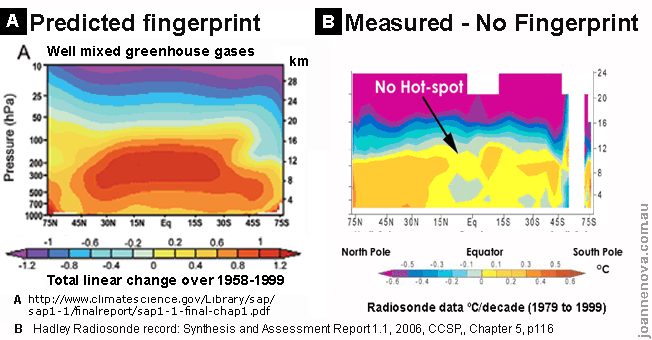
Predicted hot spot from water vapor forcing is missing
Claim 3. Carbon dioxide is important because it has a forcing effect on other factors such as water vapor which magnify warming effects.
Truth: Since the atmospheric absorption of CO2 is already near saturation, (see previous post), very little additional heating can take place due to increased CO2. Contrary to AGW advocates, increased water vapor from warming doesn’t stay as vapor to trap heat near the surface. It forms low altitude clouds that strongly reflect solar heat back out into space, overwhelming any trapped re-radiation from the Earth and having an overall cooling effect. The models, which assume water vapor remains as vapor, predict an atmospheric “hot spot” at middle altitudes. Weather balloons and satellites have failed to find this assumed hot spot, which is the signature of atmospheric forcing of global warming in computer models. Due to low altitude clouds reflecting sunlight back into space, any feedback is negative (cooling), not positive (warming) as assumed in computer models. For earlier posts, go to http:realscienceblog.com
AGW Claim 2. Manmade carbon dioxide (CO2) is the main cause of global warming
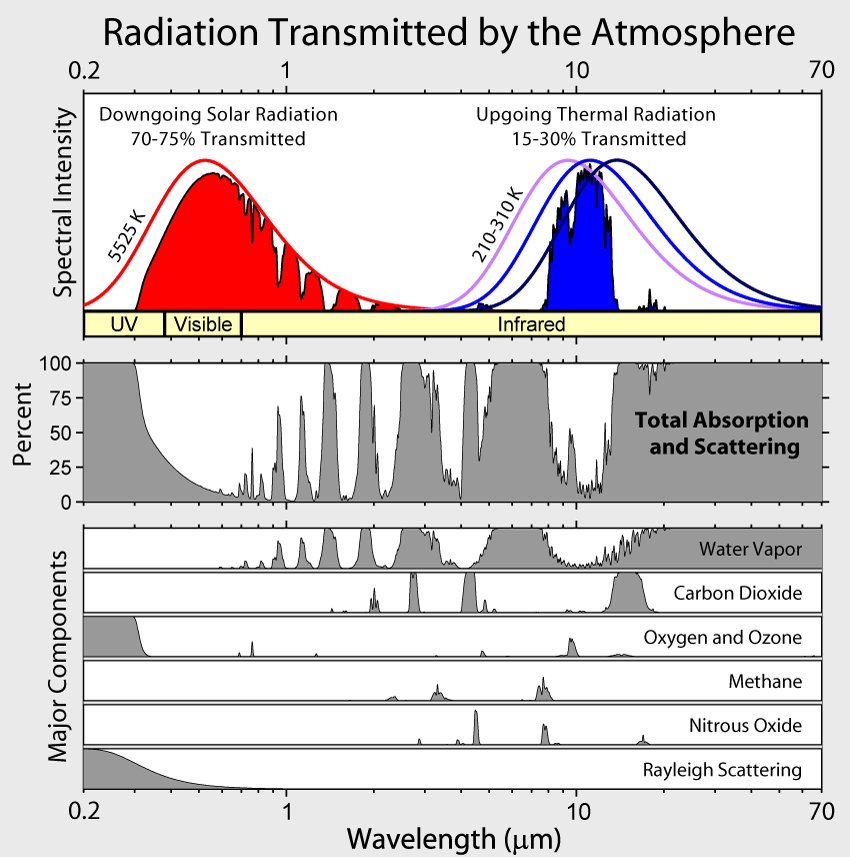
Truth: a.) Carbon dioxide is a minor player in any further warming. It is uniformly distributed in the atmosphere but only absorbs infrared (heat) in a very narrow wavelength range. The CO2 wavelength range is outside the range of most of the solar radiance that penetrates our atmosphere. It falls roughly inside the wavelength range of temperatures re-radiated when solar radiation heats the Earth’s surface.
The atmospheric CO2 already absorbs almost all of the radiation that it can in that wavelength range. Most of the warming effect of CO2 has already occurred in the past and is one of the reasons our planet is not a frozen wasteland. Any increase in CO2 will have a very minor effect. With CO2 absorption near saturation, almost all of the re-radiated heat in that wavelength range is already being trapped, so it can have little or no effect on future increases in temperature or supposed forcing of water vapor. (will be explained in claim 3 analysis in future posts.) With CO2 essentially eliminated as a source, any increase in temperature must be from other sources.
This figure above requires a bit of explaining. The top spectrum shows the wavelengths at which the atmosphere transmits light and heat as well as the blackbody idealized curves for no absorption. It is a little misleading because the data is not based on actual solar and earth data. It is based on two experimental heat sources, one centered at 5525 K (5252o C or 9485o F), the approximate temperature of solar radiation, and one centered in the range of 210 to 310 K (-63o C to 36.8o C or -82oF to 98o F), the approximate temperature range of re-radiated heat from the earth. In reality, solar radiation power, (Watts/m2/micron), is six million times as strong as the power of re-radiated heat from the Earth.
The other spectra are absorption[1] spectra. The first one shows the relative percent absorption by total atmospheric gases at various wavelengths, (note that this spectrum is practically the inverse of the transmission spectrum above it), and the spectra below that show the absorption wavelength ranges of individual atmospheric gases, (but not the relative strength of that absorption in reality). As experimental, not real atmospheric, data they can only tell us the wavelength ranges of the absorption, not their relative strengths in the atmosphere.
Note that CO2 absorbs in the 15 micron range[2], which is within both the range of re-radiated heat and the strong absorption by water vapor, of which the CO2 peak forms a mere shoulder. CO2, in the atmosphere is evenly distributed and is near-saturation level at this wavelength. That means that little if any re-radiated heat can escape through the blanket of CO2, which is why our earth is not a frozen wasteland. This also mean that adding more CO2 will have little effect on future temperatures. Lesser CO2 peaks in the 2.7 and 4.3 micron ranges only contribute in a minor way. The first is completely covered by a water vapor absorption peak and the second forms a shoulder in another water vapor peak. These minor peaks occur in a region where both solar radiation and re-radiation are minimized. Methane and nitrous oxide are also shown to be minor players, having narrow absorption ranges and are at low concentrations in the atmosphere. Note too that ozone blocks most of the ultraviolet light from the sun.
b.) Water is by far the most important greenhouse gas/liquid in the form of vapor, high and low altitude clouds, rain and snow, which both absorb and reflect in-coming sunlight and re-radiated heat from the surface. Water vapor is not uniformly distributed in the atmosphere, being concentrated near the earth, it strongly absorbs heat in a wide range of wavelengths. More heat means more water vapor evaporating from the oceans. Sounds pretty scary, doesn’t it? Contrary to what is assumed by climate modelers, who use this to claim forcing by CO2, the extra vapor doesn’t remain as vapor. It quickly forms low altitude clouds that strongly reflect in-coming sunlight and heat into space. Any re-radiated heat from the surface that may be trapped by clouds is a small fraction compared to the in-coming solar radiation, so blocking solar radiation has a net cooling effect that overwhelms any increases in trapped re-radiation. High altitude clouds tend to trap heat from being re-radiated into space, but have little effect because the increases in cloud cover due to warming are mostly in low altitude clouds.
c.) Methane, like CO2, only absorbs heat in narrow wavelength ranges far from most of solar heat radiance, so that water, with its broad absorbance spectrum, trumps all other greenhouse gases. Like CO2, methane is at or near its absorbance saturation point in the atmosphere so that increases would have little effect. While it is true that continued warming could result in release of methane from melting permafrost, it would have a relatively minor effect on global temperatures. Methane is derived mostly from decaying organic material and from natural seeps on the land and under the sea, as well as termites and ruminant flatulence. Methane absorbs 29 times as much heat per volume as carbon dioxide but at 1.8 ppbv[3], (.00000018 percent), compared to CO2 at 380 ppmv[4], (0.038 percent), it is recognized as a minor player in greenhouse warming along with Ozone (O3) and Nitrous Oxide (N2O).
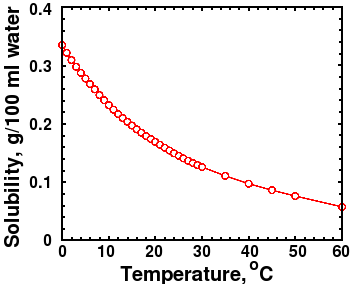
CO2 Solubility in Water vs Temperature
d.) Manmade carbon dioxide is estimated to be about 5 percent (1/20th) of the total CO2 emitted. Animals and man are relatively minor contributors. Decaying organic matter is the major source, followed by volcanic activity and release from warmer oceans. Warmer water releases more CO2 than cooler water due to decreased solubility of CO2 with rising temperature. Many studies show that atmospheric CO2 concentration rises AFTER warming, not before. So which is the cause and which is the effect?
See next post for the beneficial effects of CO2 on plant life.
[1] Transmission and Absorption are inversely related by the formula A = 1/log T.
[2] The horizontal axis is a log scale in microns so that the 1 to 10 range is in units of 1 and the 10 to 70 range is in tens.
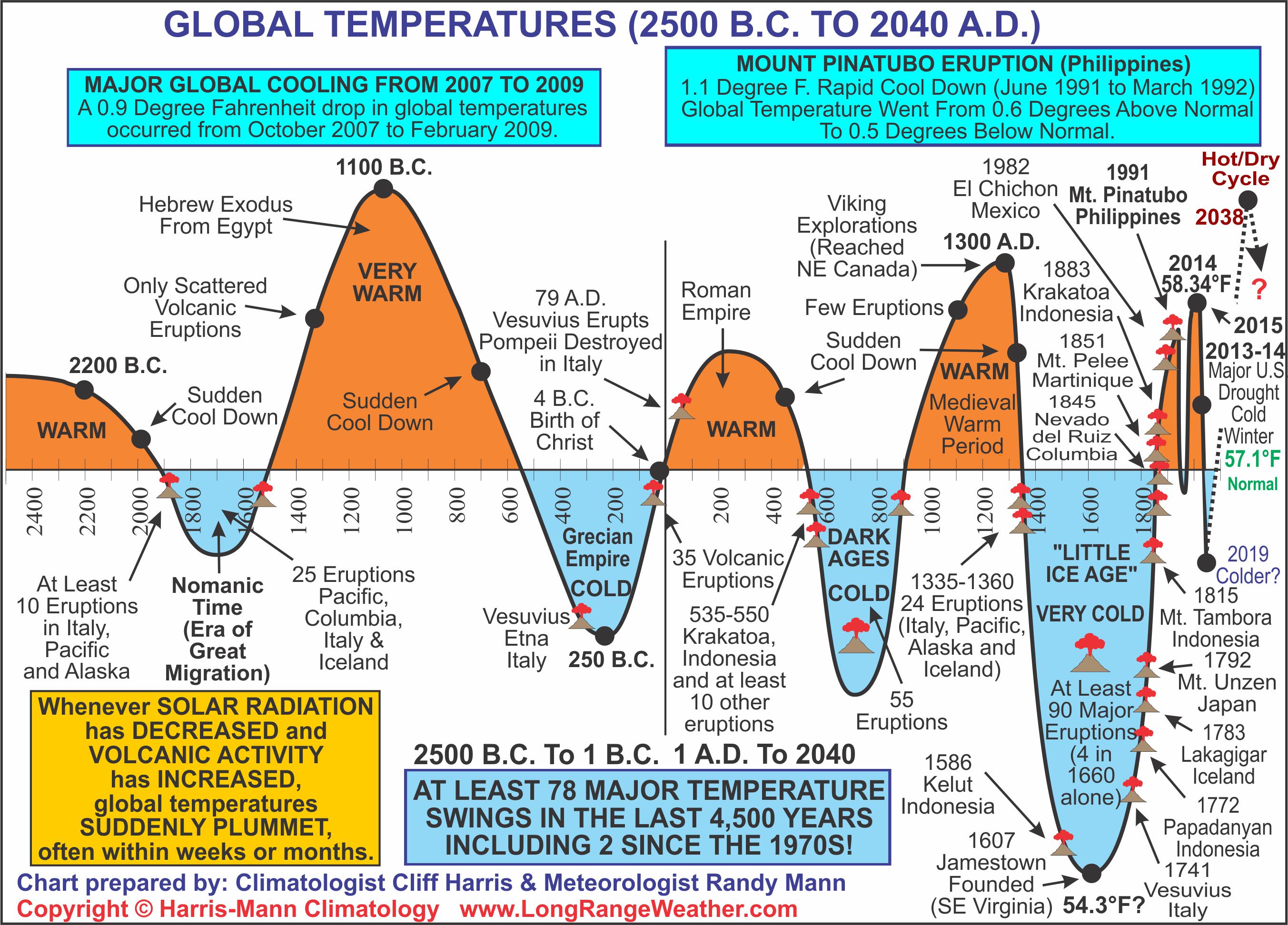
Global Temperatures 2500 BC to 2040 AD (projected) Note: Temperature range is less than plus or minus 2.5oF (1.4oC) from present.
Part 2 of answers to AGW Claim 1. “Global warming and/or climate change are established facts.” See “Anthropogenic Global Warming vs. Truth – Part 1” blog post for Part 1.
Quote: “Since 1895, the media has alternated between global cooling and warming scares during four separate and sometimes overlapping time periods. From 1895 until the 1930’s the media peddled a coming ice age. From the late 1920’s until the 1960’s they warned of global warming. From the 1950’s until the 1970’s they warned us again of a coming ice age. This makes modern global warming the fourth estate’s fourth attempt to promote opposing climate change fears during the last 100 years.”
— Senator James Inhofe, Monday, September 25, 2006
1872 John Tyndall measured the heat absorption of various atmospheric gases over the entire wavelength range of his heat source. He found that water vapor and CO2 absorbed more strongly than other atmospheric gases such as oxygen and nitrogen. Oxygen and nitrogen, major components of the atmosphere, had little or no absorption of heat in the range tested. It is important to note that his experiments did not separate the heat into specific wavelengths. See Claim 2 and its chart in the next blog post.
Quote: “…if, as the above experiments indicated, the chief influence be exercised by the aqueous vapour, every variation of this constituent must produce a change of climate. Similar remarks would apply to the carbonic acid [CO2] diffused through the air… they constitute true causes, the extent alone of the operation remaining doubtful.”
— John Tyndall, Contributions to Molecular Physics in the Domain of Radiant Heat, 1872
1895, February, The New York Times: “Geologists Think the World May Be Frozen Up Again”
1899, Nils Eckholm claims that burning coal will double CO2 and cause climate change. Eckholm and Svante Arrhenius claim that it will prevent a predicted coming Ice Age. From Historical Perspectives on Climate Change by James Rodger Fleming, 1998, Oxford University Press.
1902, Los Angeles Times: “Disappearing Glaciers … persistency that means their final annihilation …”
1912, October, The New York Times: “Prof. Schmidt Warns Us of an Encroaching Ice Age”
1923, Chicago Sun-Times: “Scientist says Arctic ice will wipe out Canada”
1923, The Washington Post: “The discoveries of changes in the sun’s heat and southward advance of glaciers … possible advent of a new ice age.”
1924, September, The New York Times: “MacMillan Reports Signs of New Ice Age”
1929, Los Angeles Times: “Is another ice age coming?” “Most geologists think the world is growing warmer, and that it will continue to get warmer.”
1932, The Atlantic magazine, “This Cold, Cold World”
1933, March, The New York Times, “America in Longest Warm Spell Since 1776; Temperature Line Records a 25-Year Rise.”
1933, National Weather Bureau Monthly Weather Review: “…wide-spread and persistent tendency toward warmer weather … Is our climate changing?”
1938, Royal Meteorological Society Quarterly Journal: (Global warming, caused by man heating the planet with carbon dioxide) “is likely to prove beneficial to mankind …”
1938, Chicago Tribune, “Experts puzzle over 20 year mercury rise … mysterious trend toward warmer climate in the last two decades.”
1939, The Washington Post: “… weather men have no doubt that the world at least for the time being is growing warmer.”
1952, August, The New York Times: “… the world has been getting warmer in the last half century.”
1954, U.S. News and World Report: “… winters are getting milder, summers drier. Glaciers are receding, deserts growing.”
1954. Fortune magazine: “Climate – the Heat May Be Off”
1955, Gilbert Plass predicts 3.6o C (6.8o F) warming if CO2 is doubled.
Quote: “ … average surface temperature of the earth increases 3.6o C if the CO2 concentration in the atmosphere is doubled …” (this is the false assumption on which many computer models rest)
Quote: “The extra CO2, released into the atmosphere by industrial processes and other human activities may have caused the temperature rise during the present century. In contrast with other theories of climate, the CO2 theory predicts that this warming trend will continue, at least for several centuries.”
—Gilbert Plass, 1956, “The Carbon Dioxide Theory of Climatic Change.” [1]
1956, October 28, The New York Times: “Warmer Climate on Earth May Be Due To More Carbon Dioxide in the Air,” by Waldemar Kaempffert in The New York Times “Science in Review”
1959, The New York Times: “Arctic Findings in Particular Support Theory of Rising Global Temperatures”
1969, February, The New York Times: “… the Arctic pack ice is thinning and that the ocean at the North Pole may become open sea within a decade or two.”
1970, The Washington Post: “… get a good grip on your long johns, cold weather haters – the worst may be yet to come … there’s no relief in sight.”
1974, Time magazine: “Global cooling for the past forty years”
1974, The Washington Post: “… weather aberrations they are studying may be the harbinger of another ice age.”
1974, Fortune magazine: “As for the present cooling trend a number of leading climatologists have concluded that it is very bad news indeed.”
1974, The New York Times: “… the facts of the present climate change are such that the most optimistic experts would assign near certainty to major crop failure … mass deaths by starvation, and probably anarchy and violence.” (emphasis added)
1975, The New York Times: “Scientists Ponder Why World’s Climate is Changing; A Major Cooling Widely Considered to Be Inevitable”
1975, Nigel Calder, editor of New Scientist in International Wildlife Magazine: “The threat of a new ice age must now stand alongside nuclear war as a likely source of wholesale death and misery for mankind” (emphasis added)
1976, U.S. News and World Report: “Even US farms may be hit by cooling trend”
1981, The New York Times: (Global Warming) “… of an almost unprecedented magnitude”
1988, James Hansen, Goddard Institute for Space Studies, testifies before Congress that global warming is a fact and that consequences of doing nothing will be dire.
IPCC, Intergovernmental Panel on Climate Change, was established by the United Nations in that year with the mission to find a connection between human activity and climate change. (emphasis added)
After that, the media blitz of articles supporting the belief in global warming or climate change are too numerous to list in detail here.
Quote: “The 1995 IPCC draft report said, ‘Any claims of positive detection of significant climate change are likely to remain controversial until uncertainties in the total natural variability of the climate system are reduced.’ It also said, ‘No study to date has positively attributed all or part of observed climate changes to anthropogenic causes.’ Those statements were removed, and in their place appeared: ‘The balance of evidence suggests a discernable human influence on climate.'” (emphasis added)
— “Aliens Cause Global Warming,” Caltech Michelin Lecture, Michael Crichton, 1/17/2003
Quote:“I readily confess a lingering frustration: uncertainties so infuse the issue of climate change that it is still impossible to rule out either mild or catastrophic outcomes, let alone provide confident probabilities for all the claims and counterclaims made about environmental problems. Even the most credible international assessment body, the Intergovernmental Panel on Climate Change (IPCC), has refused to attempt subjective probabilistic estimates of future temperatures. This has forced politicians to make their own guesses about the likelihood of various degrees of global warming.” (emphasis added)
— Stephen Schneider, (warmist camp), former Professor of Environmental Biology and Global Change at Stanford University, in “Global Warming: Neglecting the Complexities,” Scientific American, January 2002, an article requested by the publisher to critique Bjorn Borg’s book The Skeptical Environmentalist
Quote: “On the one hand, as scientists we are ethically bound to the scientific method, in effect promising to tell the truth, the whole truth, and nothing but — which means that we must include all the doubts, the caveats, the ifs, ands, and buts. On the other hand, we are not just scientists but human beings as well. And like most people we’d like to see the world a better place, which in this context translates into our working to reduce the risk of potentially disastrous climatic change.
To do that we need to get some broadbased support, to capture the public’s imagination. That, of course, entails getting loads of media coverage. So we have to offer up scary scenarios, make simplified, dramatic statements, and make little mention of any doubts we might have. This ‘double ethical bind’ we frequently find ourselves in cannot be solved by any formula. Each of us has to decide what the right balance is between being effective and being honest. I hope that means being both.” (emphasis added. Note that the excuse for dishonesty is based on an unsubstantiated assumption that doing so will result in a better world.)
— Stephen Schneider, (warmist camp), former Professor of Environmental Biology and Global Change at Stanford University, in Discover, 1989
[1] Plass, G. N. (1956), “The Carbon Dioxide Theory of Climatic Change.” Johns Hopkins University Press, Tellus, 8: 140–154. doi: 10.1111/j.2153-3490.1956.tb01206.x

 Science is distorted by progressive philosophy