AGW Claims vs Truth – Claim 6. Temperatures are hotter than in the last 100,000 years

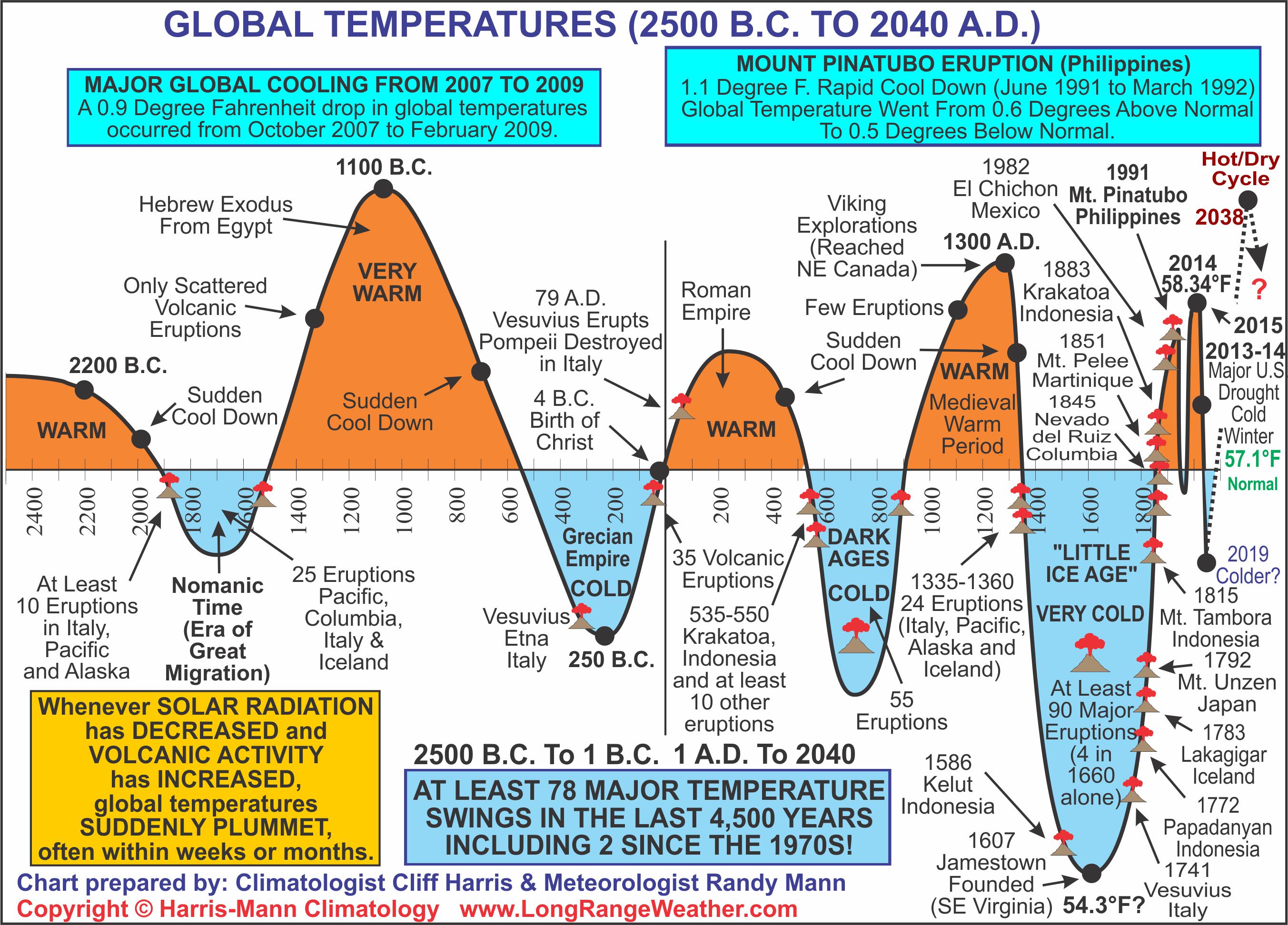
Global Temperatures 2500 BC to 2040 AD

Claim 6. Temperatures are hotter now than they have been in the last 100,000 years

Truth: This is clearly an unsubstantiated myth meant to scare people into compliance with drastic environmental regulations.  The climate modelers have eliminated the Medieval Warm Period, which was hotter than it is today, and it was a time of prosperity. It was hotter in the 1930s than it is today. However, the American “Dust Bowl” of the 1930s was not due to warming. It was caused by opening up vast areas to farming that were poorly suited to it and a years-long severe drought. Based on historical accounts, ice cores and tree rings, modelers have dismissed the Medieval Warm Period and the Little Ice Age by claiming that they were not global phenomena but were limited to Europe and North America. More recent and more detailed ice core studies, etc. have shown that both of these periods were indeed global. Over the last 100,000 years, temperatures have been far hotter and far colder than the present.  Who can say what “normal” global temperature is when it is always changing?  Should we attempt to freeze the present day conditions as the ideal, or should we take a more reasonable approach to an ever changing climate?

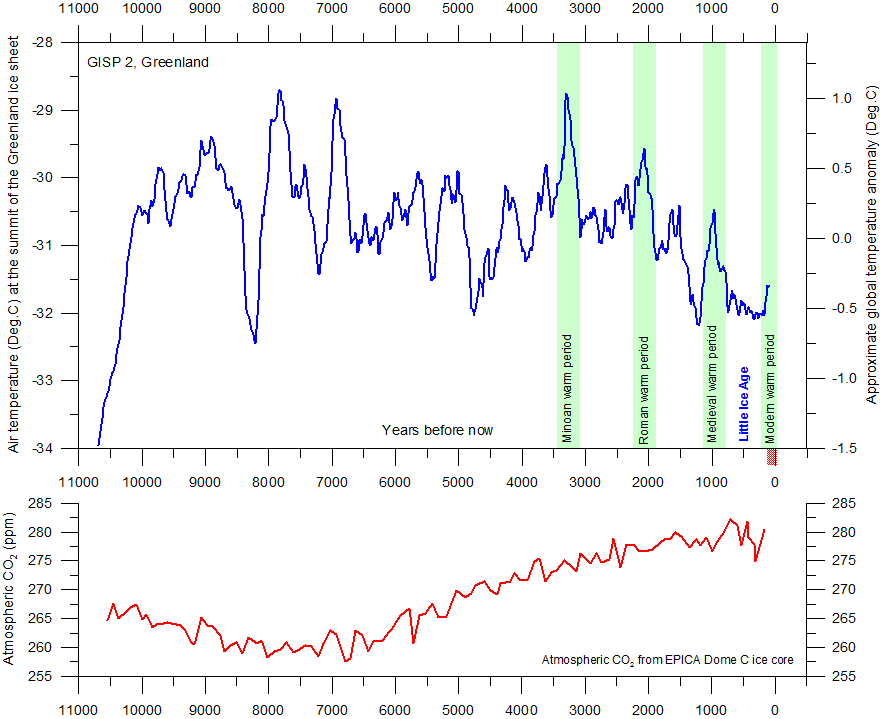
15 climate chart - 11K yrs vs CO2
11,000 year record of Temperatures vs. CO2

AGW Claims vs. Truth – 5. Developed countries are to blame for increased manmade carbon dioxide because they use most of the fossil fuels.

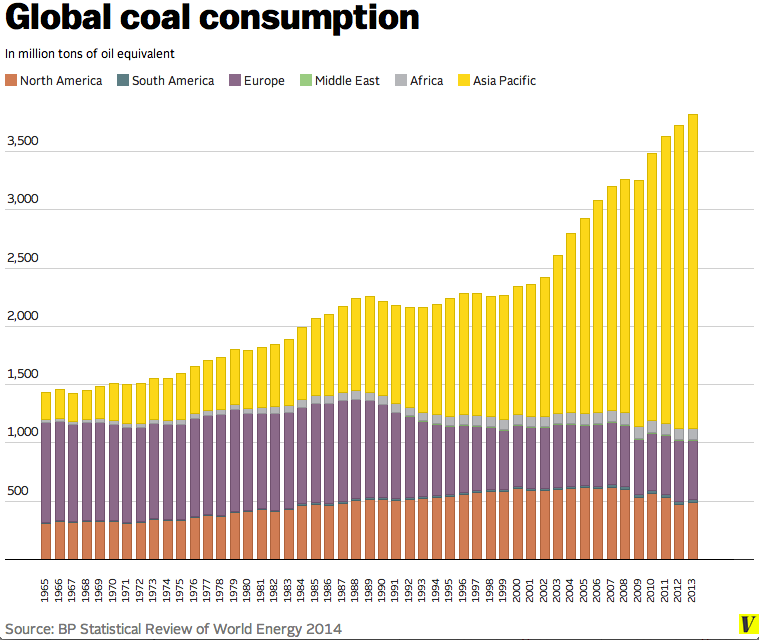
Global coal consumption

Truth: This is partially true. Industrialization is steadily increasing in developed and developing countries such as China and India. While developed countries are putting restrictions on themselves, international agreements exempt developing countries from such restrictions. These increases more than offset any gains from restrictions on developed countries.  However, see previous post AGW Claims vs. Truth – 2 & 2b for why we shouldn’t worry about increased CO2

In addition to industrialization, increased cooking fires and subsistence agriculture to feed an increasing population are also significant contributing factors. CO2 is CO2. There is no escape clause for renewable sources. It doesn’t matter whether it is from fossil fuels or burning dung or wood. Increased population in developing countries means more slash and burn agriculture and more cooking and heating by burning organic material. The modelers assume that renewable sources are exempt as causes because it is a renewable source. This is faulty thinking. Slash and burn agriculture of one acre releases a tenth of the carbon dioxide as ten acres. Subsistence agriculture is harmful to the environment because it results in depletion of soils so that it is necessary to clear more forest lands.

Subsistence farming requires burning to release the nitrogen for crops. Modern agriculture releases far less carbon dioxide than subsistence farming, so keeping people in poverty makes no sense unless your aim is to control or reduce the population in developing countries. It would be better if we helped developing countries develop modern agriculture and industry so they can clean up their act. When people are worried about how to feed their families, there is little time or incentive to do anything about pollution or the environment. In many underdeveloped countries the tradition of having as many children as possible is mostly due to the high rate of mortality in infancy and childhood from unchecked diseases, poor diet, indoor air pollution and poverty. Without the incentive of high infant and childhood mortality, family size and populations could naturally stabilize.

World Life Expectancy Map
World Life Expectancy Map which tracks well with Poverty Rates
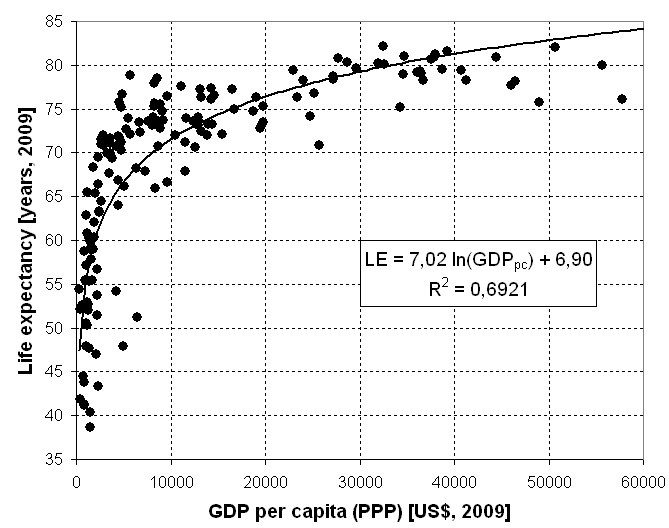
LifeExpectancy_GDPperCapita - wiki
Life Expectancy vs. GDP per capita, 2009, World Bank


New Book Now Available on Amazon and wnd.com

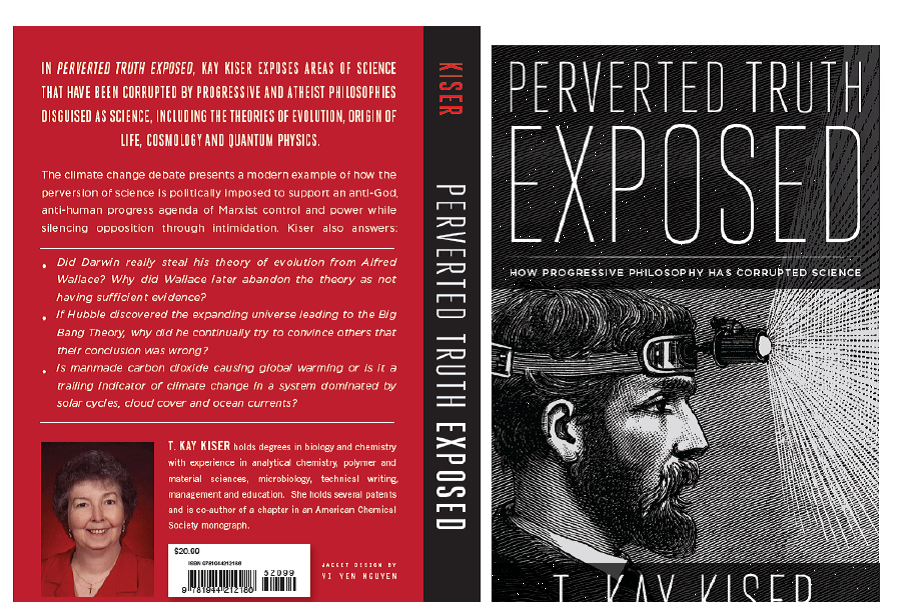
Perverted Truth Exposed cover image

In Perverted Truth Exposed, Kay Kiser exposes areas of science that have been corrupted by progressive and atheist philosophies disguised as science, including the theories of evolution, origin of life, cosmology, and quantum physics.

The climate change debate presents a modern example of how the perversion of science is politically imposed to support an anti-God, anti-human progress agenda of Marxist control and power while silencing opposition through intimidation. Kiser also answers:

  • Did Darwin really steal his theory of evolution from Alfred Wallace?
  • Why did Wallace later abandon the theory as not having sufficient evidence?
  • If Hubble discovered the expanding universe leading to the Big Bang Theory, why did he continually try to convince others that their conclusion was wrong?
  • Is man-made carbon dioxide causing global warming or is it a trailing indicator of climate change in a system dominated by solar cycles, cloud cover, and ocean currents?

My book has just been published and is available at Amazon.com World Net Daily Books @wnd.com and other outlets.  Soon to be available as an eBook.

http://superstore.wnd.com/Perverted-Truth-Exposed-How-Progressive-Philosophy-Has-Corrupted-Science-Paperback

AGW Claims vs. Truth – 4. Increased Fossil Fuel use and CO2 level

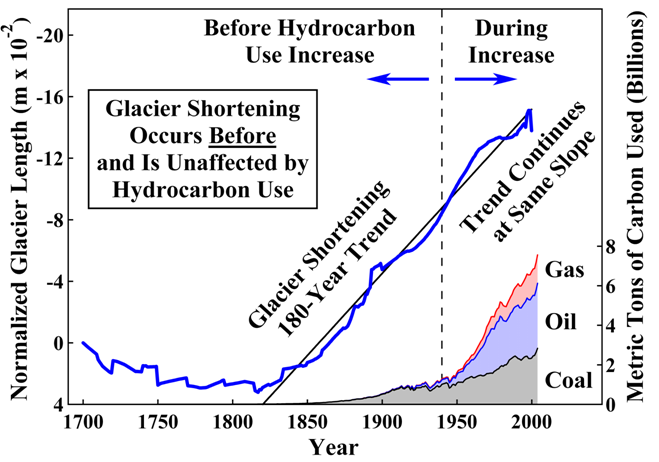
CO2 Increase since 1950 does not track Glacier Shortening
Increase in hydrocarbon use since 1950 does not change Glacier shortening rate since Little Ice Age (indicator of warming climate)

Claim 4. Manmade CO2 levels have been rising rapidly due to increased industrialization and populations since the 1950s.

Truth: CO2 levels have been steadily rising along with warming since the Little Ice Age. Recent increases in industrialization and population appear to have contributed to the increase in atmospheric CO2 since the 1950s when fossil fuel consumption began increasing. Rising temperatures have also contributed to increased CO2 because it is less soluble in warmer ocean water and is thus released.  it is unclear how much is from manmade sources and how much is from natural processes, but some estimate put it at 5%. However, if CO2 is not responsible for global warming, (see previous posts) increased levels shouldn’t alarm anyone and in fact increased CO2 should be celebrated as a plant growth promoter.

15 climate chart - 11K yrs vs CO2
Eleven thousand year temperature and CO2 level record from ice cores

AGW Claims vs. Truth -3. Water Vapor Magnifies Warming from Carbon Dioxide

No hot spot - JoNova
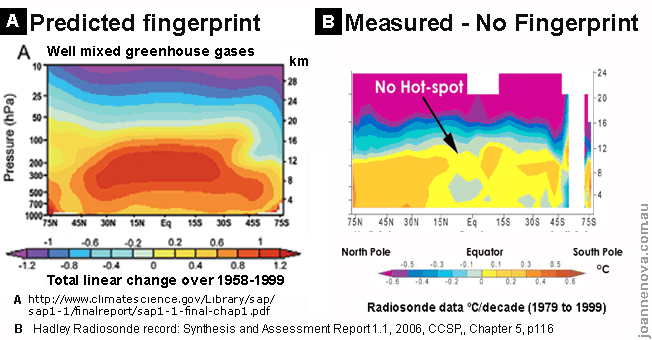
Predicted hot spot from water vapor forcing is missing

Claim 3. Carbon dioxide is important because it has a forcing effect on other factors such as water vapor which magnify warming effects.

Truth: Since the atmospheric absorption of CO2 is already near saturation, (see previous post), very little additional heating can take place due to increased CO2. Contrary to AGW advocates, increased water vapor from warming doesn’t stay as vapor to trap heat near the surface. It forms low altitude clouds that strongly reflect solar heat back out into space, overwhelming any trapped re-radiation from the Earth and having an overall cooling effect. The models, which assume water vapor remains as vapor, predict an atmospheric “hot spot” at middle altitudes. Weather balloons and satellites have failed to find this assumed hot spot, which is the signature of atmospheric forcing of global warming in computer models. Due to low altitude clouds reflecting sunlight back into space, any feedback is negative (cooling), not positive (warming) as assumed in computer models.  For earlier posts, go to http:realscienceblog.com

Source of Figure: “The Skeptic’s Handbook” at http://www.Joannenova.com.au


AGW Claims vs. Truth – 2. Carbon Dioxide and Warming

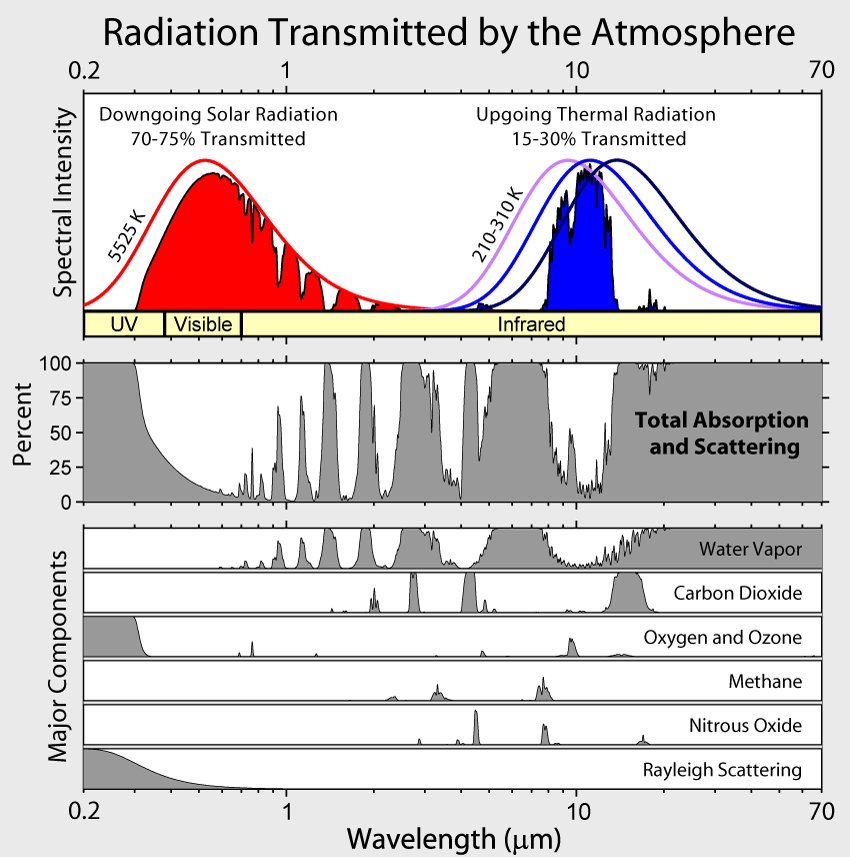
Atmospheric Transmission of Different Gases

AGW Claim 2. Manmade carbon dioxide (CO2) is the main cause of global warming

Truth: a.) Carbon dioxide is a minor player in any further warming. It is uniformly distributed in the atmosphere but only absorbs infrared (heat) in a very narrow wavelength range. The CO2 wavelength range is outside the range of most of the solar radiance that penetrates our atmosphere. It falls roughly inside the wavelength range of temperatures re-radiated when solar radiation heats the Earth’s surface.

The atmospheric CO2 already absorbs almost all of the radiation that it can in that wavelength range. Most of the warming effect of CO2 has already occurred in the past and is one of the reasons our planet is not a frozen wasteland. Any increase in CO2 will have a very minor effect. With CO2 absorption near saturation, almost all of the re-radiated heat in that wavelength range is already being trapped, so it can have little or no effect on future increases in temperature or supposed forcing of water vapor. (will be explained in claim 3 analysis in future posts.) With CO2 essentially eliminated as a source, any increase in temperature must be from other sources.

This figure above requires a bit of explaining. The top spectrum shows the wavelengths at which the atmosphere transmits light and heat as well as the blackbody idealized curves for no absorption. It is a little misleading because the data is not based on actual solar and earth data. It is based on two experimental heat sources, one centered at 5525 K (5252o C or 9485o F), the approximate temperature of solar radiation, and one centered in the range of 210 to 310 K (-63o C to 36.8o C or -82oF to 98o F), the approximate temperature range of re-radiated heat from the earth. In reality, solar radiation power, (Watts/m2/micron), is six million times as strong as the power of re-radiated heat from the Earth.

The other spectra are absorption[1] spectra. The first one shows the relative percent absorption by total atmospheric gases at various wavelengths, (note that this spectrum is practically the inverse of the transmission spectrum above it), and the spectra below that show the absorption wavelength ranges of individual atmospheric gases, (but not the relative strength of that absorption in reality). As experimental, not real atmospheric, data they can only tell us the wavelength ranges of the absorption, not their relative strengths in the atmosphere.

Note that CO2 absorbs in the 15 micron range[2], which is within both the range of re-radiated heat and the strong absorption by water vapor, of which the CO2 peak forms a mere shoulder. CO2, in the atmosphere is evenly distributed and is near-saturation level at this wavelength.  That means that little if any re-radiated heat can escape through the blanket of CO2, which is why our earth is not a frozen wasteland.  This also mean that adding more CO2 will have little effect on future temperatures.  Lesser CO2 peaks in the 2.7 and 4.3 micron ranges only contribute in a minor way. The first is completely covered by a water vapor absorption peak and the second forms a shoulder in another water vapor peak. These minor peaks occur in a region where both solar radiation and re-radiation are minimized. Methane and nitrous oxide are also shown to be minor players, having narrow absorption ranges and are at low concentrations in the atmosphere. Note too that ozone blocks most of the ultraviolet light from the sun.

b.) Water is by far the most important greenhouse gas/liquid in the form of vapor, high and low altitude clouds, rain and snow, which both absorb and reflect in-coming sunlight and re-radiated heat from the surface. Water vapor is not uniformly distributed in the atmosphere, being concentrated near the earth, it strongly absorbs heat in a wide range of wavelengths. More heat means more water vapor evaporating from the oceans. Sounds pretty scary, doesn’t it? Contrary to what is assumed by climate modelers, who use this to claim forcing by CO2, the extra vapor doesn’t remain as vapor. It quickly forms low altitude clouds that strongly reflect in-coming sunlight and heat into space. Any re-radiated heat from the surface that may be trapped by clouds is a small fraction compared to the in-coming solar radiation, so blocking solar radiation has a net cooling effect that overwhelms any increases in trapped re-radiation. High altitude clouds tend to trap heat from being re-radiated into space, but have little effect because the increases in cloud cover due to warming are mostly in low altitude clouds.

c.) Methane, like CO2, only absorbs heat in narrow wavelength ranges far from most of solar heat radiance, so that water, with its broad absorbance spectrum, trumps all other greenhouse gases. Like CO2, methane is at or near its absorbance saturation point in the atmosphere so that increases would have little effect. While it is true that continued warming could result in release of methane from melting permafrost, it would have a relatively minor effect on global temperatures. Methane is derived mostly from decaying organic material and from natural seeps on the land and under the sea, as well as termites and ruminant flatulence. Methane absorbs 29 times as much heat per volume as carbon dioxide but at 1.8 ppbv[3], (.00000018 percent), compared to CO2 at 380 ppmv[4], (0.038 percent), it is recognized as a minor player in greenhouse warming along with Ozone (O3) and Nitrous Oxide (N2O).

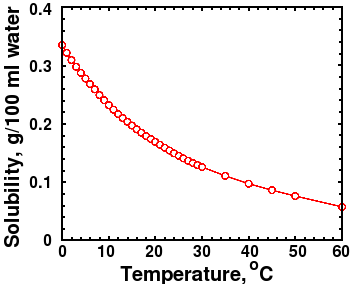
CO2 Solubility in Water vs Temperature

d.) Manmade carbon dioxide is estimated to be about 5 percent (1/20th) of the total CO2 emitted. Animals and man are relatively minor contributors. Decaying organic matter is the major source, followed by volcanic activity and release from warmer oceans. Warmer water releases more CO2 than cooler water due to decreased solubility of CO2 with rising temperature. Many studies show that atmospheric CO2 concentration rises AFTER warming, not before. So which is the cause and which is the effect?

See next post for the beneficial effects of CO2 on plant life.

[1] Transmission and Absorption are inversely related by the formula A = 1/log T.

[2] The horizontal axis is a log scale in microns so that the 1 to 10 range is in units of 1 and the 10 to 70 range is in tens.

[3] Ppbv stands for parts per billion by volume.

[4] Ppmv stands for parts per million by volume.

AGW Claims vs Truth – 1b timeline of climate alarms

Global Temperatures 2500 BC to 2040 AD
Global Temperatures 2500 BC to 2040 AD (projected) Note: Temperature range is less than plus or minus 2.5oF (1.4oC) from present.

Part 2 of answers to AGW Claim 1. “Global warming and/or climate change are established facts.”  See “Anthropogenic Global Warming vs. Truth – Part 1” blog post for Part 1.


Quote: “Since 1895, the media has alternated between global cooling and warming scares during four separate and sometimes overlapping time periods. From 1895 until the 1930’s the media peddled a coming ice age. From the late 1920’s until the 1960’s they warned of global warming. From the 1950’s until the 1970’s they warned us again of a coming ice age. This makes modern global warming the fourth estate’s fourth attempt to promote opposing climate change fears during the last 100 years.”

— Senator James Inhofe, Monday, September 25, 2006


Here is a more complete timeline straight from the headlines and texts of leading newspapers and other reliable sources, thanks to http://butnowyouknow.net/those-who-fail-to-learn-from-history/climate-change-timeline/ and other reliable documentation as noted below.

  • 1872 John Tyndall measured the heat absorption of various atmospheric gases over the entire wavelength range of his heat source. He found that water vapor and CO2 absorbed more strongly than other atmospheric gases such as oxygen and nitrogen. Oxygen and nitrogen, major components of the atmosphere, had little or no absorption of heat in the range tested. It is important to note that his experiments did not separate the heat into specific wavelengths. See Claim 2 and its chart in the next blog post.

Quote: “…if, as the above experiments indicated, the chief influence be exercised by the aqueous vapour, every variation of this constituent must produce a change of climate. Similar remarks would apply to the carbonic acid [CO2] diffused through the air… they constitute true causes, the extent alone of the operation remaining doubtful.”

              — John Tyndall,                                                                             Contributions to Molecular Physics in the Domain of Radiant Heat, 1872


  • 1895, February, The New York Times: “Geologists Think the World May Be Frozen Up Again”
  • 1899, Nils Eckholm claims that burning coal will double CO2 and cause climate change. Eckholm and Svante Arrhenius claim that it will prevent a predicted coming Ice Age. From Historical Perspectives on Climate Change by James Rodger Fleming, 1998, Oxford University Press.
  • 1902, Los Angeles Times: “Disappearing Glaciers … persistency that means their final annihilation …”
  • 1912, October, The New York Times: “Prof. Schmidt Warns Us of an Encroaching Ice Age”
  • 1923, Chicago Sun-Times: “Scientist says Arctic ice will wipe out Canada”
  • 1923, The Washington Post: “The discoveries of changes in the sun’s heat and southward advance of glaciers … possible advent of a new ice age.”
  • 1924, September, The New York Times: “MacMillan Reports Signs of New Ice Age”
  • 1929, Los Angeles Times: “Is another ice age coming?” “Most geologists think the world is growing warmer, and that it will continue to get warmer.”
  • 1932, The Atlantic magazine, “This Cold, Cold World”
  • 1933, March, The New York Times, “America in Longest Warm Spell Since 1776; Temperature Line Records a 25-Year Rise.”
  • 1933, National Weather Bureau Monthly Weather Review: “…wide-spread and persistent tendency toward warmer weather … Is our climate changing?”
  • 1938, Royal Meteorological Society Quarterly Journal: (Global warming, caused by man heating the planet with carbon dioxide) “is likely to prove beneficial to mankind …”
  • 1938, Chicago Tribune, “Experts puzzle over 20 year mercury rise … mysterious trend toward warmer climate in the last two decades.”
  • 1939, The Washington Post: “… weather men have no doubt that the world at least for the time being is growing warmer.”
  • 1952, August, The New York Times: “… the world has been getting warmer in the last half century.”
  • 1954, U.S. News and World Report: “… winters are getting milder, summers drier. Glaciers are receding, deserts growing.”
  • 1954. Fortune magazine: “Climate – the Heat May Be Off”
  • 1955, Gilbert Plass predicts 3.6o C (6.8o F) warming if CO2 is doubled.

Quote: “ … average surface temperature of the earth increases 3.6o C if the CO2 concentration in the atmosphere is doubled …” (this is the false assumption on which many computer models rest)

Quote: “The extra CO2, released into the atmosphere by industrial processes and other human activities may have caused the temperature rise during the present century. In contrast with other theories of climate, the CO2 theory predicts that this warming trend will continue, at least for several centuries.”

—Gilbert Plass, 1956, “The Carbon Dioxide Theory of Climatic Change.” [1]


  • 1956, October 28, The New York Times: “Warmer Climate on Earth May Be Due To More Carbon Dioxide in the Air,” by Waldemar Kaempffert in The New York Times “Science in Review”
  • 1959, The New York Times: “Arctic Findings in Particular Support Theory of Rising Global Temperatures”
  • 1969, February, The New York Times: “… the Arctic pack ice is thinning and that the ocean at the North Pole may become open sea within a decade or two.”
  • 1970, The Washington Post: “… get a good grip on your long johns, cold weather haters – the worst may be yet to come … there’s no relief in sight.”
  • 1974, Time magazine: “Global cooling for the past forty years”
  • 1974, The Washington Post: “… weather aberrations they are studying may be the harbinger of another ice age.”
  • 1974, Fortune magazine: “As for the present cooling trend a number of leading climatologists have concluded that it is very bad news indeed.”
  • 1974, The New York Times: “… the facts of the present climate change are such that the most optimistic experts would assign near certainty to major crop failure … mass deaths by starvation, and probably anarchy and violence.” (emphasis added)
  • 1975, The New York Times: “Scientists Ponder Why World’s Climate is Changing; A Major Cooling Widely Considered to Be Inevitable”
  • 1975, Nigel Calder, editor of New Scientist in International Wildlife Magazine: “The threat of a new ice age must now stand alongside nuclear war as a likely source of wholesale death and misery for mankind” (emphasis added)
  • 1976, U.S. News and World Report: “Even US farms may be hit by cooling trend”
  • 1981, The New York Times: (Global Warming) “… of an almost unprecedented magnitude”
  • 1988, James Hansen, Goddard Institute for Space Studies, testifies before Congress that global warming is a fact and that consequences of doing nothing will be dire.
  • IPCC, Intergovernmental Panel on Climate Change, was established by the United Nations in that year with the mission to find a connection between human activity and climate change. (emphasis added)
  • After that, the media blitz of articles supporting the belief in global warming or climate change are too numerous to list in detail here.

Quote: “The 1995 IPCC draft report said, ‘Any claims of positive detection of significant climate change are likely to remain controversial until uncertainties in the total natural variability of the climate system are reduced.’ It also said, ‘No study to date has positively attributed all or part of observed climate changes to anthropogenic causes.’ Those statements were removed, and in their place appeared: ‘The balance of evidence suggests a discernable human influence on climate.'”  (emphasis added)

 — “Aliens Cause Global Warming,” Caltech Michelin Lecture, Michael Crichton, 1/17/2003


Quote: “I readily confess a lingering frustration: uncertainties so infuse the issue of climate change that it is still impossible to rule out either mild or catastrophic outcomes, let alone provide confident probabilities for all the claims and counterclaims made about environmental problems. Even the most credible international assessment body, the Intergovernmental Panel on Climate Change (IPCC), has refused to attempt subjective probabilistic estimates of future temperatures. This has forced politicians to make their own guesses about the likelihood of various degrees of global warming.” (emphasis added)

— Stephen Schneider, (warmist camp), former Professor of Environmental Biology and Global Change at Stanford University, in “Global Warming: Neglecting the Complexities,” Scientific American, January 2002, an article requested by the publisher to critique Bjorn Borg’s book The Skeptical Environmentalist


Quote: “On the one hand, as scientists we are ethically bound to the scientific method, in effect promising to tell the truth, the whole truth, and nothing but — which means that we must include all the doubts, the caveats, the ifs, ands, and buts. On the other hand, we are not just scientists but human beings as well. And like most people we’d like to see the world a better place, which in this context translates into our working to reduce the risk of potentially disastrous climatic change.

To do that we need to get some broadbased support, to capture the public’s imagination. That, of course, entails getting loads of media coverage. So we have to offer up scary scenarios, make simplified, dramatic statements, and make little mention of any doubts we might have. This ‘double ethical bind’ we frequently find ourselves in cannot be solved by any formula. Each of us has to decide what the right balance is between being effective and being honest. I hope that means being both.” (emphasis added. Note that the excuse for dishonesty is based on an unsubstantiated assumption that doing so will result in a better world.)

— Stephen Schneider, (warmist camp), former Professor of Environmental Biology and Global Change at Stanford University, in Discover, 1989


[1] Plass, G. N. (1956), “The Carbon Dioxide Theory of Climatic Change.” Johns Hopkins University Press, Tellus, 8: 140–154. doi: 10.1111/j.2153-3490.1956.tb01206.x


Anti-humanism, Environmentalism and the Overpopulation Myth

The roots of environmentalism go back to the eighteenth century in the form of the overpopulation myth of Malthusianism, which was all about limiting the human population to prevent a predicted Malthusian Catastrophe, i.e. mass starvation, and for genetic purity, especially among supposedly genetically inferior groups e.g. certain races, cultures and the chronically poor. This is based on the progressive beliefs in materialism, (i.e. there is no spiritual side, only the material we can see and touch), and humanism, (i e. man is the measure of everything and determines morals to suit his circumstances).  From these progressive philosophies grew socialism, communism, fascism, the eugenics[1] movement and environmentalism, all of which are about control of the masses by an elite few, and all are basically anti-human, anti-development and anti-freedom.

In 1798 Thomas Malthus published An Essay on the Principles of Population[2]  in which he predicted future starvation based on the assumption that the rate of population growth would far surpass the growth rate of food supplies. Using this, he proposed draconian measures to “fix” an assumed overpopulation problem at a time when world population was below one billion.  Malthus made two major erroneous assumptions:

  1. Genetic inferiority and enhanced fertility of less accomplished peoples
  2. No improvement in crop yields per acre.

He assumed that the only way to grow more food was to increase the number of acres under cultivation, which limited the total “carrying capacity” of any region and indeed the world. We now know that yields have improved by orders of magnitude through things such as introduction of more prolific, disease resistant plant varieties and high yield hybrids, nitrogen and mineral fertilization, mechanization and control of insect and rodent pests. Nor did he foresee the natural reduction of family size that usually occurs when people are raised beyond near-starvation subsistence, and when diseases are controlled so that high childhood mortality is reduced.

Using these false assumptions as a “reason,” he advocated government measures to reduce population growth rates among the poor such as regulating marriage, educating for moral abstinence, as well as birth control and sterilization. However, he opposed nutritional relief and improved hospital access that would have reduced infant mortality and extended life spans among the poor.  In his opinion, helping the poor only made the supposed overpopulation problem worse.  He extended this same philosophy to Africa where he observed that the Tsetse fly and Malaria helped to keep human population numbers and lifespans low, which he saw as a good thing.

This same upside down philosophy persists today among progressives who only typically want to manage the poor while keeping them poor.  Malthus was pushing evolution and eugenics long before Charles Darwin[3] and Frances Galton[4].   In The Descent of Man, Charles Darwin assumed that the superior races (white Europeans) would eventually cause the extinction of the inferior races (black and brown). Francis Galton coined the term eugenics for a theory about improving the human race through selective breeding and exclusion from reproduction of supposedly genetically inferior groups.


“At some future period, not very distant as measured in centuries, the civilized races of man will almost certainly exterminate and replace the savage races throughout the world.

—Charles Darwin, Descent of Man


Because genetic inferiority of certain races, cultures and the poor has largely been rejected by more enlightened geneticists and the public in general, (but apparently not for powerful population control supporters), along with vastly improved food production rates, environmentalism is the latest cause celebre to cover brutal inhumanity to man in the form of forced or coerced population control in places like China, lndia and Africa.  The shift from eugenics or racial purity to environmentalism is based on the false assumption that the world is overpopulated, resulting in harm to the environment.  This makes environmentalism and population control a perfect match and a good fit for the progressive elite seeking control.

Is it true that the world overpopulated? Only if agriculture had remained as it was in the eighteenth century.  However, the advances in crop yields are more than enough to feed the world.  There is more than enough food for all.  The reason for starvation and poor nutrition is usually political mismanagement or worse, such as well-meaning environmental and population control philanthropic societies, NGOs, UN and local governments intentionally keeping the poorest in their disease ridden squalor without adequate infrastructure to provide for basic needs in order to control the people.  A healthy and educated population is much harder for a dictator to control and thereby remain in power.

The best way to stabilize population, if that is the goal, is to raise the standard of living by providing employment, transportation, electricity, medical care, education, clean water and adequate food. It is a well known fact that family size is naturally reduced when living standards are improved beyond the point where excess children are needed to insure replacement of those lost in early childhood to disease and malnutrition.  It can be argued that the population is too low in many areas to provide the cooperation and man power to provide better facilities without outside aid. Only cities are overpopulated, and that is usually by choice. As population numbers have grown, the world has seen an increase in the standard of living, as reflected in the global GDP per capita, due to division of labor and shared responsibility for both agriculture and developing infrastructure.  We should be doing all we can to raise the world’s poor out of poverty. Caring for the environment is the last thing on the minds of people who are having difficulty feeding their children.  Raising their standard of living is the best thing we could do to stabilize the population and protect the environment. Unfortunately, the progressives would rather do the opposite for ideological reasons.

I have seen the benefits of higher population and the negative side of low population myself. I grew up in an area of the Appalachian Mountains where population is low. Services that are available in the cities and towns a couple of hours away are not or only marginally available in these mountainous rural areas.  Even finding a plumber or electrician is difficult.  Although the situation is better now because of improvements in highways, many in the area still must travel to the cities for proper medical care.  Lower population means lower tax basis, fewer businesses, less opportunity. It has been difficult getting businesses, whether they are medical facilities, manufacturing, commercial or food and entertainment,  interested in locating in an area where the customer and workforce base are low.  It has been particularly difficult getting doctors to come and stay.  It hasn’t been that long since the first fast food restaurant came into the area.  I bring this up to illustrate the logic of raising the population to improve living standards.  Granted, this is a far cry from poor villages in other countries, but it still illustrates the point that higher population brings higher living standards.

[1] Eugenics is the “science” of improving the human race by selective breeding of genetically superior people and preventing supposedly genetically inferior people from reproducing.

[2] Thomas Robert Malthus, An Essay on the Principles of Population, 1798, London

[3] Charles Darwin, On the Origin of Species , 1858, London, The Descent of Man, 1871

[4] Francis Galton, 1865 article “Hereditary Talent and Character”, Hereditary Genius., 1869, Inquiries into Human Faculty and Its Development, 1883.

The Necessity of God

Philosophically there are only three reasons for existence or action: necessity, chance and design.

Everything in the physical realm has a beginning, an end and a cause.  Nothing physical is permanent.  Everything changes as a result of causes and are thus contingent on preceding events.  If everything has a cause, then an endless series of causes into the past is the result.  Of necessity, there must have been a beginning of the series of causes and effects.  But what started the series?  If everything in the physical universe has a cause, then something outside of the physical universe, by necessity, must have started the series of causes.  Why is there something instead of nothing?  Why does anything exist?  It must have been caused by something.  God or The Creator, by whatever name you wish to use, is the necessary first cause, the uncaused cause and everything else is contingent on it.   Therefore God is a necessary being that is eternal, having no cause, no beginning, and no end.

Since something outside the physical universe necessarily started the series of cause and effect, it also voids the assumption of the materialists that the physical universe is all there is; that the non-physical or spiritual only exists in our imagination. Of necessity, there must be a spiritual realm because, of necessity, something outside the physical must have started the series of causes.  This is a very old, but very valid argument for the necessary existence of God.  Atheists and materialists will dismiss it as “old news” but it is as valid today as it was when St. Thomas Aquinas included it in his Summa Theologica as one of the proofs of God.

If God started the whole thing, including existence, was it a singular act of creation which was then left to develop by itself without guidance? It can be argued that the present form of the universe is a matter of chance and only LOOKS designed.  It can also be argued that life came about by chance through some undefined “Life Principle” and only LOOKS designed.  Neither of these chance occurrences holds up to scientific or statistical scrutiny.  The physical universe is so finely tuned that if any of the fundamental forces or particles were changed by an infinitesimal amount, then stable galaxies, stars, planets and life would not have formed.

Life is a particularly complex and fine-tuned process and we are only just beginning to explore the workings of living creatures. For example, the probability of assembling one specific protein chain of 200 readily available amino acid units, from the 20 left-handed amino acids used in living systems is 1 in 20200.  To be plausible, the number of attempts must be in the ballpark of the odds.  If the universe is 13.7 billion years old, there have been 4.32 x 10¹⁷ seconds since it began. We would need to make 231.4 x 10180 attempts each second since the beginning of the universe to make the random assembly of even this one specific protein plausible.

If we assume that life molecules were assembled on Earth, which is thought to be only 4.5 billion years old, and evidence of life was present 3.8 billion years ago, then the number of attempts per second rises to even more impossible levels. And that is just for one protein enzyme assembled from readily available units, excluding interfering molecules, and under the ideal conditions for assembly and preservation. Already we are seeing the extreme odds against a specific enzyme being produced. If we look at what it would take to produce by chance the thousands of different specific enzymes necessary for metabolism, the probability of random assembly of the correct mix would be (20200)3000 for a simple bacterium with 3,000 enzymes, or 1 in 10780,000; that’s a 1 with 780,000 zeros after it. The terms impossible and miracle come to mind.

If chance is so improbable, then design or intent is a more plausible explanation for life and, indeed, the universe. The argument for intelligent design is that of impossibly high odds against the specified complexity we find.  A design necessarily implies a designer.  Not just any enzyme would perform the metabolic functions of even the simplest living being.  It must be a specific mix of specific enzymes with specific functions. That does not even address the formation of a living being, which is many orders of magnitude more complex than the formation of simple enzymes or structural proteins or DNA.

Conclusions:

  1. God necessarily exists.
  2. The spiritual realm really exists.
  3. God has remained involved in the universe.

Some Logical Fallacies

Logical Fallacy Definition:  A statement that appears to be logical but does not meet the requirements of valid logical arguments or induction.

SOME Logical Fallacies

Appeal to Authority – (Argument from Authority)  If an authority, leader or expert says it is true, it must be true.  That all depends on the authority, his knowledge of the subject, his agenda and his belief system.  This argument goes: if Einstein or (fill in the blank) said it, then it must be true.  Another form of this is the consensus of experts.   Yes, a whole cadre of experts can be wrong if the framework (or paradigm) in which they believe is false or incomplete.  Also, remember that being an expert in one field of science or being accomplished in any field does not qualify for expert status in another, sometimes related, field.   We are all ignorant in more areas than those in which we are well versed.  I wouldn’t want a physicist or engineer performing surgery on me, even if he is world renowned.  Likewise, I wouldn’t want a surgeon to build a bridge.  What makes a celebrity (or scientist or politician) more qualified than others to comment on issues of the day unless they are also experts in that field?  Nothing.

Even experts can be wrong and their theories should never be sacrosanct against criticism or question.  Could Einstein be wrong? Of course.  Experts are not infallible, and treating them that way leads us back to protecting the status quo and COWDUNG[1].   One example from my past is a professor of zoology who insisted that holes found in pastures surrounding the college were due to pocket gophers.  He had spent years studying them in the southwestern United States, so he could be considered an expert on pocket gophers.  The college was in Virginia, well outside their range.  The holes were due to ground hogs (wood chucks) which are common in the area.   If you are a hammer, everything looks like a nail.

Appeal to Ignorance – (or argument from ignorance) This argument says that if a theory has not been proven wrong, it must be true.  On the other hand, it can be argued that if the theory has not been proven true, it must be false.  Or yet, if there is a lack of evidence for one theory, then another theory is assumed to be true.  This is also called an Argument by Lack of Imagination.  It can be applied to the arguments for macro-evolution[2].  In the sense that, because no one has come up with a different theory, which excludes God as a cause, then Darwin’s theory must be true.  While there could be some validity in it, this is a specious[3] argument.  Absence of another explanation does not make the current one true.  The theory must rest on the evidence, not on an absence of an alternative theory or evidence to the contrary.

Argument from Silence – (argumentum ex silentio)  Similar to Appeal to Ignorance; absence of evidence to the contrary or a different theory is deemed to validate the argument.  Absence of evidence is not evidence of absence.

Argument from Personal Incredulity A theory is thought to be proven untrue because someone finds it personally offensive, unlikely or unbelievable, and consequently a preferred alternative is thought to be proven true.  Also known as Argument from Personal Belief or Argument from Personal Conviction.

Appeal to the Majority  – Consensus as proof.  A commonly held belief must be true.  Consensus is an alien concept to science because it is based on opinion, assumption or belief not fact.  Those advocating man-made global warming use this one profusely.  They say the argument is over; it is a proven fact based on a supposed majority of scientists.  Never mind that many of those included in the “consensus” know next to nothing about that field of study and many competent scientists in the field disagree or have doubts.  Truth is never determined by committee vote or marketing or propaganda.


“In questions of science the authority of a thousand is not worth the humble reasoning of a single individual.”                                                                         —- Galileo


Appeal to Emotion – Replacing rational arguments with emotional appeals.  Propaganda is often laced with emotionally charged statements.  Hitler was a master of this one.

False cause or non sequitur[4] – Incorrectly assumes that one thing is the cause or explanation of another; an argument where the conclusion does not connect well with the premise.  Big trucks do not beget little trucks, although big (adult) animals beget little (infant) animals.  City buses do not necessarily cause a reduction in the number of cars, especially when many buses are nearly empty or are scheduled poorly.

Irrelevant Conclusion  – An argument for one conclusion really proves a different one. For example, arguments against Intelligent Design as not being science, but this argument can also be applied to Evolution itself.

Amphiboly – A sentence that can be interpreted in more than one way.  Example: The statement, “He only said that.” could mean “only he” or “only said” or “only that.”  Was he the only one saying it? Does it mean that he only said he would do it and that he didn’t actually do it? Does it mean he said only that and not the other statements attributed to him?  As you can see, what is being modified by “only” makes a lot of difference.

Equivocation – Using the same term to mean two or more different things.  Changing what is meant in mid-argument.  This is commonly used in evolution’s defense where micro and macro-evolution are used interchangeably to defend the theory.  Well documented variability within species is used in a confusing way to imply the ability of species to change into other species.

Changing the subject  – Arguing for one thing to prove another.  This is another favorite tool in evolution’s defense.  Example: Using changes within a species as “proof” of evolution into an entirely different creature.  See equivocation above.

Red Herring – inserting another unrelated factor intended to throw off the opposition rather than address the issue.  Example:  Citing the belief in seven literal days of Biblical creation to change the subject and/or discredit valid scientific objections to evolution.

Straw Man  – arguing against a weaker proposition to imply winning a stronger one. Darwin set up his case for Evolution by arguing for repeated special creations from nothing.  (God points and Poof! a new animal appears.)  The prevailing view was really that changes had obviously happened through the ages, but that there was no evidence for a particular mechanism, divine or otherwise.  Darwin didn’t provide a fact-based mechanism either, just opinions; but in light of this straw man argument, many found it plausible.

Ad Hominem Attack  – attacking the opponent on personal grounds not related to the subject, including name calling or mischaracterizing the opponent’s beliefs.  Example:  Grouping people together to imply guilt by association to invalidate their arguments.  Again, evolutionists group everyone who argues against Darwinian Evolution with young earth or seven-day creationists.  This is also called guilt by association.  Another form of this is maligning the opponent’s motives or character.

Begging the Question  – The premise automatically assumes the truth of the conclusion in the statements to support it. Example: saying “Everyone knows—.” “There is a consensus among scientists that—-.” or “It has been proven—.”

Complex Question – The statement contains the conclusion within it.

Wrong Direction – An argument in which the cause and effect are reversed.

Post Hoc – because one thing follows another it is assumed to cause it.  Example:  According to statistics, people who smoke, drink alcohol and engage in sex at younger ages die younger, therefore early smoking, drinking and sex cause premature death.  It does not take into account that this may imply a philosophy of risk taking and that the stated activity may have nothing to do with the causes of premature death, such as by accident, suicide or diabetes associated with extreme obesity and sedentary lifestyle.

Insignificant or Complex Cause  – one thing is assumed to cause another but it is only one, perhaps minor, part of a group of causes.  Example:  The assumption that man is the cause of global warming, when other factors such as changes in solar radiance, water vapor and clouds, methane from animals and decomposing vegetation, changes in surface reflectivity and the fact that we have been recovering from the Little Ice Age since the mid-1700s could be equally or more important.

Appeal to Motives: Prejudicial Language – value or moral goodness is attached to agreeing with the argument; conversely, assigning immoral or sinister motives to the opponent.  Those opposed to the theory of man-made global warming are judged to have sinister motives that will harm mankind and the planet.

[1] COWDUNG – the COnventional Wisdom of the DomiNant Group, Michael Disney, The Hidden Universe, 1984

[2] Macro-evolution – that which gives rise to whole new species, as opposed to micro-evolution that describes variations within a single species.  Micro-evolution is well known and has been applied successfully by breeders of everything from petunias to dogs.

[3] Specious – having a false appearance of truth or genuineness.

[4] Non sequitur – (Latin: it does not follow) an inference that does not follow from the premise.